
Many homeowners notice the symptoms before they understand the cause: stale odors that linger, condensation on windows, musty bathrooms, or a nagging sense that one room never feels as comfortable as the rest. The DOE's ventilation guide notes that an airtight house without proper ventilation can retain pollutants and damaging moisture.
This guide walks through exhaust-only, supply-only, balanced, HRV, and ERV strategies, plus how to size, install, and maintain whichever system fits your building. The right answer depends on your climate, how tight your home is, how many people live there, and what's already installed.
Key Takeaways
- Whole-house ventilation delivers controlled outdoor-air exchange, not reliance on open windows or random leaks
- Exhaust-only, supply-only, balanced, HRV, and ERV systems each solve different climate and building problems
- Proper sizing, commissioning, and filtration matter more than fan capacity alone
- Ventilation doesn't replace kitchen exhaust, air cleaning, humidity control, or combustion safety
What Whole House Ventilation Does
Whole-house ventilation is a mechanical system, not an open window. It uses fans, ductwork, filters, and controls (sometimes paired with an energy-recovery core) to remove stale indoor air and replace it with fresh outdoor air throughout the building.
That's different from spot ventilation. Bathroom fans, range hoods, and laundry exhaust still matter, because they capture concentrated moisture and pollutants right at the source. A whole-house system handles background air exchange; spot exhaust handles the spikes.
Your HVAC System Probably Isn't Ventilating
A furnace, air conditioner, or heat pump moves air around your home. It doesn't necessarily bring in outdoor air unless it's specifically designed and controlled to do so. Many homeowners assume their HVAC system handles ventilation. It usually doesn't, not without added equipment or controls.
Ventilation Isn't the Same as Filtration or Humidity Control
These terms get used interchangeably, but they solve different problems:
| System | What it actually does |
|---|---|
| Ventilation | Exchanges stale indoor air for outdoor air |
| Filtration | Removes particles from air already in the system |
| Humidification | Adds moisture to dry indoor air |
| Dehumidification | Removes excess indoor moisture |
A home can have excellent filtration and still have stale, humid air if there's no outdoor-air exchange.
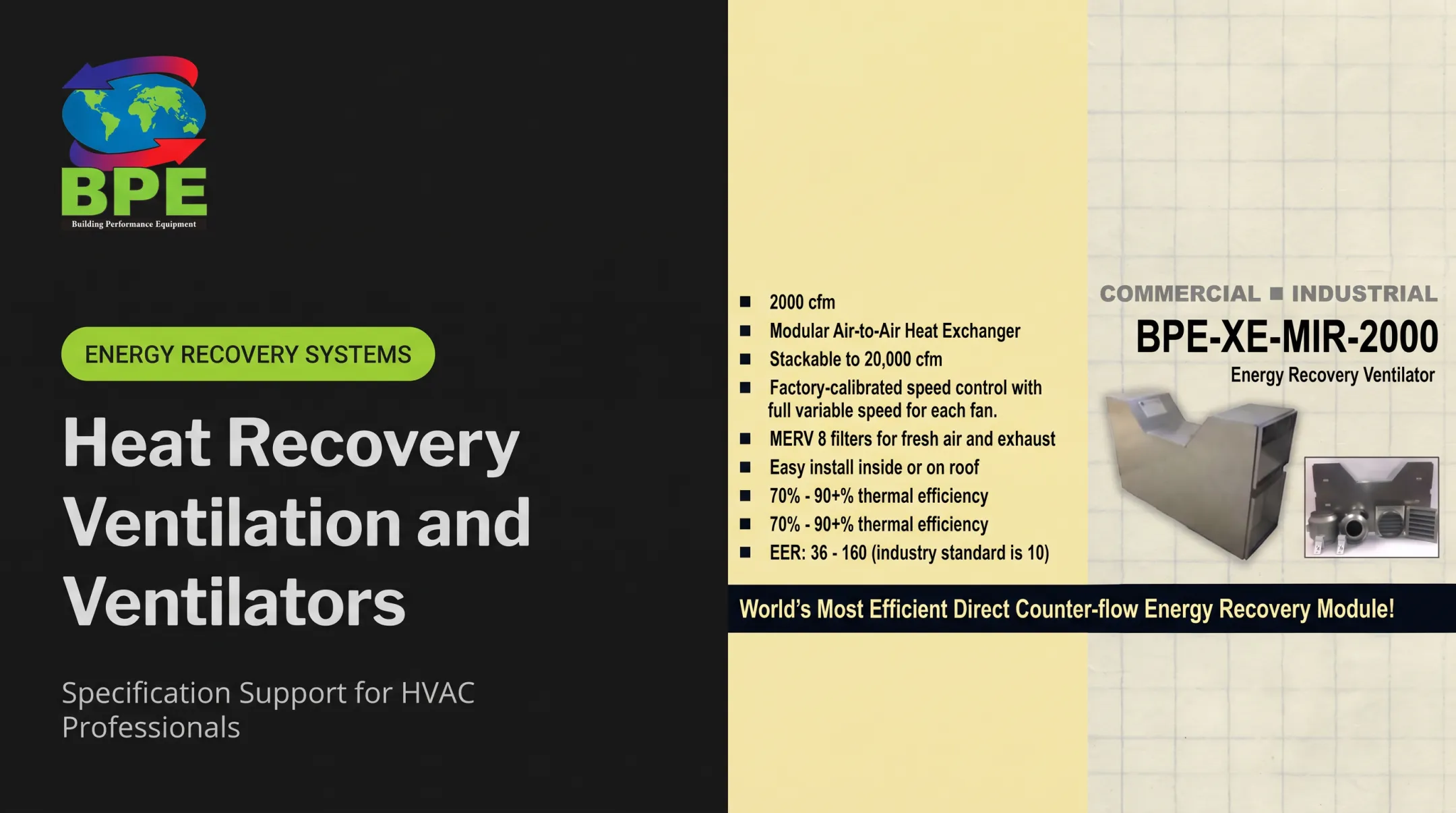
Building Performance Equipment's ERVs, for instance, pair two in-line fans (one pulling outdoor air in and one pushing stale air out) with a heat-exchanger core that recovers energy during that swap. That's ventilation with energy recovery, not a substitute for your furnace or a standalone air purifier.
Whole House Ventilation Strategies: Match the System to the Building
Five basic strategies cover most residential applications. Each handles pressure, moisture, and makeup air differently.
Exhaust-Only Ventilation
Exhaust fans pull air out, and replacement air seeps in through leaks, gaps, and passive vents. This slightly depressurizes the building.
The approach is inexpensive and works reasonably well in cold climates. Uncontrolled makeup air is the tradeoff: it can drag in humidity, dust, pollen, or combustion byproducts from attached garages.
Supply-Only Ventilation
A fan pushes filtered outdoor air in; stale air exits through leaks or exhaust points elsewhere. This creates positive pressure, which helps keep pollutants from infiltrating. In cold climates, though, that pressurized air can push moisture into wall cavities. Condensation control then becomes a real design concern.
Balanced Ventilation
Balanced systems use dedicated supply and exhaust paths running simultaneously, keeping pressure close to neutral. This gives more predictable air distribution across the house. Single-point systems serve one central location; multi-point systems duct air to individual rooms, which costs more but distributes air more evenly.
HRV vs. ERV: What's the Real Difference?
Both are balanced-ventilation strategies. According to Building Performance Equipment's technical FAQ, an HRV recovers heat only, while an ERV recovers heat and moisture. Neither is universally "better":
- HRVs suit climates where you want heat recovery without transferring moisture between airstreams
- ERVs suit climates with strong seasonal humidity swings, since they moderate moisture transfer between incoming and outgoing air
BPE's units, as one example, are designed for either mode: they can run as standard ERVs or be fully sealed to operate as HRVs, depending on the project's humidity profile.

Quick Decision Summary
| Building scenario | Likely-fit strategy |
|---|---|
| Leaky existing home | Exhaust-only, often lowest-cost upgrade |
| Tight, high-performance home | Balanced, HRV, or ERV |
| Cold climate | HRV, or ERV with frost protection |
| Humid climate | ERV, often paired with dehumidification |
| Multifamily dwelling | Balanced, per-unit ERV |
Caution: process exhaust from industrial sources, chemical fumes, tannery operations, or fragrance manufacturing is not a residential ventilation problem. Those applications need source capture, contaminant-compatible materials, and engineered exhaust safety design, not a standard whole-house system.
How to Choose and Size the Right Ventilation Strategy
Sizing starts with an honest assessment, not a spec sheet.
Building Assessment First
Document these factors before comparing equipment:
- Floor area and occupancy
- Airtightness and existing ductwork
- Combustion appliances
- Moisture history
- Local code requirements
A six-person household and a two-person household have very different ventilation needs even in identical floor plans.
Airflow Sizing Standards
Residential ventilation rates in the US are generally governed by ASHRAE 62.2, though you'll need to verify which edition your local jurisdiction has adopted. The ASHRAE 62.2 standard sets minimum dwelling-unit ventilation requirements, but local code can be more stringent.
As a rough starting point, Building Performance Equipment's own sizing guideline uses 20 cfm per person. A six-person home, for example, points toward a unit like the BPE-XE-MIR-200i rated for 60–200 cfm.

Rated maximum airflow on a spec sheet isn't the whole story. Selection should also weigh:
- Delivered airflow at actual design static pressure (not just lab conditions)
- Balancing capability between supply and exhaust
- Turndown and boost capacity for changing loads
- Sound output, measured in sones
- Electrical consumption
Climate and Moisture Considerations
Cold-climate installations need frost protection, a clear defrost strategy, and insulated, sloped ductwork, since cores can frost at low supply-air temperatures.
Humid-climate projects often need supplemental dehumidification even with an ERV installed, because moisture transfer is not the same as active moisture removal. Occupancy density matters too: more people generate more internal moisture, which can shift the HRV-versus-ERV decision.
Filtration Compatibility
Higher-efficiency filters restrict airflow more, so they need to match your fan's capacity. BPE units ship standard with MERV 8 filters, with MERV 13 available for wildfire smoke or heavy pollen seasons, provided the fan and ductwork are sized to handle the added pressure drop.
A Simple Cost-Planning Framework
Rather than one number, separate your budget into:
- Equipment (exhaust-only costs far less than a balanced ERV system)
- Ductwork and retrofit access
- Electrical work and controls
- Commissioning and balancing
- Filters and ongoing maintenance
Get a project-specific quote. Costs vary widely by region and scope. For complex airflow or energy-recovery requirements, Building Performance Equipment supplies high-efficiency air-to-air energy-recovery equipment. Review options with a qualified HVAC or engineering professional before you purchase.
Design, Commission, and Maintain the System
Good equipment installed poorly still performs poorly. Design, controls, and ongoing maintenance all affect whether a system delivers what it promises.
Mapping Airflow and Avoiding Short-Circuiting
Supply air should reach bedrooms and living areas; exhaust should pull from moisture- and pollutant-producing rooms.
Fresh-air intakes need separation from combustion exhaust, garbage areas, and gas-appliance vents, generally at least 10 feet, to avoid drawing contaminated air back in.
Sealed, insulated ductwork and balancing dampers prevent air from short-circuiting between supply and return before it ever reaches occupied space.

Operating Modes
Systems typically run one of several ways:
- Continuous low-speed operation for steady background exchange
- Timed or intermittent cycling tied to a schedule
- Demand-controlled operation using humidity or CO2 sensors
- Boost mode for cooking, showers, or elevated occupancy
The correct schedule depends on your specific equipment and climate, so follow manufacturer instructions rather than guessing.
Commissioning Isn't Optional
Every installation needs field verification. Confirm these items on site:
- Measure actual supply and exhaust airflow at terminals
- Confirm pressure balance across the system
- Check for excess noise at design airflow
- Document final settings for the homeowner or facilities team
BPE's own installation guidance requires commissioning for proper flows on every project. A unit rated for 200 cfm on paper can deliver meaningfully less once ductwork resistance enters the picture.
Maintenance Checklist
- Inspect filters roughly once a year; replace when airflow or performance drops
- Check the heat-exchanger core on both the outdoor-air and exhaust-air sides
- Keep condensate drainage clean; BPE identifies this as the single most important maintenance item
- Confirm intake and exhaust screens are clear of debris
- Recalibrate sensors and review seasonal control settings
Warning signs worth acting on: persistent condensation, musty odors, unusual dryness, rising energy bills, or noticeably weaker airflow. Any of these suggest it's time for professional testing, especially after a renovation, HVAC replacement, or significant air-sealing work.
Build a Ventilation Strategy Around the Building
There's no single "best" whole-house ventilation system. Effective ventilation is a coordinated strategy that covers:
- Airflow quantity
- Pressure control
- Distribution
- Filtration
- Moisture management
- A maintenance plan that keeps it running as designed
Before comparing equipment or requesting quotes, have your building assessed by a qualified professional who can size, install, balance, and commission the system properly. That groundwork determines whether your ventilation strategy actually solves the problems you started with.
Frequently Asked Questions
How much does a whole house ventilation system cost?
Cost depends on equipment type, airflow capacity, ductwork, retrofit access, controls, electrical work, and commissioning. Get a project-specific quote from a qualified contractor in your region rather than relying on a general estimate.
What does whole house ventilation do?
It exchanges stale indoor air for controlled outdoor air throughout the building. Filtration, humidity control, and pollutant removal depend on the specific design and equipment you choose, not ventilation alone.
Should I leave whole house ventilation control on or off?
Many systems are designed for continuous low-speed operation with periodic boost modes. The correct schedule depends on your equipment, climate, and commissioning instructions, so check manufacturer guidance first.
What is the best house ventilation system for my home?
It depends on your climate, airtightness, occupancy, humidity levels, pollutant sources, and existing HVAC setup. Compare exhaust-only, supply-only, balanced, HRV, and ERV options before settling on a specific model.