
Introduction
Every occupied building needs a steady supply of outdoor air. Codes require it, occupants need it, and stale indoor air has to go somewhere. The catch is that conditioning incoming air eats into your heating and cooling budget, sometimes dramatically. In schools, ventilation can account for up to 70% of the total heating and cooling load, according to internal industry data from Building Performance Equipment (BPE).
That's where energy recovery comes in. "Energy recovery" is a broad engineering concept covering everything from regenerative braking in vehicles to heat recovery in industrial plants.
Energy recovery ventilators, or ERVs, are the building-specific application: equipment that transfers heat and moisture between outgoing exhaust air and incoming outdoor air before either stream crosses the building envelope.
This article covers how ERVs actually work, where they deliver the most value, how to select and size one, and what cold-climate and maintenance considerations you need to plan for.
Key Takeaways
- Energy recovery captures heat, moisture, pressure, or kinetic energy a process would otherwise waste
- ERVs precondition outdoor air by transferring sensible and latent energy from exhaust air
- Well-matched ERVs improve indoor air quality, comfort, and energy efficiency, supporting decarbonization goals
- Climate, airflow, contaminants, and controls all determine whether an ERV design fits your building
Energy Recovery Systems: Definition, Types, and Examples
Energy recovery means capturing energy that would otherwise leave a process unused, then converting or redirecting it somewhere useful. Nothing new gets created. Energy already present in an exhaust stream, a braking system, or a pressurized pipe just gets redirected instead of thrown away.
That's different from energy conservation. Conservation reduces how much energy a process demands in the first place, say, by tightening a building envelope. Recovery works on the other end. It reuses energy that's already been generated and is about to be wasted.
Four Categories Worth Knowing
- Heat recovery: Capturing heat from ventilation exhaust, flue gas, wastewater, or industrial cooling systems. A building-level ERV recovering heat from stale exhaust air is a direct example.
- Kinetic energy recovery: Regenerative braking in hybrid and electric vehicles, where wheel motors act as generators during braking and send electricity back into the battery.
- Pressure recovery: Using turbines or expanders to capture energy from pressurized fluid that would otherwise be throttled down, such as a backpressure steam turbine replacing a pressure-reducing valve.
- Process or waste-energy recovery: Reusing heat generated by manufacturing equipment or data center servers, like hot-aisle containment systems that redirect server heat elsewhere in a building.
Air-to-air energy recovery, the category ERVs belong to, is the one most relevant to buildings. ASHRAE defines it as recovering heat and moisture between two airstreams at different temperatures and humidities. That typically means supply air coming in and exhaust air going out of a building, per ASHRAE's handbook.
One distinction trips people up: an "energy recovery facility" is not the same as an ERV. The EPA uses that term for waste-to-energy plants that convert municipal solid waste into electricity, steam, or fuel.
An ERV installed in a school or office building does something entirely different. It exchanges heat and moisture between two ventilation airstreams, with no combustion or waste processing involved.
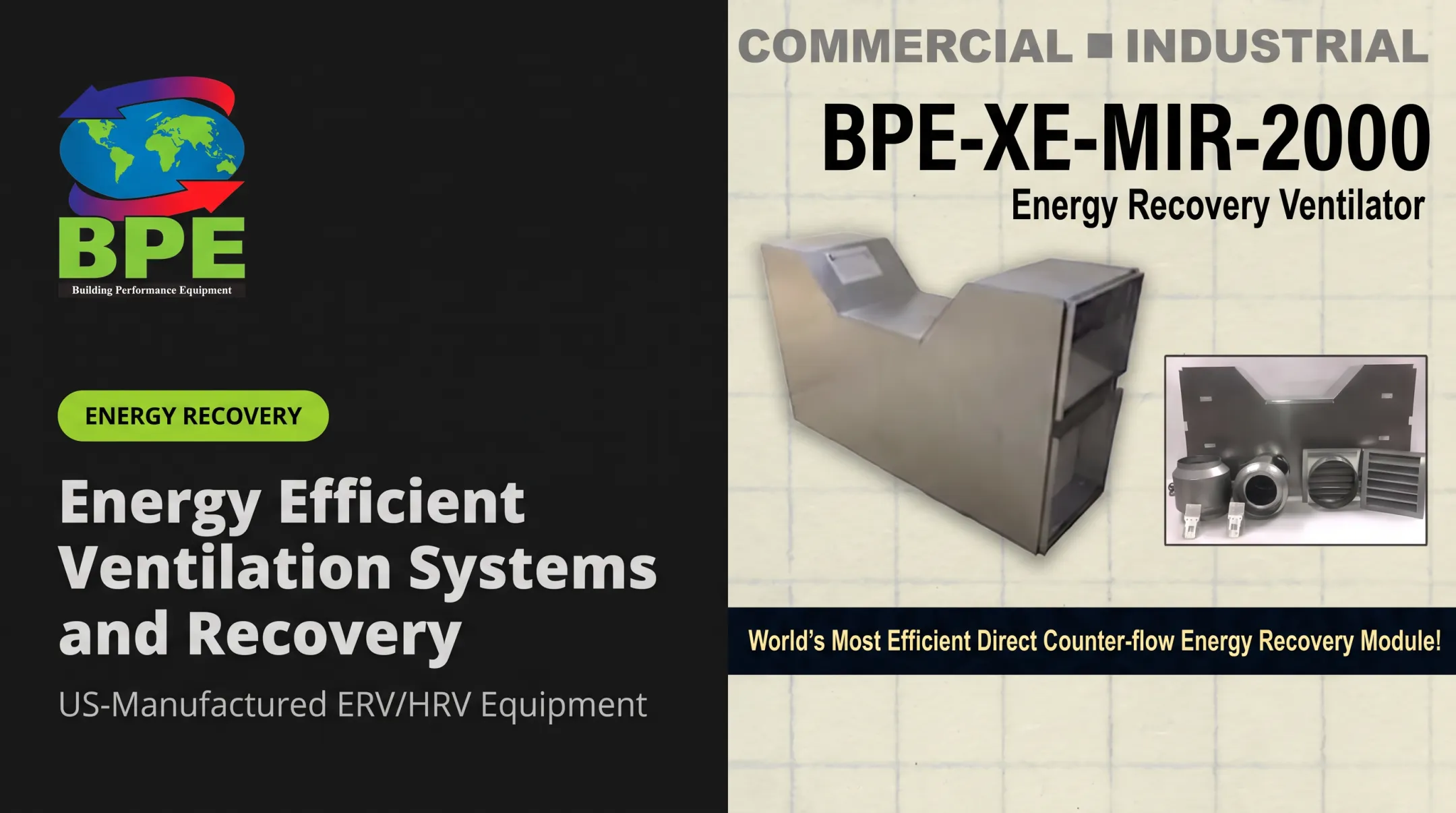
BPE's own equipment sits squarely in that building-ventilation category. Its energy-recovery modules, like the BPE-XE-MIR-3000, use a sealed flat-plate heat exchanger to transfer energy between two airstreams without mixing them. Each unit ships as a packaged system with fans, dampers, and controls rather than a bare core.
How ERVs Work in Building Ventilation
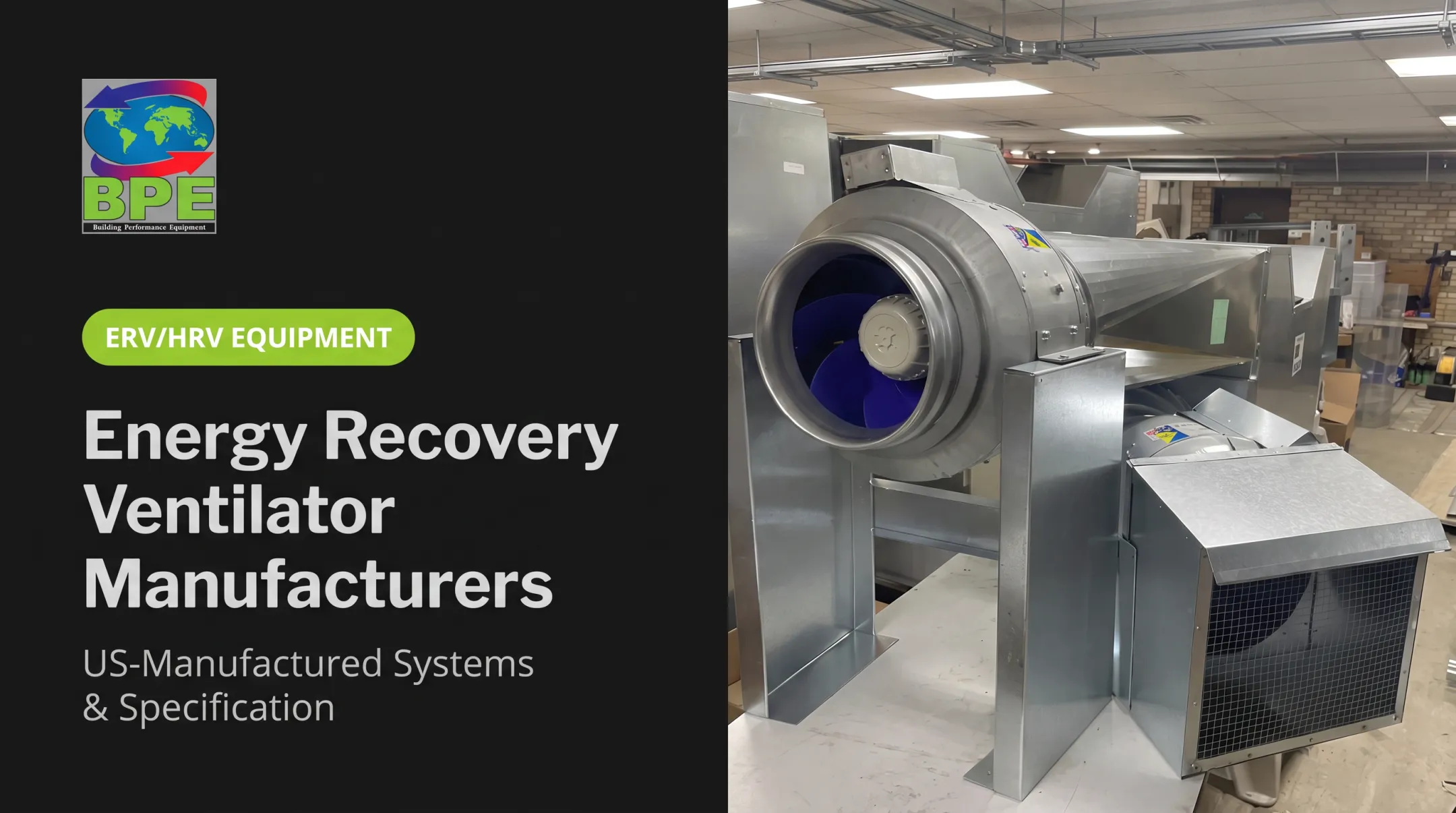
An ERV runs two airstreams side by side without letting them mix. BPE's units use two in-line fans: one pulls outdoor air into the building, the other pulls stale indoor air out. Both streams pass through a shared heat-exchanger core on their way through the unit.
The core is an air-to-air heat exchanger that transfers energy between the two airstreams while keeping them physically separate. How much energy transfers, and whether moisture crosses along with heat, depends on the equipment design.
Sensible vs. Latent Energy
- Sensible energy relates to temperature, the heat you can feel.
- Latent energy relates to moisture, the humidity in the air.
An ERV transfers both. An HRV (heat recovery ventilator) transfers sensible energy only.
BPE's fixed-plate ERVs, for example, are tested to over 80% sensible effectiveness and over 30% latent effectiveness under ARI 1060 testing conditions, according to the company's equipment specifications.
Winter and Summer Operation
In winter, warm indoor exhaust air passes next to cold incoming outdoor air inside the core. Heat transfers from the warm stream to the cold one, so outdoor air enters the building already partway toward room temperature. At the Red Bank YMCA, BPE's heat exchangers reportedly warm 20°F to 35°F incoming air to 75°F before it reaches occupied space.
Summer works in reverse. Cooler indoor exhaust air helps cool incoming hot, humid outdoor air, and latent transfer can moderate incoming humidity too. Actual performance always depends on airflow rates, indoor and outdoor conditions, bypass operation, and the specific equipment's rated effectiveness. No unit hits its nameplate number under every condition.
Plate Cores vs. Rotating Wheels
Two main configurations dominate the market:
- Stationary plate cores have no moving parts in the exchange path, so cross-leakage risk and routine maintenance stay low. BPE seals its flat-plate exchangers permanently to the enclosure for this reason.
- Rotating wheels absorb and release heat and moisture as they turn, which can boost latent transfer, but add seals, drive motors, and purge sections that need regular inspection for leakage and carryover.
Fans, filters, dampers, sensors, and controls round out the system:
- Filters protect the core from dust and debris
- Dampers manage bypass and airflow balance
- Sensors feed controls that match supply and exhaust airflow and protect the core from frost
The basic airflow path: Outdoor air and building exhaust air enter the unit through separate ducts. Both pass through the core, where energy transfers across the separating material without the streams mixing. Preconditioned outdoor air then continues into the occupied space, while the depleted exhaust air exits outdoors.

Benefits and Building Applications
An ERV reduces the heating or cooling energy your HVAC equipment needs to condition ventilation air, because incoming air arrives partially preconditioned. How much you save depends on climate, airflow rates, occupancy schedules, controls, and the equipment's effectiveness.
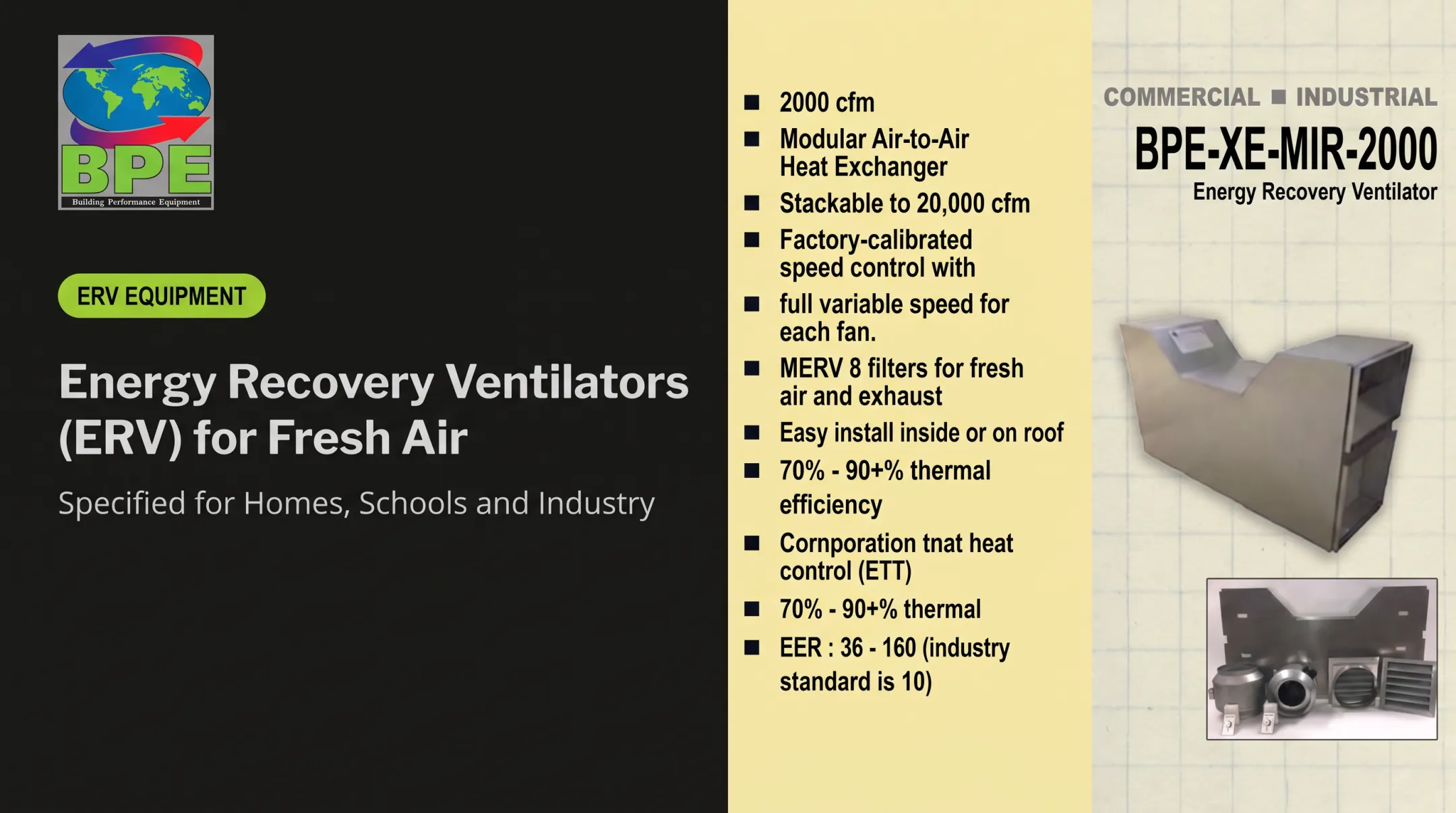
BPE's own ERV systems are specified to capture 70% to 90%+ of the thermal energy that would otherwise be exhausted outdoors, according to the company's product data.
Real-world studies show similar results, with important caveats. A NIST study of a net-zero test house in Gaithersburg, Maryland found an HRV cut annual heat-pump energy for conditioning ventilation air by 7%. Heating-season savings reached as high as 36%, offset by a 5% increase in cooling-season energy use, per NIST's net-zero study.
Fan electricity use also rose in that study. Evaluate ERV performance over a full year, not just a winter snapshot.
Indoor Air Quality and Comfort
ERVs support indoor air quality by continuously removing stale air and replacing it with outdoor air, but they're not a substitute for source control, filtration, or contaminant-specific exhaust. In humid climates or tightly built homes, latent transfer also moderates incoming humidity.
BPE's Regenerative Condensate Return technology is built to move excess summer condensate into the exhaust stream rather than draining it inside the building.
Where ERVs Make Sense
- Schools and universities: Hopewell Valley Regional School District retrofitted 13 classrooms with BPE ERVs and reportedly cut facility energy consumption by over 32% within five years while improving comfort and air quality.
- Offices and light-commercial buildings: A strip mall retrofit achieved greater than 86% apparent sensible heat recovery and eliminated the need for a separate reheat system.
- Multifamily and high-performance homes: Compact, plug-and-play units handle per-unit fresh-air requirements without major ductwork.
- Industrial facilities: Grainger Warehouse reported over 94% sensible thermal efficiency while improving staff comfort without raising energy bills.

A Caution for Process Exhaust
Chemical processing, tanneries, and fragrance manufacturing need extra scrutiny before specifying energy recovery. Fumes, VOCs, odors, and corrosive compounds can damage a core or create cross-contamination risk.
Chanel Perfumes, for example, had chemical-fume exhaust that risked damaging standard ventilation equipment before working with BPE on an application suited to that exhaust stream. Always assess the exhaust air classification and the equipment's leakage rating before specifying a unit for process exhaust.
Choosing and Applying an ERV System
Start with the ventilation requirement, not the equipment catalog. Identify occupancy counts, required outdoor-air rates, exhaust volumes, operating schedules, and zoning before you look at a single spec sheet. BPE's own sizing guidance uses 20 CFM per person as a starting benchmark, then adjusts for space type and code minimums.
Match Climate to Equipment
Cold climates bring frost risk at the core; hot, humid climates bring heavy latent loads. BPE recommends extra application assistance for its BPE-XE-MIR-3000 unit below -10°F outdoor temperature or above 40% relative humidity, the kind of threshold worth confirming with any manufacturer before finalizing a spec.
Evaluate the Equipment, Not Just the Nameplate
- Compare sensible and latent effectiveness ratings at your actual design airflow, not just the nominal CFM rating.
- Check pressure drop on both sides. BPE's BPE-SC-UNI-3000, for instance, lists intake pressure drop from 0.1 to 1.08 inches W.C. and exhaust pressure drop from 0.23 to 2.38 inches W.C. across its tested flow range.
- Confirm the unit delivers rated airflow against your project's actual external static pressure, since duct runs and filters add resistance that nominal ratings don't always reflect.
- Review filtration, service access, and cross-leakage ratings, especially for process exhaust applications.

Coordinate With the Rest of the HVAC Design
ERVs rarely work alone. They need to be coordinated with dedicated outdoor-air systems, rooftop units, heat pumps, demand-controlled ventilation, and existing exhaust infrastructure. BPE's modules are designed as stand-alone heat-recovery components that connect into new or existing dedicated systems, meaning existing exhaust fans, caps, and goosenecks can often stay in place during a retrofit.
Check Codes Before You Finalize a Spec
The 2024 IECC requires at least 50% design enthalpy recovery for qualifying commercial spaces above certain airflow thresholds, along with economizer bypass or compatible controls, per the 2024 IECC. ASHRAE 62.1 and 90.1 add further ventilation and energy requirements. Verify the current code edition your jurisdiction has adopted, since adoption timelines vary by state and municipality.
Think in Lifecycle Terms, Not Sticker Price
Compare purchase and installation costs against expected energy use, filter replacement, controls integration, and serviceability over the equipment's full life, not just the purchase order. A unit with a shorter service life needs multiple core replacements factored into any fair comparison. There's no universal payback number. It depends on your climate, your schedule, and your building's actual operating profile.
This is where a manufacturer with engineering-led project support earns its keep. Building Performance Equipment works directly with specifiers on airflow, pressure drop, and climate-specific selection for its air-to-air energy recovery equipment rather than handing over a single generic spec sheet.
Installation, Controls, and Maintenance Considerations
Retrofit and new-construction installations both need coordinated planning across several systems:
- Duct connections and outdoor-air/exhaust locations
- Structural support and weather protection
- Condensate management and electrical service
Outdoor units need intakes at least 8 feet above ground, protected by mesh screens, with sealed, weatherproof duct connections.
Controls That Keep the System Running Efficiently
- Occupancy scheduling: Fans ramp up or down based on occupied and unoccupied periods.
- Demand-controlled ventilation: CO2 sensors can trigger changes. BPE recommends 600 ppm as a control-on point and 500 ppm as control-off, adjustable per project.
- Bypass and frost protection: Outdoor-air temperature sensors trigger bypass during mild weather for free cooling, and protect the core from frost in cold conditions.
- Building automation integration: BACnet-capable controllers let the ERV report status and accept commands from the broader building automation system.
A Short Maintenance Checklist
- Inspect and replace filters based on pressure drop and site conditions, not a fixed calendar date.
- Inspect the core or wheel annually, checking both the exhaust-air and outdoor-air sections for fouling, and clean according to the manufacturer's instructions.
- Verify airflow balance, listen for unusual noise, and check for frost formation or active alarms during scheduled service.
Maintenance intervals should follow manufacturer instructions, operating hours, outdoor conditions, and filter loading rather than a single universal schedule.
BPE's guidance suggests cleaning when performance drops by about 10%. In typical school or office environments, that often means once a year, with an insect screen check every five years or so.
Commissioning matters as much as maintenance. A qualified HVAC professional should verify supply and exhaust airflow balance, confirm control sequences, and document baseline operating conditions at startup, so later service visits have something real to compare against.

Frequently Asked Questions
What is energy recovery?
Energy recovery is the process of capturing energy that would otherwise be wasted, usually as heat, moisture, pressure, or motion, and reusing it elsewhere. In buildings, an ERV recovering heat from exhaust air to warm incoming outdoor air is a common example.
Can you give me an example of energy recovery?
An ERV transferring heat and moisture from outgoing exhaust air to incoming outdoor air is a direct building example. Outside of buildings, regenerative braking in hybrid vehicles captures kinetic energy during braking and sends it back to the battery.
What is an energy recovery facility?
An energy recovery facility typically refers to a waste-to-energy plant that converts municipal solid waste or industrial waste into usable heat, steam, or electricity. That's different from an ERV, which is ventilation equipment installed inside a building.
How does an ERV save energy?
An ERV preconditions incoming outdoor air using energy recovered from exhaust air, reducing the heating or cooling work the primary HVAC system has to do. Actual savings depend on climate, airflow, occupancy schedules, and equipment effectiveness.
What is the difference between an ERV and an HRV?
Both recover sensible heat from exhaust air. An ERV also transfers latent energy, meaning moisture, which can help moderate indoor humidity year-round. An HRV typically transfers sensible heat only.