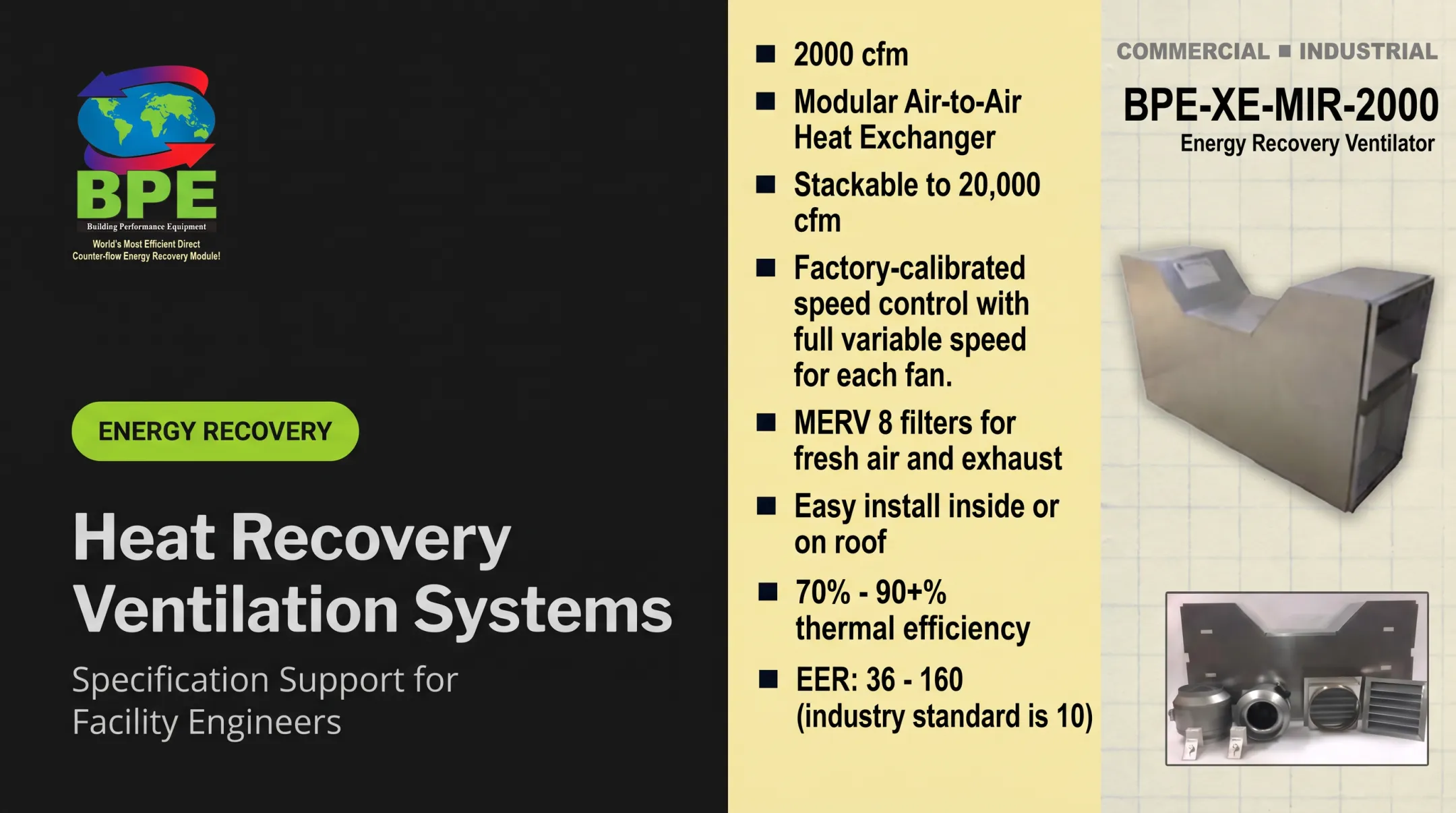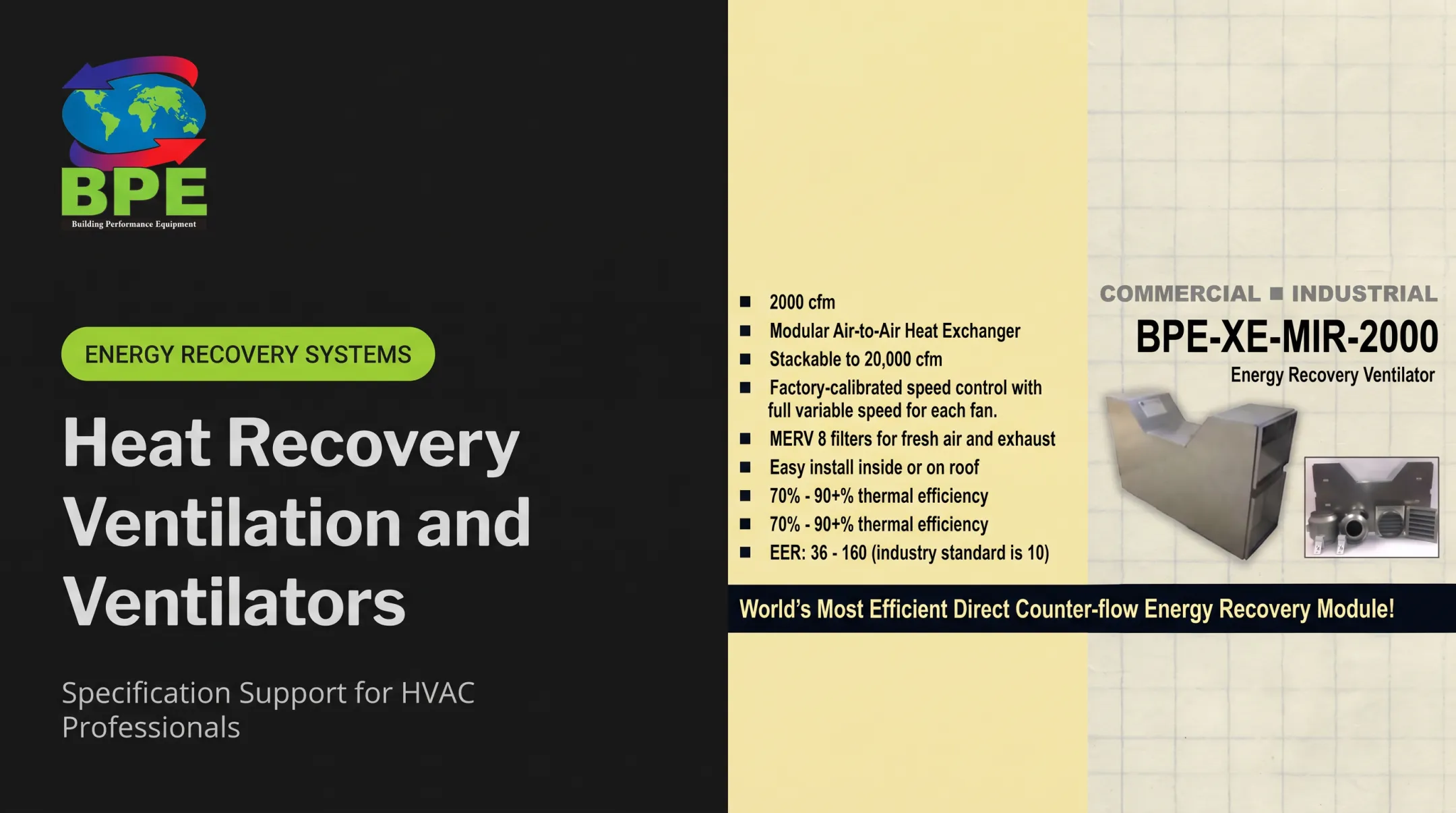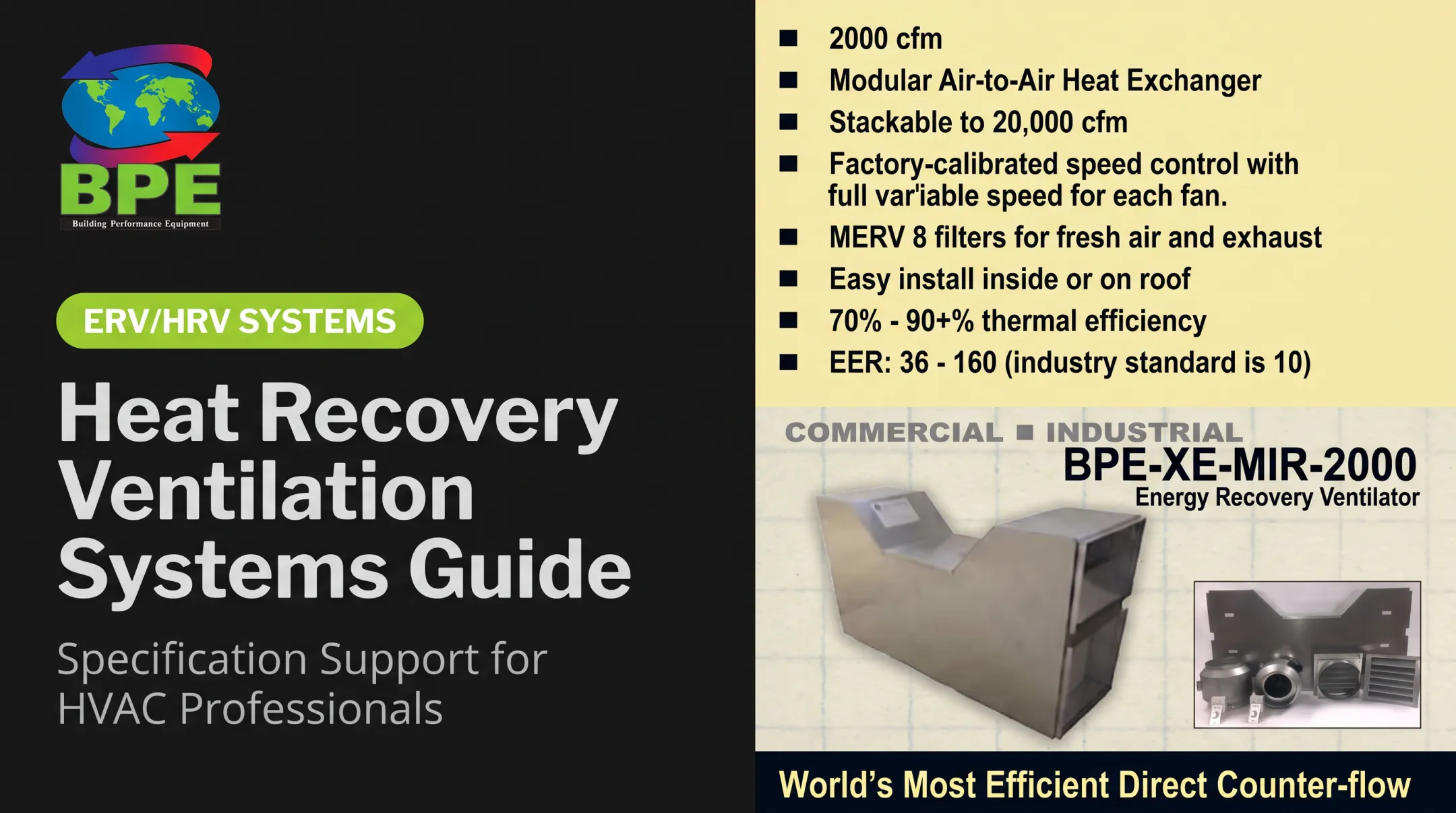

Heat recovery units solve this by capturing usable thermal energy from outgoing air before it leaves the building. The US Department of Energy explains that balanced, energy-recovery ventilation systems precondition incoming air instead of simply discarding the heating or cooling potential already paid for. This article covers how these units operate, how to pick between an HRV and an ERV, where they make sense, what installation involves, and what they actually cost.
Key Takeaways
- Heat recovery ventilation exhausts stale air and supplies outdoor air while transferring usable heat between the two streams.
- HRVs move sensible heat only; ERVs also transfer moisture, which matters in humid or dry climates.
- These units are not heat pumps, VRF systems, or water heaters, even though all four recover heat in some form.
- Real-world value depends on airflow, climate, fan power, ductwork, and maintenance—not just sticker price.
What Is a Heat Recovery Unit and How Does It Work?
A heat recovery unit is mechanical equipment that exchanges stale indoor air for outdoor air while recovering thermal energy that would normally be exhausted and lost. Think of it as a traffic cop for two air streams moving in opposite directions. It pulls heat from one stream and hands it to the other without letting them mix.
Two Separate Air Paths
Every unit runs two distinct airflow paths through a shared heat-exchange core:
- Exhaust air leaving the building, carrying heat (and in some units, moisture)
- Outdoor air entering the building, picking up that recovered energy
- Shared core transferring energy between the streams without mixing them
Building Performance Equipment (BPE) commercial systems, such as the BPE-XE-MIR-3000, supply 3,000 cfm of pre-conditioned outdoor air while capturing as much as 80% of the heat energy from the air it's replacing. The two streams pass through the core, exchange energy, and exit on separate sides. No cross-contamination, no mixing.

Winter and Summer Operation
In winter, warm exhaust air passes through the core and transfers heat to the cold incoming outdoor air before that air reaches the space. This reduces the load on the heating system.
In summer, the process runs in reverse. Cooler exhaust air pulls heat out of the hot incoming outdoor air, cutting the cooling load. A ventilation heat recovery unit doesn't actively heat or cool like a heat pump does. It just transfers energy that's already present between the two streams.
Performance Factors Worth Researching
Before comparing units, look past the headline efficiency number. Factors that actually determine field performance include:
- Sensible and latent recovery effectiveness
- Airflow capacity at your required static pressure
- Fan power (watts per cfm)
- Frost protection and bypass controls
- Filtration, sound levels, and commissioning requirements
A unit's performance should be grounded in manufacturer data tested to recognized standards like AHRI 1060 and ASHRAE 84. An unsupported efficiency claim on a spec sheet is not enough.
A heat recovery unit supports indoor air quality and comfort. It is not a substitute for source control, proper filtration, contaminant exhaust, or a well-designed HVAC system around it.
HRV, ERV, and Related Heat-Recovery Technologies
Two terms dominate this space, and they're not interchangeable.
| Type | What it transfers | Best suited for |
|---|---|---|
| HRV | Sensible heat only | Cold, relatively dry climates |
| ERV | Sensible heat plus moisture | Humid climates or buildings generating indoor moisture |
| DOE notes that HRVs work well in colder, drier regions, while ERVs can help manage indoor humidity year-round because they move water vapor along with heat. | ||
| BPE's ERVs use patented Regenerative Condensate Return technology for up to 34% latent effectiveness. They can also be field-modified toward HRV-style operation when a building runs too humid in winter. |
MVHR and MEV Aren't the Same Thing
If you've come across UK-style terminology: MVHR refers to balanced mechanical ventilation with heat recovery, meaning both supply and exhaust are mechanically handled through a shared core. MEV typically just exhausts air mechanically, without the balanced supply-and-recovery arrangement. In US practice, "HRV" and "ERV" cover the same functional ground as MVHR.
Not a Heat Pump, VRF, or Water Heater
These are easy to confuse because all of them "recover" heat somehow:
- A heat pump uses a refrigeration cycle to actively move heat for heating or cooling; an HRV or ERV only passively transfers energy between air streams. BPE's modular ERM docs recommend adding a heat pump on the fresh-air side when extra winter heat is needed.
- Heat-recovery VRF captures heat rejected by one zone to serve another zone's heating needs. Different equipment, different purpose.
- Water-heating or wastewater recovery captures heat from hot water or drain lines. No airside connection at all.
Industrial and Contaminated Exhaust
Facilities exhausting fumes, VOCs, or process chemicals need a specialist review before any ventilation recovery is installed. Not every exhaust stream is a candidate for straightforward recovery. BPE's work with a machine shop used two BPE-XE-MIR-3000 units to displace chemical odors and fumes with clean outdoor air. That kind of application still needs careful attention to heat-exchanger materials, cross-contamination risk, and exhaust treatment.
Benefits and Building Applications
The core benefit is simple: controlled, balanced ventilation with less wasted energy. Beyond that, owners typically see:
- Reduced stale air and odors
- Lower ventilation-related heating and cooling loads
- Better comfort and improved indoor air quality
- Support for energy and carbon reduction goals
Where These Systems Fit
Heat recovery ventilation shows up across a wide range of building types:
- Schools and universities — classrooms need high outdoor-air delivery without large heating and cooling penalties
- Multifamily housing — compact, unit-by-unit systems instead of one central plant
- Offices, healthcare, and institutional buildings — balanced fresh air with lower ventilation energy cost
- Selected industrial spaces — specialized exhaust and contaminant controls where recovery is appropriate
Classroom rates show why the load math matters. ASHRAE's 2025 addendum lists 10 cfm per person plus 0.12 cfm per square foot for classrooms, versus 5 cfm per person plus 0.06 cfm per square foot for office space. Different occupancy, different math; don't size either from a single per-person number alone.
Those application differences show up in real projects. Hopewell Valley Regional School District cut energy consumption by over 32.1% across five years after installing energy recovery ventilation, with better thermal comfort and air quality as well.
A separate strip-mall retrofit reached greater than 86% sensible heat-recovery effectiveness with ECM fans at less than 0.75 watts per cfm. That performance removed the need for a separate reheat system entirely.

Trade-offs to Plan For
No system is free of maintenance or energy use. Expect to plan for:
- Added fan energy and periodic filter or core maintenance
- Ductwork requirements and condensate or frost management
- Noise considerations and controls integration
- Reduced suitability where exhaust air is hazardous or heavily contaminated
Choosing, Designing, and Installing a Heat Recovery Ventilation System
Good system selection starts with a building assessment, not a product catalog. Before picking equipment, evaluate:
- Occupancy and room use
- Envelope tightness and climate zone
- Indoor humidity and exhaust sources
- Existing HVAC and controls
Sizing by Airflow, Not Square Footage
Size around required outdoor airflow and exhaust airflow, not floor area alone. Standards like ASHRAE 62.1 and 62.2 account for occupancy and diversity, and local code may be more stringent than either. A gym and a classroom of the same square footage can need very different cfm.
Specs Worth Comparing Side by Side
When comparing equipment, put these on the same table:
- Airflow at your required static pressure, not just a nameplate cfm figure
- Sensible and latent recovery performance, tested to a recognized standard
- Fan power, filter type, and sound levels
- Core material, frost strategy, and bypass operation
- Service access for filters and core cleaning
BPE's modular ERM systems, like the BPE-SC-UNI-3000, scale from 500 to 3,500 cfm per module and stack to 20,000 cfm, with thermal efficiency adjustable from 70% to over 90% depending on airflow.
Installation Details That Affect Real Performance
A few details separate a system that works from one that underdelivers:
- Intake and exhaust placement, including minimum height and mesh screening
- Duct insulation, sealing, and sloped condensate drainage
- Access panels for filter and core cleaning
- Protection against recirculation or short-circuiting between supply and exhaust
For commercial, institutional, or retrofit projects, evaluate modular units inside the full MEP design, envelope plan, and building-performance goals—not as a late add-on.
BPE's stackable modules and BACnet-compatible controllers are built for that workflow. Under CEO and ASHRAE veteran Klas Haglid, the equipment is specified with the same rigor as the ductwork and controls around it.
Commissioning Is Not Optional
Nameplate performance is a lab number. Field commissioning should cover:
- Airflow measurement
- Supply and exhaust balancing
- Temperature and humidity verification
- Control checks and alarm testing
- Owner training Skip this step and even a well-specified unit may never hit its rated numbers in the field.
For retrofits, check whether existing rooftop curbs or ductwork can be reused. BPE's unitary systems can often be purchased without fans where existing fan infrastructure is already in place, which keeps retrofit costs down.
Cost, Value, and Maintenance
Pricing depends on a handful of variables, and there's no single honest national number to quote. The main cost drivers are:
- Equipment capacity and HRV versus ERV configuration
- Ductwork, electrical, and controls work
- Structural modifications and crane or lifting needs
- Commissioning, labor rates, and permits
One documented BPE commercial project came in at $298,847 installed, with annual energy savings of $53,555, a 5.58-year simple payback, and a 17.2% internal rate of return over a 20-year measure life.

NREL's 2024 modeling found median heating-end-use savings of roughly 15% to 25%, with cooling savings closer to 10%. A cited field study in Minnesota found that real-world performance often fell short of modeled assumptions. That gap is exactly why commissioning matters.
What Keeps Performance Real Over Time
A high recovery-efficiency rating on paper doesn't guarantee results. Watch for:
- High fan power or excessive pressure drop eating into savings
- Poor balancing between supply and exhaust
- Contaminated cores or inaccessible components that never get cleaned
BPE recommends annual filter inspection for typical school or office units, with HEPA vacuuming of the core roughly every five years depending on airborne debris.
Flat-plate heat exchangers carry a minimum 10-year limited lifetime warranty against corrosion, and equipment typically carries an 18-month parts warranty.
Before buying, ask your installer or supplier:
- What's the tested airflow at my actual static pressure?
- What does the warranty cover, and for how long?
- What's the commissioning scope, and who performs it?
- How accessible are filters and the core for ongoing service?
Frequently Asked Questions
What is a heat recovery unit?
A heat recovery unit exchanges energy between two air streams: one exhausting stale indoor air and one supplying outdoor air. Unlike heat-recovery water heaters or heat pumps, it does not use a refrigeration cycle to move heat.
What are the two types of recovery ventilators?
HRVs transfer sensible heat only, while ERVs transfer both heat and moisture. Climate and indoor humidity conditions determine which one fits a given building better.
What is the difference between a heat pump and a heat recovery unit?
A heat pump actively moves heat through a refrigeration cycle to provide heating or cooling. A ventilation heat recovery unit passively transfers energy already present between incoming and outgoing air streams.
Are heat recovery units worth it?
Value depends on ventilation demand, climate, energy prices, installation cost, and indoor air quality priorities. For larger commercial or institutional projects, a lifecycle-cost analysis gives a clearer answer than a general rule of thumb.
How much does a heat recovery unit cost?
Price varies by capacity, HRV versus ERV selection, ductwork, controls, labor, and retrofit complexity. No single national price applies—request a project-specific quote based on your building's airflow requirements.
Can a heat recovery unit be used with air conditioning?
Yes. HRV and ERV systems work alongside air conditioning to precondition ventilation air before it reaches the space, reducing the cooling load. They don't replace the air conditioner or provide active cooling on their own.