
Introduction
Modern US homes and commercial buildings are built tighter than ever. That's great for energy bills, but it creates a problem: stale air, trapped moisture, and indoor pollutants have nowhere to go. The EPA specifically flags this trade-off, noting that air-sealing and weatherization work needs to be paired with attention to ventilation and indoor pollutant sources.
An energy recovery ventilator (ERV) solves this by swapping stale indoor air for filtered outdoor air through two balanced airstreams. As the air passes through the core, the system transfers heat and, when the core allows it, moisture between streams. You get fresh air without losing the energy you already paid to condition.
This guide compares leading residential and commercial ERV options and walks through how to evaluate:
- Capacity and airflow (CFM)
- Recovery performance
- Filtration and controls
- Installation requirements and safety
- Lifecycle cost before you buy
Key Takeaways
- Select by airflow, climate, humidity, duct layout, filtration, and service access—not one spec-sheet number
- Prefer HVI and AHRI certified performance data over marketing claims
- Professional sizing, balancing, and commissioning determine whether an ERV actually performs as rated
- Building Performance Equipment manufactures patented high-efficiency air-to-air ERVs for residential through industrial use
Overview of Energy Recovery Ventilators in the US Market
An ERV is a balanced mechanical ventilation system. One fan pulls outdoor air in while a second fan pushes indoor air out.
Both airstreams pass through filters and an energy recovery core. That core transfers sensible heat (temperature) and, in many designs, latent moisture (humidity) between the streams without mixing the airstreams.

In practice, this matters most in:
- Airtight single-family homes where natural leakage no longer provides adequate fresh air
- Multifamily buildings needing per-unit, code-compliant ventilation
- Schools, universities, and offices with high occupant density
- Commercial buildings pursuing lower HVAC energy costs
- Select industrial or process spaces, with engineering review
Ventilation standards back this up. ANSI/ASHRAE Standards 62.1 and 62.2 set the design requirements for acceptable indoor air quality in nonresidential and residential buildings, respectively. Neither standard endorses specific equipment. They establish the airflow targets an ERV has to meet.
Not Every Exhaust Stream Is a Good Fit
ERVs aren't universally interchangeable. These exhaust streams need engineering review before energy recovery is applied:
- Contaminated process exhaust
- Chemical fumes and solvents
- Infectious exhaust
- Grease-laden air
- Corrosive airstreams
Each carries cross-contamination or fouling risk the core design must address. ASHRAE's lab and epidemic guidance both require that review—not a blanket yes or no.
The products below represent a cross-section of what's available for different building types, not a universal ranking. Verify every model name and spec against current manufacturer documentation before you spec or purchase anything.
Top Energy Recovery Ventilators in the US Market
Judging ERVs fairly means looking past a single headline efficiency number. Weigh these criteria side by side:
- Documented recovery performance at realistic airflow
- Airflow versus external static pressure and fan energy draw
- Filtration, humidity transfer, and cold-weather protection
- Controls, sound output, and installation flexibility
- Serviceability, certifications, warranty terms, and real technical support
Building Performance Equipment ERV Systems
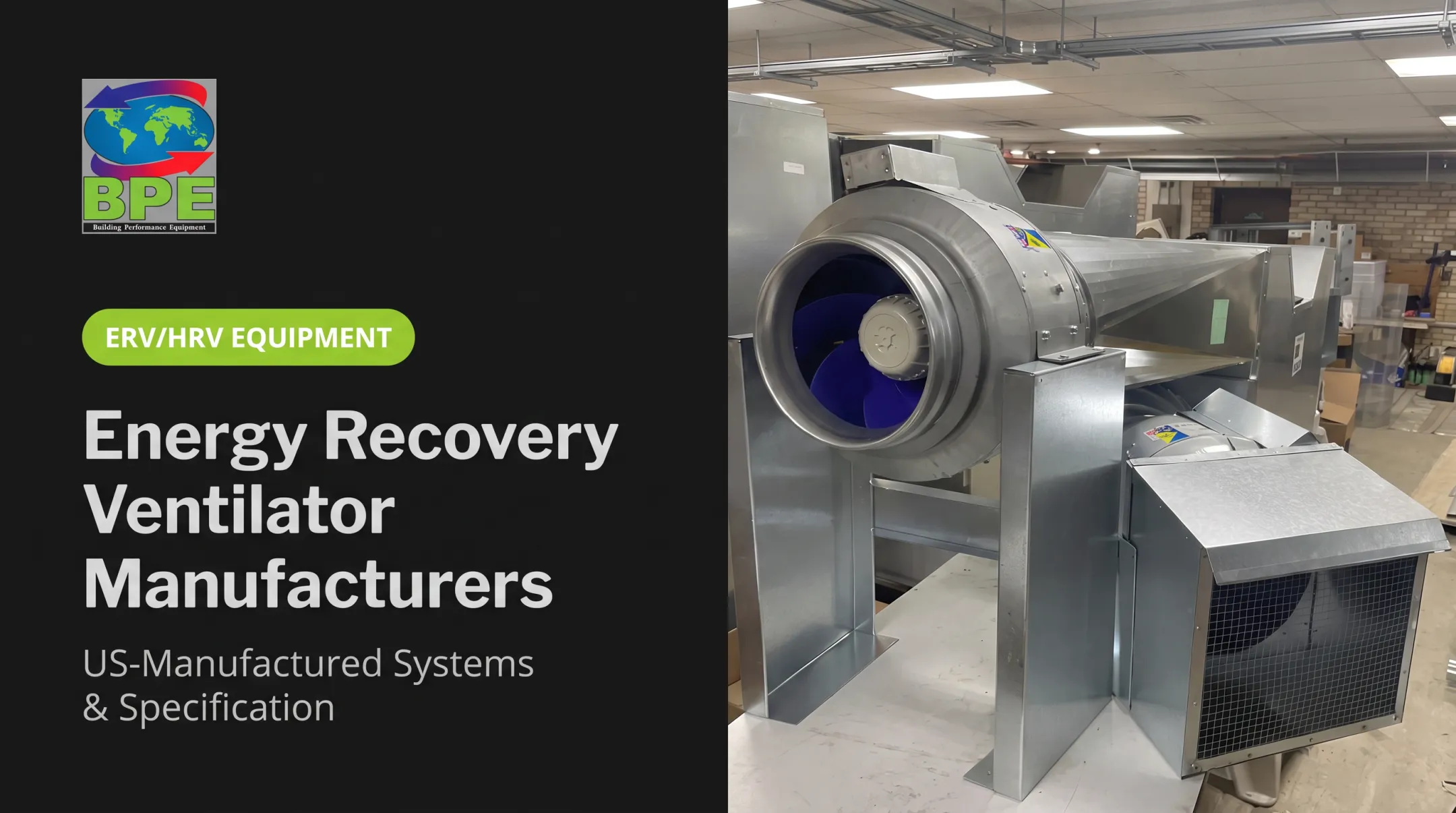
Building Performance Equipment (BPE), based in Hillsdale, New Jersey, has engineered energy-recovery ventilation systems since 1997. The lineup runs from residential and light-commercial units at roughly 60–2,250 CFM up to commercial and industrial unitary systems at 20,000 CFM.
Units are built around true direct counter-flow heat exchangers.
What sets the line apart:
- Guide-spec floor: Over 80% sensible and over 30% latent effectiveness under ARI 1060, with outdoor air preconditioned to within 10°F of room temperature in a single pass
- Regenerative Condensate Return Technology: Reported 34% latent efficiency in hot, humid summer conditions without a separate condensate drain
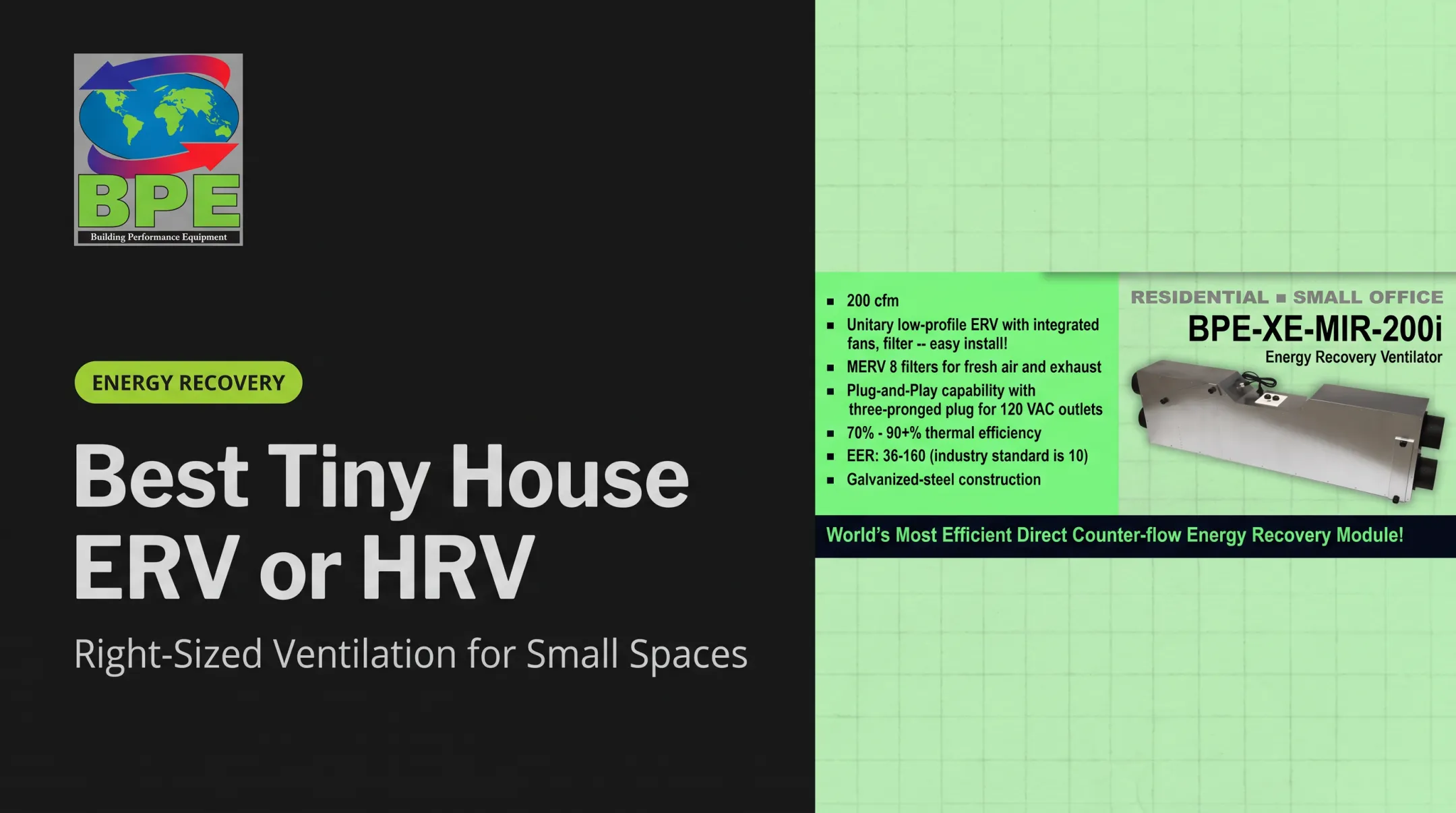
- Plug-and-play residential units: BPE-XE-MIR-200i runs on a standard 120V outlet with MERV 8 filtration on both airstreams
- Modular, stackable unitary systems: Two installers can assemble on-site without a crane—useful for school and multifamily retrofits
| Model | Airflow Range | Recovery Performance | Filtration | Climate Strategy |
|---|---|---|---|---|
| BPE-XE-MIR-200i | Up to 200 CFM | Summer EER 31.53 / Winter EER 75.67 (ARI 1060) | MERV 8 (fresh + exhaust) | Standard; contact BPE below -10°F or 40% RH |
| BPE-SC-UNI-1000 | 400–1,100 SCFM | 92% sensible at 400 SCFM, 66% at 1,100 SCFM | Not publicly documented | Contact BPE below -10°F or 40% RH |
| BPE-XE-MIR-2000 | 500–2,250 CFM | Summer EER 35.4 / Winter EER 82.4 (ARI 1060) | Not publicly documented | Contact BPE below -10°F or 40% RH |
| BPE-SC-UNI-20000 | 14,000–20,000 CFM | Not publicly documented | Not publicly documented | Not publicly documented |

Zehnder Residential and High-Performance Ventilation Systems
Zehnder's ComfoAir Q series targets airtight, Passive House, and premium residential projects. The current US lineup lists Q350, Q450, and Q600 ERV configurations, each with Passive House Institute and HVI certification resources. A verified PHI certificate confirms the Q350 ERV configuration specifically; don't assume every Q-series variant carries the same rating.
Smaller homes or retrofit jobs have options too: the ComfoAir 200 ERV tops out at a manufacturer-stated 125 CFM maximum, and the ComfoAir 160 offers an ERV core option with an optional resistance preheater for cold climates.
| Model | Airflow (Max) | Notable Features | Controls |
|---|---|---|---|
| ComfoAir Q350/Q450/Q600 ERV | Not publicly documented per variant | PHI and HVI certification resources | LAN-C smartphone app |
| ComfoAir 200 ERV | 125 CFM | Compact residential format | Not publicly documented |
| ComfoAir 160 ERV | Not publicly documented | Optional resistance preheater | Not publicly documented |
Zehnder's premium positioning fits projects where Passive House certification or documented PHI performance is a design requirement, not just a nice-to-have.
Panasonic Intelli-Balance ERV Systems
Panasonic's Intelli-Balance line splits by climate:
- 100 Any Climate (FV-10VEC2H hardwire, FV-10VEC2RH mirror): 30–100 CFM, MERV 8 standard / MERV 13 optional, occupant boost, recirculation defrost for colder climates
- 100 Temperate (FV-10VE2): Same 30–100 CFM range; Panasonic recommends it where outdoor temps rarely drop below 14°F
- 200 Any Climate (FV-20VEC1): 60–200 CFM, MERV 13 supplied, HEPA upgrade available
| Model | Airflow Range | Filtration | Defrost Strategy |
|---|---|---|---|
| Intelli-Balance 100 Any Climate | 30–100 CFM | MERV 8 standard, MERV 13 optional | Recirculation defrost cycle |
| Intelli-Balance 100 Temperate | 30–100 CFM | MERV 8 standard, MERV 13 optional | Rated for milder climates (above ~14°F) |
| Intelli-Balance 200 Any Climate | 60–200 CFM | MERV 13 supplied, HEPA optional | Any-climate rated |
Comparable SRE/TRE and sone data aren't on the general product pages—pull the model-specific submittal before you finalize a spec.
RenewAire Commercial and Residential ERV Systems
RenewAire splits into the EV family for residential and light-commercial work and the CA family for larger commercial projects. EV90, EV130, and EV200 cover roughly 40–200 CFM with any-orientation mounting.
On the commercial side, CA2X through CA4X units span about 500–4,400 CFM. IN and RT suffixes mark indoor versus rooftop configurations.
One documented snapshot: the EV Premium M submittal shows 203 CFM at 0.60 in. w.g., 192W, 62% sensible efficiency, and 35% summer total efficiency—about 0.95 W/CFM at that test row only, not a family-wide rating.
| Series | Airflow Range | Configuration | Best Fit |
|---|---|---|---|
| EV90/EV130/EV200 | 40–200 CFM | Any-orientation residential/light-commercial | Homes, small multifamily |
| CA2X Series | 500–2,200 CFM | Indoor or rooftop | Mid-size commercial |
| CA3X/CA4X Series | 750–4,400 CFM | Modular, stackable cores | Larger commercial/institutional |
Lifebreath ERV Systems
Lifebreath's residential and multifamily ERVs lean toward compactness and cold-climate durability. Headline figures sit in the table below; note the SRE percentages come from different test points, so don't compare them without matching conditions.
The 130 ERVD also carries HVI cold-weather certification down to -25°C (-13°F).
| Model | Airflow (at 0.3 in. w.g.) | SRE Test Point | Warranty |
|---|---|---|---|
| 130 ERVD | 153 CFM | 75% at 89 CFM / 32°F | 5 yr core, 5 yr components |
| METRO 120 ERV-ECM | 117 CFM | 72% at 49 CFM / 32°F | 5 yr core, 5 yr components |
| RNC 110 | 108 CFM | Not publicly documented | 5 yr core, 5 yr components |
Lifebreath's HVI cold-weather certification makes it a reasonable candidate for northern climates, though MERV filtration ratings aren't published for these specific models, so confirm filter compatibility before specifying.
How We Chose the Best ERVs
Headline efficiency numbers are a starting point, not the whole story. HVI defines two separate metrics that matter here:
- SRE (Sensible Recovery Efficiency): net sensible heat recovered, adjusted for power use, case transfer, leakage, and airflow imbalance
- TRE (Total Recovery Efficiency): sensible plus latent energy, with the same adjustments
Comparing an SRE number from one manufacturer against a TRE number from another tells you nothing useful.
HVI's Section III directory reports net supply CFM at 0.4 in. w.g., maximum rated SRE, airflow at that SRE, and watts at that SRE, all at matched test conditions. That's the comparison to trust.
Sizing Comes Before Model Selection
Pick the unit after you calculate the airflow requirement, not before:
- Calculate required outdoor airflow from occupancy, floor area, building use, and the applicable ASHRAE 62.1 (commercial) or 62.2 (residential) requirement
- Add any pollutant or moisture load specific to the space
- Verify the candidate unit can hit that design airflow at your project's actual external static pressure, not its nameplate maximum

Once the airflow target is set, confirm the certified rating. AHRI 1060/1061 rates the air-to-air exchanger itself, not every installed-system attribute, so check the specific certified configuration rather than the brand name alone.
Climate, Installation, and Service Life
Real-world performance hinges on details that rarely make it onto a spec sheet headline:
- Frost or defrost strategy in cold climates
- Filtration pressure drop over time, particularly during wildfire-smoke events
- Duct design, airtight connections, and intake/exhaust separation (Building Performance Equipment recommends 10–15 ft between intake and exhaust with a 90° elbow)
- Condensate management where applicable
- Filter and core cleaning access, and local parts availability
Before recommending an ERV for industrial fumes, solvents, corrosive air, or grease-laden exhaust, check applicable building codes, ASHRAE guidance, and manufacturer restrictions. Some streams need isolation or specialized recovery equipment instead of a standard ERV core.
Conclusion
The right ERV is the one whose verified airflow, recovery performance, humidity strategy, filtration, sound output, controls, and installation requirements match your building. Peak numbers on a spec sheet do not guarantee that fit.
When comparing options, look past equipment price alone:
- Total installed cost, not just unit cost
- Commissioning quality and documented airflow balancing
- Maintenance access and filter-replacement cost over time
- Replacement-part availability and long-term technical support
If you're an engineer, contractor, facility owner, or building operator specifying high-efficiency energy recovery for a project, Building Performance Equipment's technical team can help. They will walk through sizing, climate strategy, and installation requirements before you commit.
Frequently Asked Questions
How much does an ERV system cost?
Total cost depends on equipment capacity, ductwork, controls, electrical work, installation complexity, and commissioning. Request separate quotes for equipment-only and fully installed systems—ductwork and labor vary widely by region and building type.
How big of an ERV do I need for my house?
Sizing depends on required outdoor airflow, occupancy, floor area, building tightness, duct resistance, and your local code or ASHRAE 62.2 requirement. Have a professional calculate load and airflow instead of choosing a unit by square footage alone.
Is an ERV better than an HRV?
An HRV recovers sensible heat only; an ERV recovers both sensible heat and moisture. Humid climates and buildings with indoor humidity concerns typically favor ERVs, while dry, cold climates sometimes do fine with an HRV.
Are ERV systems worth it?
Yes, when sized and commissioned correctly. You get better ventilation, improved humidity management, and potential HVAC energy savings—results still hinge on installation quality and ongoing maintenance.
Which ERV is the best on the market?
No single model wins every project. Compare certified recovery data, airflow at your design static pressure, filtration, noise, climate performance, and service support to your building’s requirements.