
Your actual cost depends on the ERV's capacity, your ductwork situation, electrical requirements, controls, local labor rates, climate zone, and commissioning needs. A straightforward swap in an existing duct system costs far less than a whole-building retrofit with new duct runs and structural work.
An ERV works by exchanging stale indoor air for fresh outdoor air while recovering the heat (and in humid climates, the moisture) that would otherwise go to waste. This reduces the ventilation load on your HVAC system while improving indoor air quality. Given that indoor air can run five times more polluted than outdoor air, that's not a small benefit.
This article breaks down equipment and installed-cost ranges, the factors that move pricing up or down, ongoing operating costs, and how to evaluate quotes that look suspiciously cheap.
Key Takeaways
- Residential ERV install: $1,500-$3,500; 130-160 CFM equipment only: $1,212-$1,453 MSRP
- Ductwork, electrical, controls, and commissioning often push totals well above equipment price
- Expect lower cost for simple replacements than for retrofits, cold-climate installs, or industrial jobs
- Lowest quotes often skip balancing, commissioning, or corrosion protection—compare lifecycle cost, not sticker price
How Much Does an Energy Recovery Ventilator Cost?
"ERV cost" means different things depending on who's quoting you. A manufacturer's price sheet gives you equipment only. A contractor's bid should give you the complete installed project. Before comparing numbers, make sure you're comparing the same scope.
Equipment-Only Pricing
Broan-NuTone's 2026 US price list shows:
- 130 CFM unit: $1,212 MSRP
- 150 CFM unit: $1,393 MSRP
- 160 CFM unit: $1,453 MSRP
These are list prices for the equipment alone—no ductwork, electrical, or labor included.
Residential Installed Pricing
American Standard puts a complete residential installation at $1,500-$3,500, factoring in home size, unit capacity, and local labor rates. This figure doesn't itemize exactly what ductwork scope is assumed, so ask your contractor to break down what's covered.
Commercial and Institutional Pricing
Commercial projects scale very differently. One school district's capital improvement plan budgeted $52,600 in construction value just to install a single dedicated laundry-room energy-recovery unit. That's a project-specific estimate, not a national benchmark, but it illustrates how far commercial pricing diverges from residential numbers.
Building Performance Equipment's own product range shows the scale differences clearly:
| Application | Typical CFM Range | Example Models |
|---|---|---|
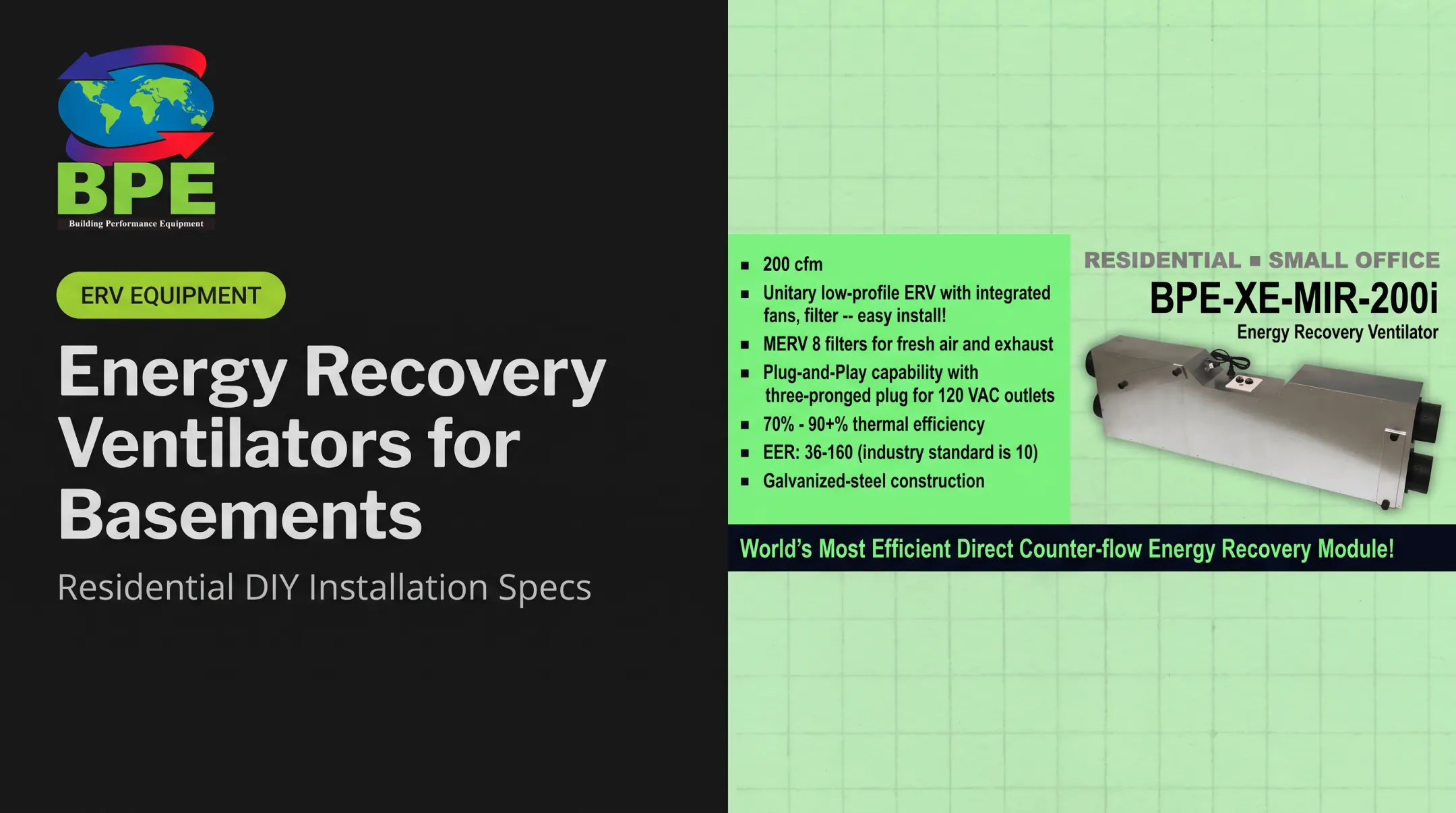
| Small residential/office | 60-200 CFM | BPE-XE-MIR-200i |
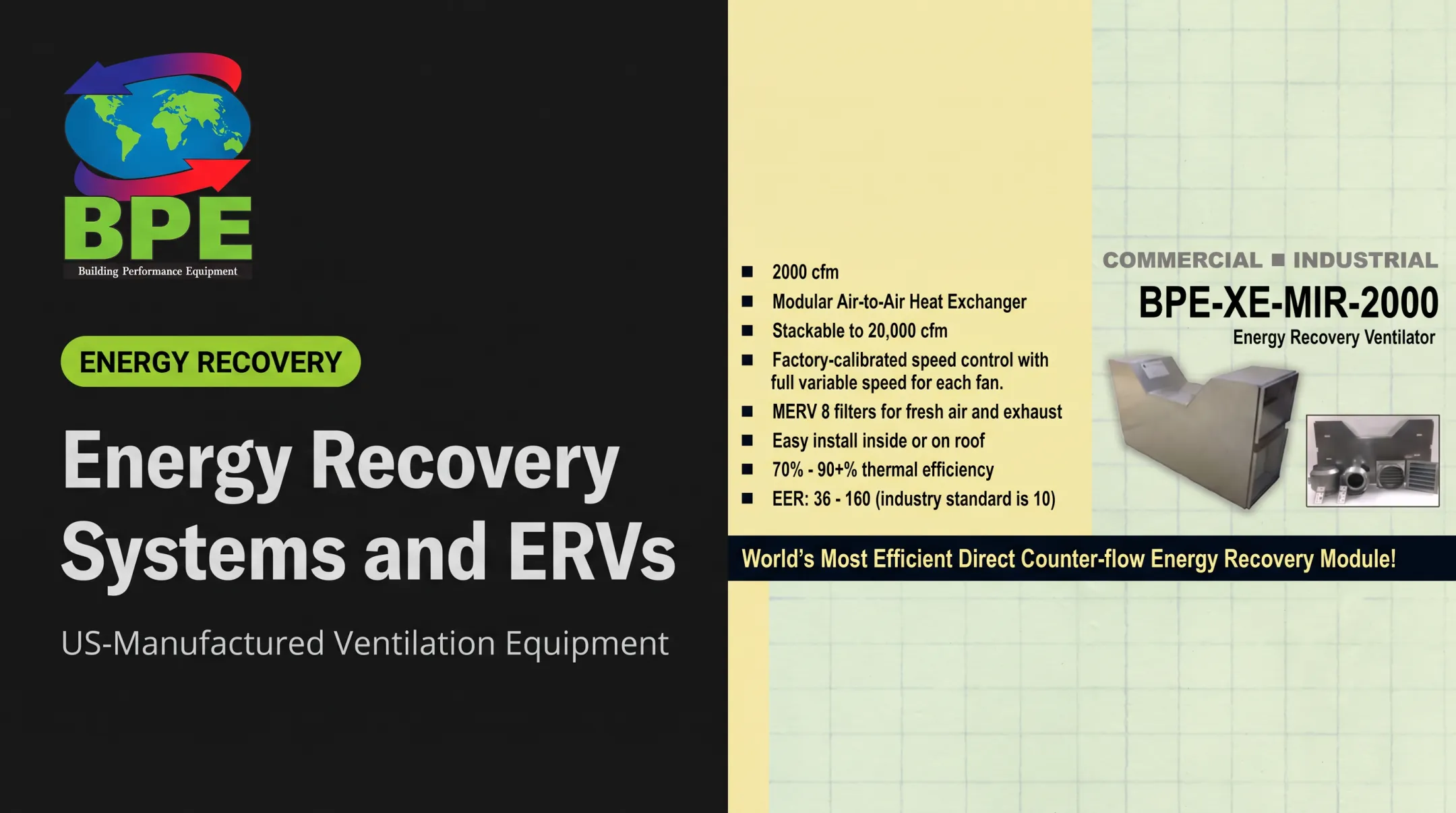
| Larger residential/office | 400-2,250 CFM | BPE-XE-MIR-500, BPE-XE-MIR-2000 |
| Commercial/industrial | 2,000-20,000 CFM | BPE-SC-UNI-20000 |

Don't apply a residential price range to a school, hospital, server farm, or manufacturing facility. Those jobs differ on several cost drivers:
- Airflow requirements and unit capacity
- Code path (ASHRAE 62.1 vs. 62.2)
- Exhaust-air separation
- Custom ductwork design
Product note: Building Performance Equipment manufactures high-efficiency air-to-air energy recovery equipment, from residential plug-and-play units to 20,000-CFM modular commercial systems. Match the configuration to the application, not only the equipment price. Their engineering team works with HVAC contractors and facility managers on correct system sizing.
Cost Factors and Total Cost Breakdown
Your purchase price is one line item in a larger budget. A reliable estimate separates one-time installation costs from recurring operating costs and periodic replacement costs.
Type, Capacity, and Configuration
Required airflow drives most of the equipment cost, but it's not the only variable. Consider:
- Higher sensible and latent recovery efficiency costs more upfront but saves more energy
- Single large unit vs. multiple smaller units for the zones you serve
- Fan efficiency (BPE guide specs call for ECM fans at 0.2 W/CFM when properly sized)
- Filtration grade (MERV 6 exhaust filters ~$12.50; MERV 8 supply filters ~$14.95)
- Sound limits and redundancy for critical applications
CFM alone doesn't set the price. Broan's 160-CFM unit costs more than its 150-CFM model because of construction differences, so capacity is only one input among several.
Building Layout, Ductwork, and Site Access
New construction with planned duct routes costs far less than retrofitting an existing building. A Seattle Housing Authority bid for replacing a corridor ventilator with an ERV required permits, shop drawings, and documented testing and balancing—typical of retrofit scope that a simple equipment quote won't capture.
Retrofit cost drivers include:
- Long duct runs through finished spaces
- Ceiling or wall openings and patching
- Structural work for unit support
- Insulation and fire-stopping at penetrations
- Difficult attic or crawlspace access
- Multiple supply/exhaust terminals
BPE duct guidance keeps air velocities below 500 fpm (except at fan and heat-exchanger connections) and targets 100% effective duct length through transitions and flex duct. Both choices change how much ductwork a retrofit needs.
Installation, Electrical, Controls, and Commissioning
A quote that skips these line items often looks cheap for a reason:
- HVAC labor for mounting, duct connections, and sealing joints
- Electrical work: most residential units use standard 115V single-phase; commercial systems need dedicated circuits
- Controls integration, including CO2 demand-control ventilation where ASHRAE 62.1 requires it
- Permits required by local jurisdictions
- Startup and commissioning to verify actual airflow matches design
- Air balancing between supply and exhaust
One documented office-area ERV estimate itemized this clearly: $232,847 in base equipment and installation, plus $23,285 in soft costs and $23,285 for management and commissioning, for a total of $279,416. That is roughly 20% on top of the base number for items a bare equipment quote leaves out.

Operating and Maintenance Costs
Fan energy is the main ongoing cost. A commercial ERV rated at 880W running at 610 CFM, operated continuously, works out to roughly $1,034/year at the 2025 average commercial electricity rate of 13.41 cents/kWh (per EIA data). Running it only 8 hours a day during occupied periods drops that to around $345/year.
Residential-scale units use far less. BPE's XE-MIR-200i draws just 60W per fan at 226 CFM, a fraction of commercial draw.
Other recurring costs:
- Filter replacement every 3–4 months (American Standard) or quarterly checks (RenewAire)
- Core cleaning: BPE counter-flow cores have no moving parts and have shown no degradation after 15 years in early installations
- Sensor calibration and periodic service visits
Replacement, Warranty, and Lifecycle Considerations
Warranty terms vary meaningfully between manufacturers:
- RenewAire: 10-year core warranty, 2-year balance-of-unit warranty
- BPE: 20-year limited lifetime warranty on select systems; commercial specs call for 18 months parts coverage plus a minimum 10-year heat-exchanger warranty against corrosion
Engineering specs sometimes require life-cycle cost comparisons over a full 20 years. If a competing ERV has a projected 4-year service life, the bid must include five total core purchases and installations to compete fairly against a longer-lived unit. A cheaper unit that needs replacing four times is not actually cheaper.
Application-Specific Requirements
Schools, multifamily buildings, cold-climate facilities, and industrial sites all carry additional requirements:
- Schools and offices follow ASHRAE 62.1; dwelling units follow 62.2, with different minimum ventilation rates
- Cold-climate jobs need frost protection; some units require manufacturer guidance below -10°F or 40% RH
- Industrial exhaust (tanneries, fragrance, chemical processing) needs corrosion-resistant cores and verified exhaust-air transfer ratios
- ASHRAE 90.1 energy-recovery triggers vary by climate zone, outdoor-air fraction, and hours; not every project must add recovery
Low-Cost vs High-Cost ERVs—What's the Difference?
A $1,200 unit and a $3,000 unit often solve different jobs. A small bedroom addition and an industrial fume-exhaust application share little beyond the acronym "ERV."
Performance and Capacity
Before comparing price tags, verify:
- Airflow at external static pressure (nameplate CFM means little without the tested pressure condition)
- Recovery efficiency under stated test conditions (ARI 1060 is the standard reference)
- Fan energy (watts per CFM, not just wattage)
- Filtration grade and sound levels
HVI's certified products directory standardizes these comparisons at 0.4 in. w.g. external static pressure, the condition to compare models against, not maximum rated airflow.
Installation Quality and Durability
Lower bids sometimes cut corners that don't show up until later:
- Skipped duct sealing or insulation
- No documented air balancing
- No commissioning report
- Missing corrosion protection for the application
- Poor service access (panels that require removing ductwork to reach a filter)
Premium installations typically document startup procedures, provide commissioning reports, and use construction details (stainless or galvanized cabinets, sealed access panels) built for the application's actual conditions.
Those quality gaps are why price alone misleads. Run a short estimating sequence before you request quotes so every bid covers the same scope.
Budget-Estimating Process
Follow this sequence:
- Define the building and occupancy — bedrooms, floor area, or employee count
- Calculate required outdoor airflow using ASHRAE 62.1 (commercial) or 62.2 (residential)
- Assess climate and humidity needs — cold climates need frost protection; humid climates benefit more from latent recovery
- Inspect existing ductwork and HVAC — does it have capacity for the added airflow?
- Identify code and controls requirements — CO2 sensors, fire-stopping, local permit rules
- Obtain itemized quotes covering all the categories above

Quote-Comparison Checklist
Get at least two or three proposals using identical scope. Ask each contractor to separately identify:
- Equipment model and certified performance rating
- Ductwork scope (new runs vs. tie-in to existing)
- Electrical work
- Controls and sensors
- Permits
- Testing and balancing
- Commissioning
- Warranty terms
- Filter access and ongoing maintenance path
- What's explicitly excluded
If a contractor can't break this down, that's a red flag, not a bargain.
Equipment form factor also moves install cost. Building Performance Equipment's modular systems stack on site; some BPE-SC-UNI-UNI units are man-portable and fit through a standard 36-inch door. On retrofits, that can reduce or eliminate:
- Crane picks
- Major structural openings
- Extended downtime for rooftop staging
For jobs that need low pressure drop or tighter integration with broader building-performance goals, modularity often shows up on the labor line more than the equipment line.
What Most People Miss When It Comes to ERV Installation Cost
Three mistakes show up repeatedly in ERV budgeting:
Pricing the box, not the project. Duct distribution, electrical work, controls, access modifications, permits, balancing, and commissioning routinely add more to a project than the equipment itself. The $279,416 office estimate referenced earlier had roughly 20% in soft costs and commissioning alone, on top of the base installed cost.
Assuming automatic utility savings. An ERV reduces ventilation load, but it doesn't guarantee a lower bill. Fan power typically represents about 15% of total energy consumption in a DX system.
If the fan runs continuously at high speed regardless of occupancy, or the existing HVAC system is already inefficient, expected savings shrink. A unit with occupancy-based controls and right-sized airflow holds those savings. One left at full speed around the clock does not.
Sizing by square footage instead of calculation. ASHRAE 62.1 and 62.2 size ventilation by occupancy, bedroom count, and airtightness, not raw floor area. Two homes with identical square footage can need very different airflow depending on how many people live there and how tight the building envelope is.
Skipping this calculation, and the external static pressure check that goes with it, is how buyers end up with an undersized or oversized unit.

Conclusion
The cost to install an ERV swings widely. Major drivers include:
- Unit capacity and building type
- Retrofit difficulty, ductwork, and controls
- Climate conditions and commissioning scope
Treat the ranges in this article as planning estimates, not firm quotes for your project.
A sound ERV project balances indoor air quality, comfort, energy use, reliability, code compliance, and lifecycle cost. Before you lock a budget, get an itemized bid from a qualified HVAC contractor or energy-recovery specialist that separates equipment, labor, ductwork, controls, and commissioning.
Frequently Asked Questions
How much does it cost to install an energy recovery ventilator?
Residential installations typically run $1,500-$3,500 installed, per American Standard's 2025 guidance. Commercial projects vary far more widely based on building type, ductwork, and code requirements. Get an itemized quote rather than relying on a general range.
How much does an ERV unit cost?
Equipment alone for residential-scale units (130-160 CFM) runs $1,212-$1,453 MSRP. This excludes ductwork, electrical connections, controls, labor, permits, and commissioning—all of which add to the installed total.
Are energy recovery ventilators worth the cost?
ERVs improve indoor air quality and cut ventilation-related heating and cooling loads. Value is strongest in tight homes, humid or cold climates, and occupied buildings, but savings still depend on fan efficiency, schedule, and proper sizing.
Is an ERV better than an HRV?
An ERV transfers both heat and moisture between incoming and outgoing air streams, while an HRV transfers heat only. ERVs generally suit humid climates or buildings needing humidity control; HRVs often work well in colder, drier climates. Your climate and building use determine the better fit.
What size energy recovery ventilator do I need for my house?
Size to ASHRAE 62.2 outdoor airflow, bedrooms, occupancy, floor area, airtightness, and duct static pressure, not square footage alone. Building Performance Equipment's smallest residential unit serves families up to six or small offices up to 10; complex projects need a design professional.
How much electricity does an energy recovery ventilator use?
Consumption depends on fan efficiency, airflow, static pressure, and runtime. A commercial unit rated at 880W running continuously costs roughly $1,034/year at 2025's average commercial electricity rate of 13.41 cents/kWh; residential units drawing 60-80W use substantially less.