
Introduction
Modern homes and commercial buildings are built tighter than ever. The 2024 model energy code calls for air-leakage limits as low as 3.0 ACH50 in many climate zones. Natural infiltration can no longer supply fresh air on its own.
That's a problem. Bringing in outdoor air is essential for indoor air quality, but conditioning that air costs energy.
In high-occupancy buildings like schools, ventilation alone can account for up to 70% of the heating and cooling load, based on Building Performance Equipment (BPE) internal field data.
Heat recovery ventilators (HRVs) and energy recovery ventilators (ERVs) both solve this by exchanging stale indoor air for fresh outdoor air while recovering energy from the exhaust stream. The difference comes down to moisture.
This article compares how each system works, where each fits best, installation and maintenance considerations, and how to select the right equipment for your project.
Key Takeaways
- HRVs recover sensible heat only; ERVs also transfer a portion of moisture between airstreams
- Cold, dry climates often favor HRVs; humid or moisture-variable buildings often favor ERVs
- Neither system replaces filtration, source control, or dedicated humidity equipment
- Sizing, balancing, and commissioning matter as much as the recovery core itself
- Select equipment by climate, occupancy, airflow needs, retrofit limits, and lifecycle cost
HRVs vs. ERVs: Quick Comparison
| Factor | HRV | ERV |
|---|---|---|
| Transfer mechanism | Sensible heat only | Sensible heat + moisture (latent) |
| Best climate fit | Cold, relatively dry | Hot-humid, mixed, or moisture-variable |
| Moisture handling | Exhausts indoor humidity | Moderates humidity swings |
| Typical core types | Fixed-plate, cross-flow | Enthalpy wheel, fixed-plate, counter-flow |
This distinction follows how ASHRAE defines air-to-air energy recovery equipment. Sensible, latent, and total effectiveness are separate performance metrics and should not be substituted for one another.
Heat and Moisture Recovery
An HRV keeps supply and exhaust air streams physically separate, transferring only temperature. An ERV uses a core or wheel that also lets a portion of water vapor cross between streams.
Building Performance Equipment's ERV line, for example, uses Regenerative Condensate Return technology to achieve up to 34% latent effectiveness even in hot, humid summer conditions.
Air Quality and Comfort
Both systems deliver controlled, filtered outdoor air instead of relying on random leakage. An HRV actively exhausts excess indoor moisture, which helps in humid-generating spaces during cold weather. An ERV moderates humidity swings but isn't a substitute for a dedicated dehumidifier or humidifier when a building has serious moisture problems.
Climate and Building Fit
- Cold, dry climates: HRVs help move excess winter humidity out of the building
- Hot-humid or mixed climates: ERVs reduce the latent load the HVAC system would otherwise handle
- Variable-occupancy buildings: ERVs help buffer humidity spikes from locker rooms, gyms, or kitchens
Energy and HVAC Impact
Both systems precondition outdoor air before it reaches the HVAC system, cutting the load tied to ventilation. DOE's 2018 residential HRV model shows just how climate-dependent that benefit is:
| IECC Climate Zone | Modeled Annual Savings |
|---|---|
| 4 | $5.97 |
| 5 | $38.43 |
| 6 | $70.84 |
| 7 | $138.15 |
| 8 | $233.23 |
These figures come from a DOE/PNNL residential HRV technical brief and reflect modeled cost savings, not a universal percentage you can apply to any building or to ERVs.

Installation and Maintenance
Both system types require:
- Balanced ductwork and airflow verification
- Controls integration (CO2 sensors, BACnet, scheduling)
- Filter access and regular replacement
- Condensate management for ERVs operating in humid conditions
- Professional commissioning to confirm rated airflow is actually delivered
What Are HRVs and ERVs?
What Is a Heat Recovery Ventilator (HRV)?
An HRV is a balanced mechanical ventilation system. It exhausts stale indoor air and supplies fresh outdoor air while transferring sensible heat between the two separate streams, without mixing them directly.
In winter, outgoing warm air preheats incoming cold air before it enters the building. In summer, the process reverses, with outgoing cooled air tempering incoming hot air. The result:
- More consistent ventilation than relying on envelope leakage
- Lower heating and cooling load tied to bringing in outdoor air
- Better occupant comfort near windows and exterior walls
HRVs show up often in tightly built homes, schools, multifamily buildings, and offices where code-required outdoor air has to be met without driving up conditioning costs.
An HRV doesn't heat or cool a space on its own, and it won't remove every pollutant. It's typically paired with filtration or source control where contaminants are a concern.
What Is an Energy Recovery Ventilator (ERV)?
An ERV is also a balanced ventilation system, but its core or wheel transfers both sensible heat and a portion of moisture between the exhaust and supply streams. That moisture transfer can ease comfort and HVAC demand during humid summers or very dry winters. Performance still varies by climate, indoor moisture generation, and the specific core technology installed.
ERVs are common in:
- High-occupancy commercial spaces and schools
- Multifamily housing with many small ventilation zones
- Offices and high-performance buildings chasing tight envelope targets
- Facilities with substantial outdoor-air requirements
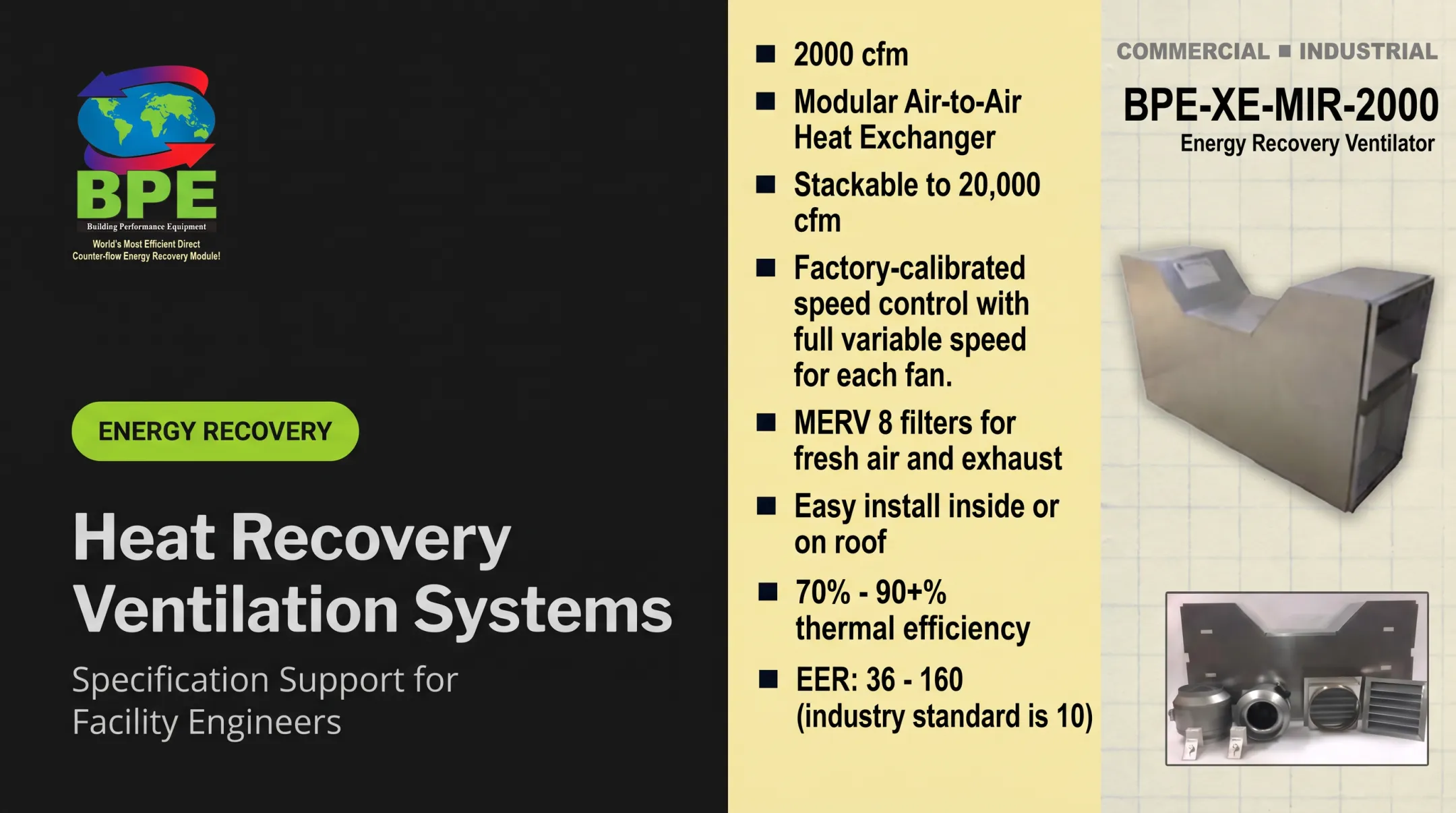
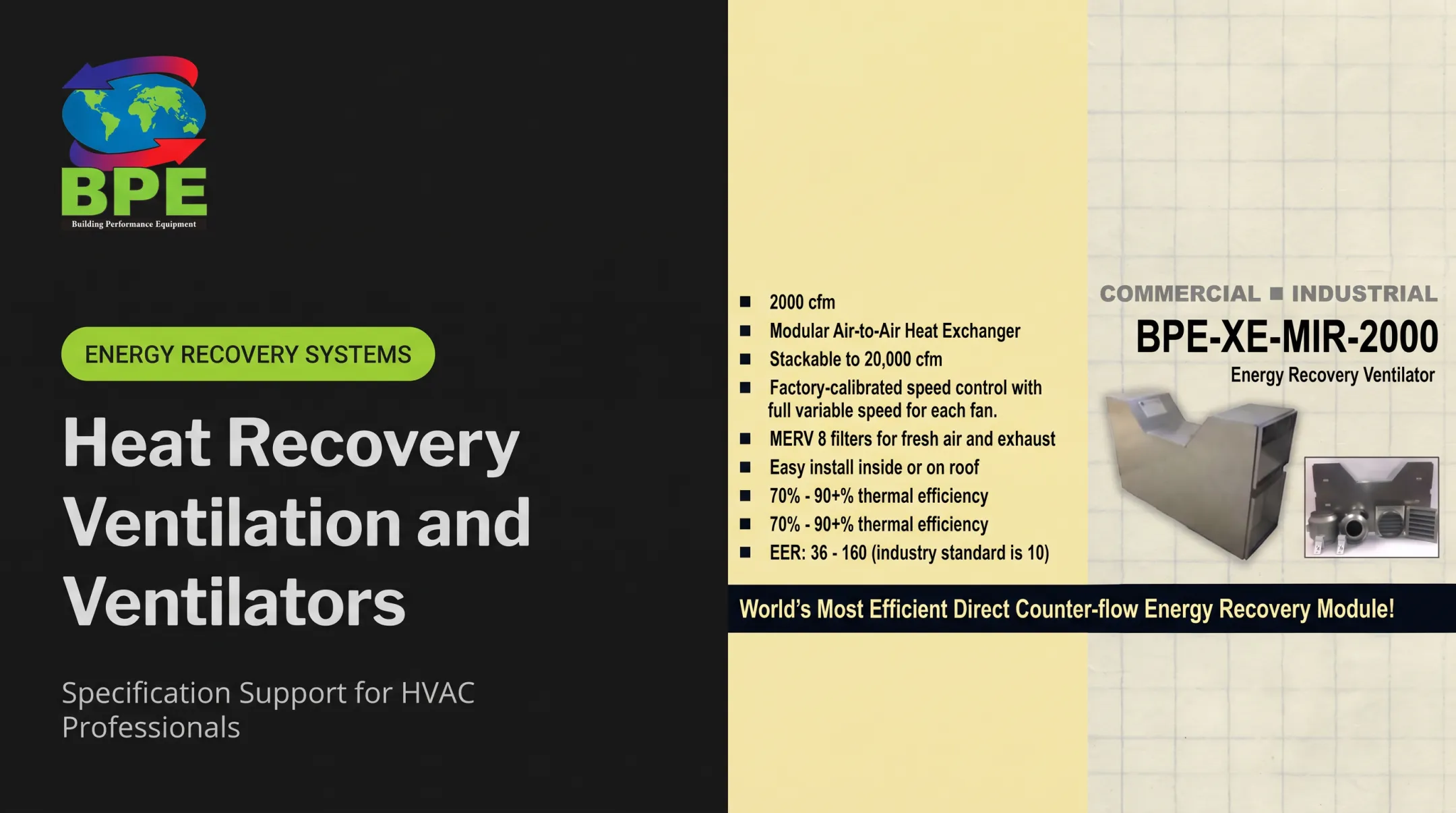
You'll encounter several core designs in the field. Building Performance Equipment's (BPE) lineup alone includes fixed-plate polymer cores (like the BPE-XE-MIR-3000, rated 500–3,500 CFM) and stackable unitary systems scaling from 500 to 20,000 CFM.
When comparing products, look past the headline efficiency number. Real-world performance also depends on:
- Airflow range and pressure drop
- Leakage rate and frost protection
- Controls, sound levels, and service access
Use Cases of HRVs and ERVs
HRV-leaning applications:
- Cold-climate homes and airtight new construction
- Buildings where exhausting indoor moisture is a priority
- Spaces with low to moderate occupancy density
ERV-leaning applications:
- Humid or mixed-climate buildings
- Multifamily properties with variable occupancy
- Commercial facilities where both thermal and moisture loads affect HVAC sizing
Some applications need extra caution. Industrial manufacturing, tanneries, perfume production, and server facilities often generate contaminated or hazardous exhaust.
ASHRAE's interpretation of Standard 62.1 disallows Class 4 exhaust air from returning through wheel carryover or seal leakage. The 2024 IECC also excludes exhaust streams carrying toxic, flammable, paint, or corrosive fumes from standard energy recovery. These situations call for dedicated exhaust, treatment, or engineering review before specifying recovery equipment.
For retrofits with constrained mechanical rooms or rooftop access, modular equipment helps. BPE's lightweight ERV modules, for example, are man-portable and fit through a standard 36-inch door, which avoids crane picks and structural modifications on many school and commercial jobs.

HRV vs. ERV: What Is Better?
Neither system is universally better. The right choice depends on climate, indoor humidity goals, ventilation requirements, building use, and the existing HVAC system's characteristics.
Climate and Moisture Decision
- Choose sensible-only recovery (HRV) when winter humidity removal matters more than retaining moisture
- Choose moisture transfer (ERV) when humid-season latent load or dry-winter comfort is the bigger concern
- Local design conditions and how the building actually operates matter more than rigid climate rules
Building and Occupancy Decision
Building type shapes occupancy patterns, contaminant loads, and outdoor-air rates—and those drive the HRV vs. ERV call.
- Schools, offices, multifamily, and healthcare spaces need equipment matched to schedule-driven outdoor-air rates
- Gyms with heavy moisture loads behave very differently than offices with steady, moderate occupancy
- Industrial facilities often put contaminant isolation ahead of energy recovery as the primary design driver
Engineering and Equipment Decision
When comparing products, evaluate:
- Airflow capacity and recovery efficiency at both design and part-load conditions
- Fan energy and pressure drop, since high static pressure erodes the energy benefit
- Frost protection and defrost strategy for cold-climate installations
- Condensate handling and filtration for moisture management and supply-air quality
- Controls integration, including CO2 demand-control ventilation per ASHRAE 62.1
- Service access and leakage rate to protect long-term efficiency and maintainability
Cost and Lifecycle Decision
Equipment price is only one piece. A full comparison includes installation and ductwork, electrical and controls work, commissioning, ongoing filter costs, energy savings, and equipment life.
BPE's internal cost modeling on one commercial ERV retrofit showed a total installed estimate near $279,000 with a calculated 3.83-year simple payback based on measured heating and cooling savings.
BPE ERV and HRV equipment is rated for a 20-plus-year service life with reasonable maintenance, which changes the lifecycle math compared to shorter-lived cores.
For owners, engineers, and contractors evaluating equipment, Building Performance Equipment manufactures air-to-air energy recovery units—from compact residential modules to stackable commercial systems up to 20,000 CFM—with engineering support for project-specific performance requirements.
Real-World Examples
Hopewell Valley Regional School District retrofitted 13 classrooms with energy recovery equipment. Documented results include:
- Recaptured 80% to 95% of thermal energy previously exhausted outdoors
- Cut overall energy consumption by more than 32.1% over five years
- Improved thermal comfort and indoor air quality
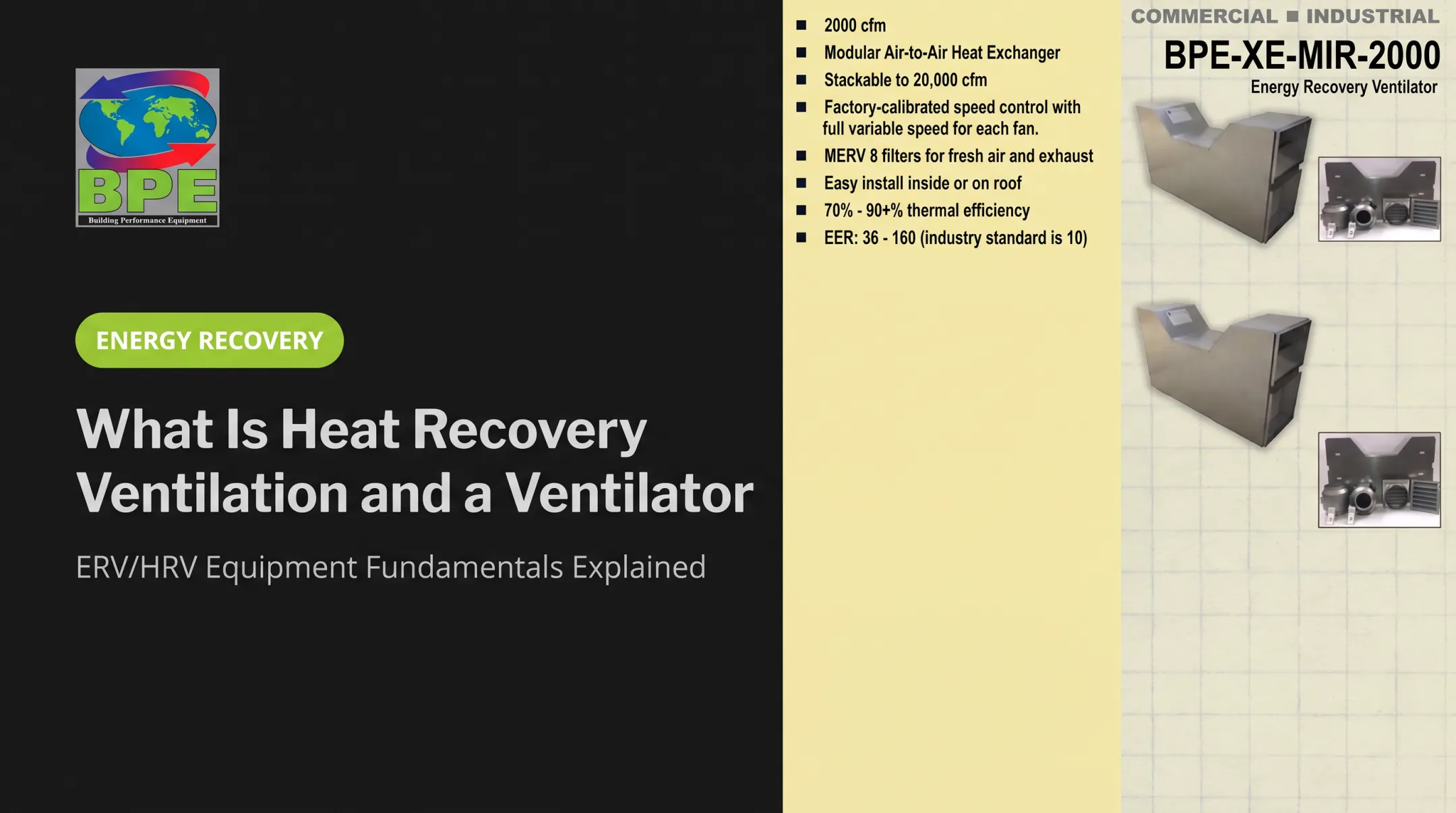
Plymouth Cultural Center faced a different challenge: an arena space with occupancy that fluctuated hour to hour, held at a steady 60°F dry-bulb temperature year-round. Four BPE-XE-MIR-2000 ERV units delivered:
- EER of 27 for cooling
- Nearly 73 seasonal EER for heating
Takeaway: Both projects show that recovery equipment performs best when matched to the actual building load pattern, whether that's steady classroom occupancy or a swinging arena schedule, rather than selected on nameplate efficiency alone.

If you're evaluating ventilation requirements, retrofit constraints, or energy-recovery design options for a school, commercial building, or industrial facility, Building Performance Equipment's team can review project-specific conditions. Reach out at info@bpequip.com or 201.722.1414.
Conclusion
HRVs focus on sensible heat recovery. ERVs recover heat and transfer moisture. Which one belongs in your building depends on a few project factors:
- Climate and humidity goals
- Occupancy and airflow requirements
- Integration with existing controls and ductwork
A properly sized and commissioned system, whichever type you choose, delivers fresher indoor air, steadier comfort, and lower ventilation-related HVAC demand. Skip the headline-efficiency shortcut. Get a project-specific evaluation before you commit to equipment.
Frequently Asked Questions
How much does a heat recovery ventilator cost, including installation?
Total cost depends on unit capacity, ductwork, controls, electrical work, access conditions, and retrofit complexity. Get a project-specific quotation rather than relying on general price ranges.
What does a heat recovery ventilator (HRV) do?
An HRV exhausts stale indoor air and brings in fresh outdoor air while transferring heat between the two separate airstreams. That heat transfer lowers the heating or cooling load created by ventilation.
What's the difference between an HRV and an ERV, and which should I use?
An HRV transfers heat only; an ERV transfers heat and some moisture. Climate, indoor humidity goals, building use, and ventilation rate determine which fits your project better.
Should I run my HRV all the time?
Most balanced ventilation systems run continuously or on a set schedule. Match the mode to occupancy, outdoor conditions, and your commissioning recommendations.
Where should an HRV be installed?
Common locations include mechanical rooms, basements, utility spaces, rooftops, or integration with an existing air handler. Access, duct routing, drainage, and service clearance all need evaluation first.
How often should an HRV filter be changed?
Inspect filters regularly and follow the manufacturer's maintenance schedule. Most systems need a check at least twice a year, with shorter intervals when outdoor air is dusty or the unit runs long hours.