
Here's the core problem: newer homes are built tight for energy efficiency, which means outdoor air can't sneak in through cracks and gaps like it used to. Older homes leak air constantly, but that leakage is random and uncontrolled. Neither situation guarantees your home gets the fresh air it needs.
This guide walks through exactly how house ventilation works—from the moment outdoor air enters to how it gets filtered, distributed, exhausted, and sometimes reused for heating or cooling. We'll also clear up a common point of confusion: ventilation is not the same thing as your air conditioner or your air filter.
Key Takeaways
- Mechanical ventilation uses fans, ducts, and controls to swap stale indoor air for fresh outdoor air
- Exhaust, supply, balanced, HRV, and ERV systems each manage airflow and moisture differently
- Air conditioning recirculates indoor air; it doesn't automatically supply outdoor air
- The right system depends on your home's airtightness, climate, size, and layout
- Energy recovery systems can reclaim 70–80% of the energy in outgoing air
What Is Air Ventilation in a House?
Residential ventilation is the deliberate process of replacing or diluting indoor air with outdoor air. Beyond comfort alone, the real job is managing moisture, carbon dioxide, odors, and contaminants that build up from everyday living.
Think about what happens inside a closed house every day: cooking releases grease and combustion byproducts, showers pump out moisture, cleaning products off-gas, and people simply breathing adds humidity and CO2. In a tightly sealed home, none of that has anywhere to go unless you make a path for it.

What Ventilation Is Not
This trips people up constantly, so let's be direct:
- HVAC circulation isn't ventilation. Your furnace or air handler blower moves air that's already inside the house around the house. It doesn't bring in anything new.
- Filtration isn't ventilation. A good filter cleans the air you already have. It doesn't replace stale air with outdoor air.
- Air conditioning isn't ventilation. AC changes temperature and pulls out some moisture, but EPA's indoor air guidance confirms that most home heating and cooling systems don't mechanically introduce fresh outdoor air at all.
Core Components of a Whole-House System
A complete ventilation setup typically includes:
- An outdoor air intake with weather protection
- An exhaust outlet for stale, humid air
- Fans or blowers that move the air
- Filters on incoming air
- Supply and exhaust ductwork or dedicated vents
- Dampers, sensors, and controls
- Optionally, a heat- or energy-recovery core
The Four Main Configurations
Ventilation systems fall into four categories, based on how air enters and leaves:
- Exhaust-only – removes stale air; replacement air seeps in through inlets or leaks
- Supply-only – pushes fresh air in; stale air exits through leaks or exhaust points
- Balanced – mechanically supplies and exhausts air at the same time
- Energy recovery (HRV/ERV) – a balanced system with a core that transfers heat, and in ERVs, some moisture, between the two airstreams
How Does Air Ventilation in a House Work?
In practice, ventilation follows a sequence: outdoor air comes in, gets filtered or conditioned, moves through the house, and swaps places with stale air pulled from problem rooms.

Initiation
A ventilation cycle starts one of a few ways:
- Running continuously at a set speed
- Switching on by timer during set hours
- Triggered by a humidity, occupancy, or CO2 sensor
Some systems run independently; others coordinate with the home's central HVAC blower, though the two serve different functions: one conditions air temperature, the other exchanges it.
For a cycle to start correctly, a few things need to be in place: dampers open, filters clean, grilles unobstructed, and ductwork properly sealed. Opening a window or flipping on a bathroom fan isn't the same thing. Those are intermittent, unpredictable fixes, not a whole-house system working on a schedule.
Outdoor-Air Intake and Filtration
Fresh air enters through a hood or louver positioned to keep out rain, debris, and pests. Building Performance Equipment's guide specifications, for example, call for intakes mounted at least 8 feet above ground with ¼-inch mesh screens on both intake and exhaust points.
From there, air passes through a filter before it reaches the fan. Filter choice matters more than people realize: denser filtration cleans better but increases pressure drop, which can strain fan capacity. EPA's Indoor AirPlus program sets MERV 8 as the minimum for its Certified tier and MERV 13 for Gold, which gives a useful benchmark even for homes not pursuing certification.
Outdoor conditions change the workload here. Cold air needs tempering before it reaches living spaces. Humid air needs moisture management. Smoky or polluted air may call for tighter filtration before distribution.
Core Operation and Air Movement
Once air clears the intake and filter, fans take over. Supply fans push fresh air into bedrooms and living areas. Exhaust fans pull stale air out of bathrooms, kitchens, laundry rooms, and other moisture-heavy spaces.
Air needs a path to travel between those two zones—through ducts, transfer grilles, or gaps under doors. If supply air can't reach exhaust rooms, parts of the house end up stagnant no matter how hard the fans work.
The three configurations behave differently under pressure:
| System | Pressure Effect | Risk if Poorly Designed |
|---|---|---|
| Exhaust-only | Negative pressure | Can draw moisture into wall cavities in humid summers |
| Supply-only | Positive pressure | Can push moisture into walls during cold winters |
| Balanced | Roughly neutral | Requires correct commissioning to stay balanced |
Pressure imbalance isn't just a comfort issue. Strong negative pressure can cause backdrafting (pulling combustion gases, including carbon monoxide, back into the house from a water heater or furnace flue). This is one reason exhaust-heavy systems need careful design around combustion appliances.
One more clarification worth repeating: ventilation exchanges air. It doesn't necessarily heat or cool it. Your HVAC system often still has to condition that incoming outdoor air once it's inside.
Regulation and Energy Recovery
Controls decide how much the system runs and when. Depending on the equipment, that might mean a simple schedule, a humidity-triggered boost, or an occupancy sensor adjusting airflow in real time.
Dampers and balancing work alongside those controls to make sure air actually reaches each room in the intended amount—not just wherever the path of least resistance leads.
This is where energy recovery comes in:
- An HRV (Heat Recovery Ventilator) transfers sensible heat from outgoing indoor air to incoming outdoor air, without mixing the two airstreams.
- An ERV (Energy Recovery Ventilator) does the same thing but also transfers some moisture, which helps moderate humidity swings depending on climate.
DOE's energy saver office reports that most energy recovery systems reclaim 70–80% of the energy in outgoing air—a meaningful reduction in conditioning load, not a guaranteed cut to your total energy bill.
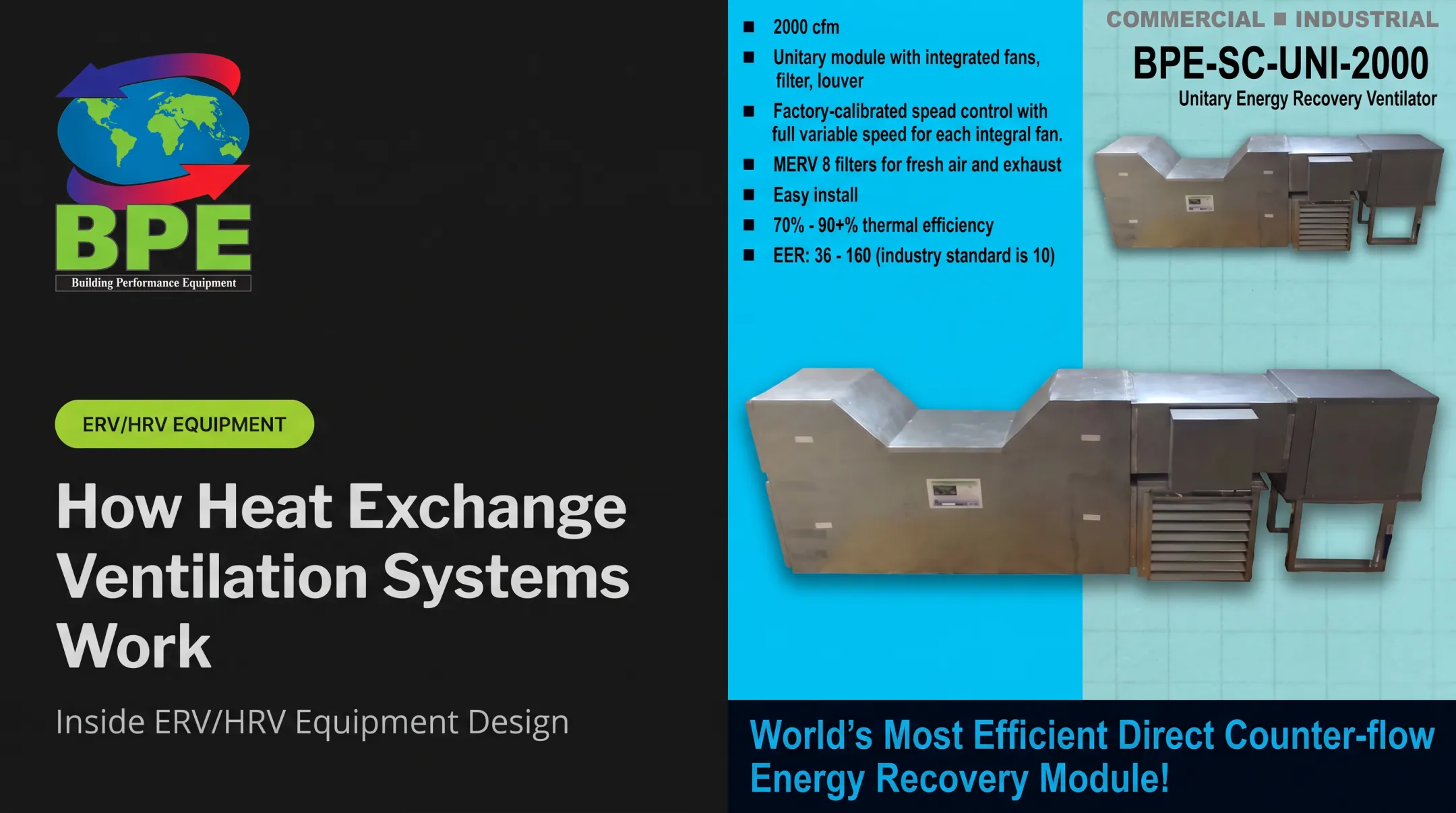
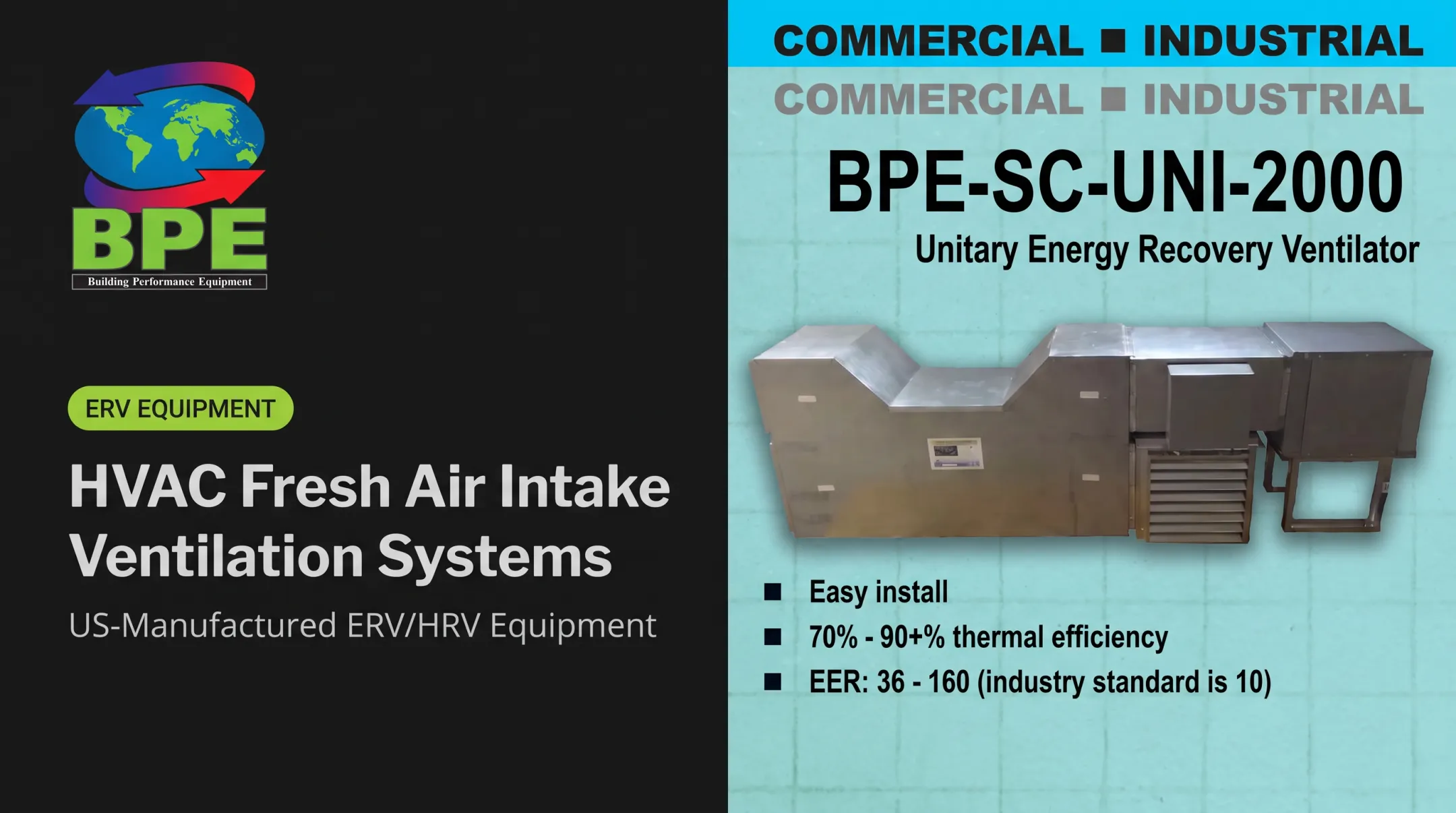
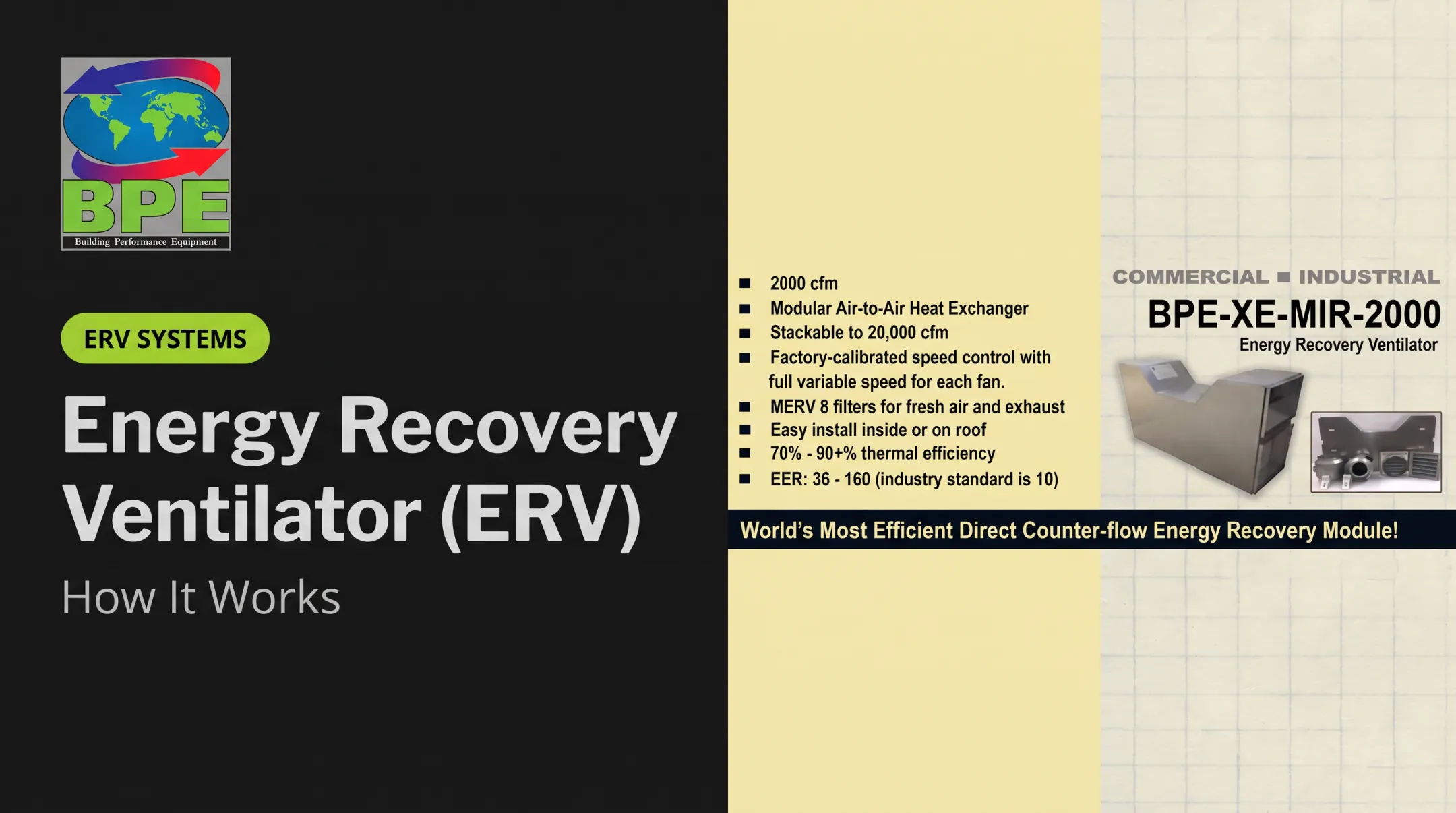
Building Performance Equipment manufactures air-to-air ERVs built around this principle, using a true counter-flow exchanger design rather than cross-flow. Company engineering documentation ties that design to higher recovery efficiency.
Its residential units pair integral MERV 8 filtration with variable-speed fans. Regenerative Condensate Return Technology is designed to manage the extra moisture load during hot, humid stretches rather than dumping it back into the building.
When comparing ERV or HRV equipment for a specific home, check documented sensible and latent efficiency numbers, airflow range, and static pressure rather than choosing by brand name alone.
Output and Result
When everything works as intended, the result is straightforward: a measured supply of fresh air in, stale air out, and more consistent conditions room to room. That translates into fewer lingering odors, better moisture control, and less strain on your heating and cooling equipment when recovery is in play.
Ventilation has limits, though. It won't eliminate every pollutant, fix a moldy basement, or replace proper combustion safety equipment. It's one layer of indoor air quality management, not the whole strategy.
Watch for these warning signs that a system isn't performing:
- Persistent window condensation or musty odors
- Weak airflow at vents
- Unusual fan noise
- Drafts or noticeably uneven room temperatures
A 2025 field study from LBNL examined 51 newer homes and found that 37 had whole-house mechanical ventilation installed, but only 11 were actually operating when researchers arrived. Installed equipment and working equipment are two different things. If you notice any of the symptoms above, get the system inspected rather than just turning up the fan speed.
Where Air Ventilation in a House Is Used
Ventilation design isn't one-size-fits-all. Fresh air typically enters living and sleeping areas, while exhaust pulls from bathrooms, kitchens, laundry rooms, and basements. Transfer grilles or door undercuts let air move between rooms when doors are closed.
New, airtight homes often need a deliberately engineered balanced system because there simply isn't enough natural leakage to exchange air reliably. At high insulation levels (walls and floors around R-40, roofs at R-60 or better), infiltration nearly disappears. That is why mechanical ventilation becomes mandatory rather than optional.
Older homes usually have the opposite problem: too much uncontrolled leakage. Before adding a whole-house system, it's worth addressing:
- Source control (fixing the pollutant, not just the airflow)
- Air sealing
- Local exhaust fans in bathrooms and kitchens
- An honest assessment of whether whole-house ventilation is even needed yet
Multifamily buildings, renovated homes, and houses with high occupancy or chronic moisture complaints often need customized airflow strategies rather than off-the-shelf solutions.

Climate Changes the Equation
- Cold climates need to manage heat loss, frost buildup in recovery cores, and condensation.
- Hot-humid climates need to watch for moisture entering through uncontrolled supply or exhaust paths.
- Mixed climates often do best with equipment that handles both sensible heat and moisture transfer.
Code requirements add another layer. The 2024 International Residential Code sets minimum continuous airflow rates based on home size and bedroom count. Balanced systems that supply bedrooms and living areas directly can qualify for reduced airflow requirements.
Final sizing and installation should go through a qualified HVAC professional familiar with your local code.
Conclusion
Ventilation works on a simple logic: bring outdoor air in, push stale air out, manage the pressure between the two, and recover energy where it makes sense. The specifics (exhaust-only versus balanced, HRV versus ERV) depend entirely on your home's airtightness, climate, and layout.
Before choosing equipment, take stock of your symptoms, your home's age and construction, your climate, and how your current HVAC system is set up. Building Performance Equipment manufactures high-efficiency air-to-air energy recovery equipment for homeowners and professionals working through these decisions. Residential units are engineered for straightforward installation into new or existing ductwork.
Frequently Asked Questions
What is the best way to ventilate my house?
It depends on your climate, how airtight your home is, occupancy levels, and existing HVAC setup. Controlled mechanical ventilation delivers consistent results; opening windows does not.
Can I use AC for ventilation?
Not usually. Most air conditioners recirculate and cool indoor air rather than bringing in outdoor air, so you'll likely need a dedicated intake or ventilation system for reliable fresh-air exchange.
Which ventilator is best for a home?
It varies by climate, humidity, home size, and duct access. Balanced ERV systems tend to suit most US climates, while exhaust-only setups work better in cold regions and supply-only in hot, humid ones.
How does an air ventilation system work?
Outdoor air enters through an intake, passes through a filter, and gets distributed by fans through ductwork to supply vents. Exhaust fans simultaneously remove stale air from bathrooms, kitchens, and similar rooms.
Is it good to ventilate your house?
Yes, when it's designed correctly. Controlled ventilation improves air quality, moisture balance, and comfort. Poorly designed or excessive airflow, though, can waste energy and even cause moisture problems.
What are the four types of ventilation?
Exhaust, supply, balanced, and energy recovery are the four residential categories. HRVs and ERVs are both energy-recovery variations of balanced ventilation, not separate airflow strategies.