
Many facility managers and homeowners treat an ERV like a single appliance with one efficiency number on a spec sheet. That's a mistake. The core's design, material, and condition determine whether your building actually gets the energy savings and air quality benefits you're paying for.
This guide breaks down how ERV cores work, the major design types available, how they differ from HRV cores, and the factors that should drive your selection for a U.S. building project — whether that's a single-family home, a school, or an industrial facility with process exhaust.
Key Takeaways
- ERV cores transfer heat and moisture; HRV cores generally transfer heat only
- Crossflow, counterflow, membrane, and rotary designs trade efficiency, size, upkeep, and cross-contamination risk
- Let climate, humidity, contaminants, and frost—not one efficiency number—drive core selection
- Compare certified performance under matching test conditions, not marketing figures
How ERV Cores Work
An ERV core is the physical heat exchanger that keeps supply and exhaust air separated while letting energy pass between them. It does not work alone. It sits inside a balanced ventilation system that typically includes:
- Fans that pull air in both directions
- Filters that protect the core from dust and debris
- Controls that manage fan speed and bypass
- Ductwork that connects the unit to outdoor hoods
Sensible energy changes air temperature. Latent energy is tied up in water vapor and humidity. An ERV core is built to transfer both. A basic HRV core typically transfers only sensible heat.
Winter and Summer Operation
In winter, warm, moist indoor exhaust passes through the core while cold, dry outdoor air moves the other way. Heat transfers into the incoming airstream, and many ERV designs also move some moisture with it. That cuts the load on your heating equipment when it brings outdoor air up to room temperature.
In summer, the relationship flips. Cooler, drier indoor exhaust can temper hot outdoor air and, in moisture-transfer designs, remove some humidity before that air reaches your air conditioning system. The real benefit tracks indoor and outdoor absolute humidity, not outdoor temperature alone.
Keeping Airstreams Separate
Internal channels route exhaust and supply air through the core without mixing them. Separation still depends on seals, airflow balance, filtration, and core integrity. Engineers track leftover cross-leakage as the exhaust-air transfer ratio (EATR).
A simple way to picture the airflow path:
- Outdoor air enters a louver, passes a filter, crosses the core, and becomes supply air to occupied space
- Return air passes a separate filter, crosses the core in the opposite or crossing direction, and leaves as exhaust
- In a properly sealed core, the streams do not combine—only heat and, in ERVs, moisture pass between them
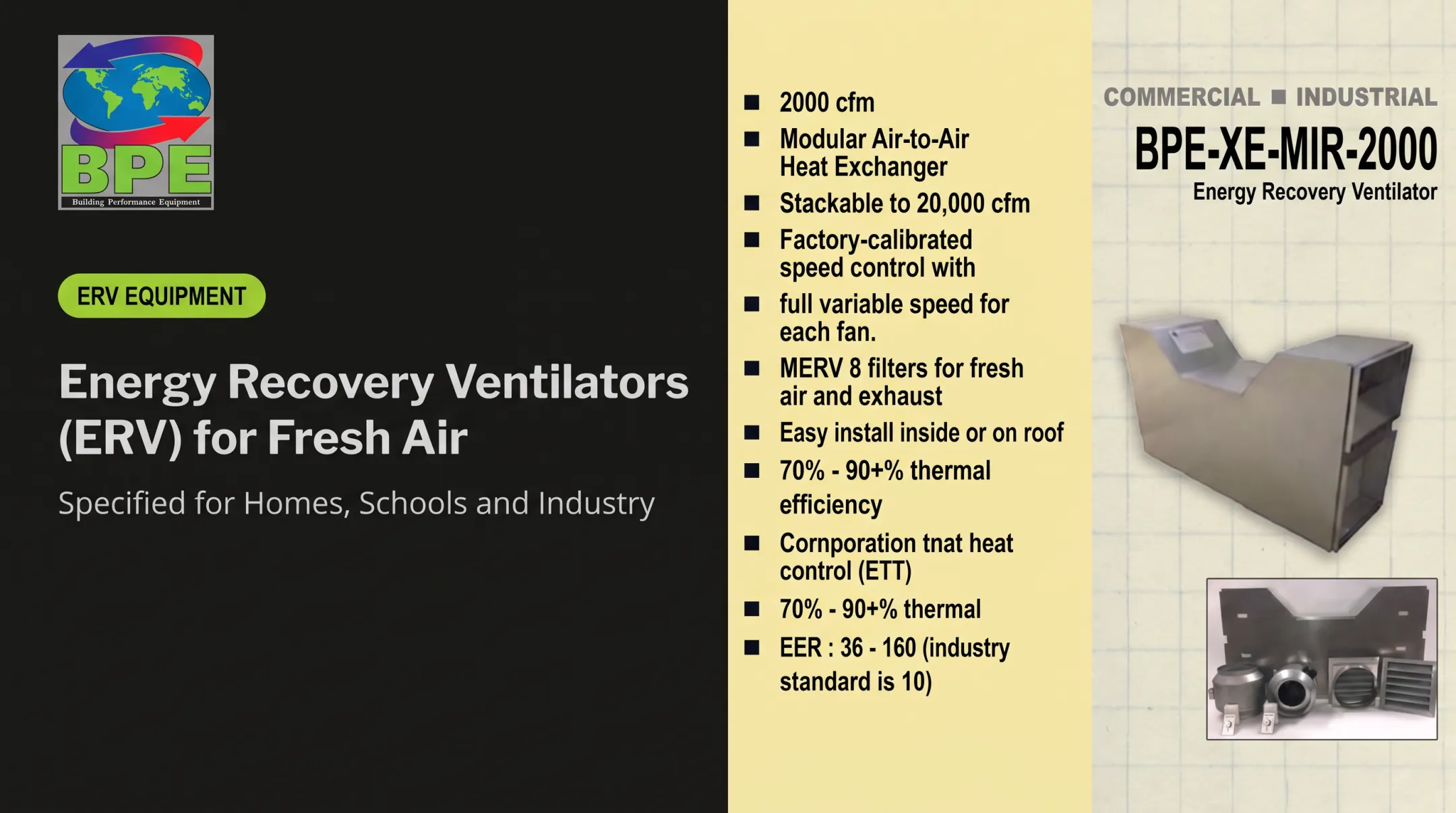
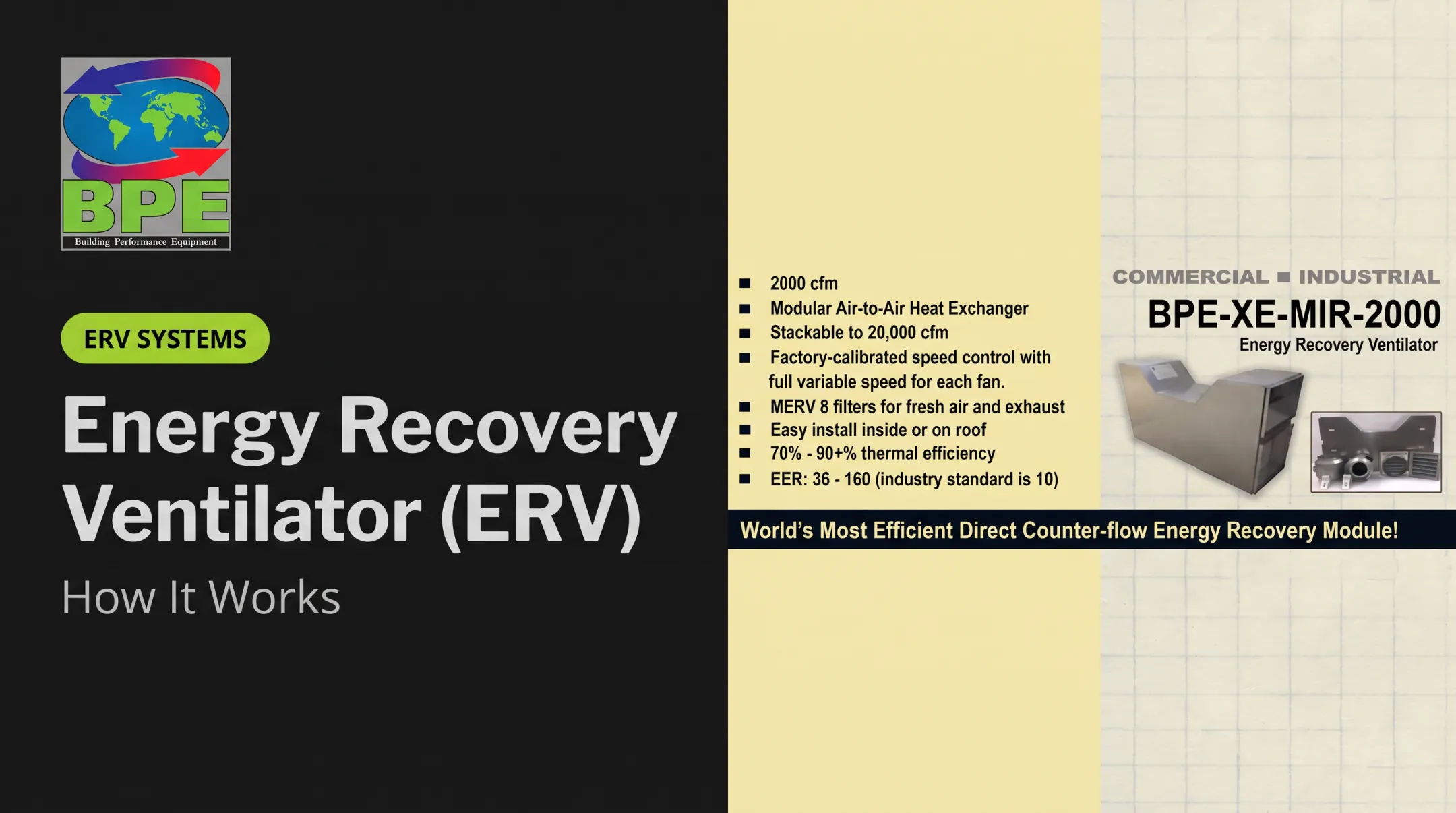
BPE flat-plate exchangers use this same separated-path idea in practice: two in-line fans move outdoor air in and stale indoor air out, and the plate assembly is sealed and fixed to the enclosure to limit leakage points and cut maintenance.
Main Types of ERV Cores
Four core configurations dominate the U.S. market: fixed-plate crossflow, fixed-plate counterflow, enthalpy or membrane cores, and rotary wheels. Note that "configuration" (how air moves through the core) and "material" (what the core is made of) are related but separate decisions: a crossflow core can be aluminum or polymer, for instance.
Crossflow Cores
Supply and exhaust air travel across one another, often at a right angle, through adjacent channels. This geometry gives crossflow cores a compact footprint and relatively simple construction, which is why they show up often in space-constrained residential and light-commercial jobs.
The tradeoff is a practical performance ceiling. ASHRAE's handbook notes that a single crossflow plate exchanger usually does not exceed 75% sensible effectiveness unless multiple units are staged in series. Don't assume a crossflow unit can match counterflow numbers without checking certified data.
Counterflow Cores
Here, airstreams travel in opposite directions through longer parallel channels, increasing both contact time and total heat-transfer surface area. BPE's guide specifications describe counterflow operation reaching up to 99% effectiveness under certain conditions, compared with roughly 75% for crossflow and 50% for parallel-flow designs, though actual performance always depends on airflow rate and the specific unit tested.

Counterflow designs can also behave differently in frost-prone climates, since the longer channel path changes how condensation and ice form at the air outlet.
Enthalpy or Membrane Cores
These use a semi-permeable material (a resin composite or polymer membrane) that lets water vapor pass through in addition to heat, while still keeping the liquid airstreams apart. Moisture transfer through a membrane is not the same thing as liquid water draining through the unit; the two processes are governed by different design features entirely.
Cleaning requirements vary by membrane type. Some manufacturers prohibit washing enthalpic cores altogether, recommending only dry methods like vacuuming instead.
Rotary-Wheel Cores
A rotary wheel rotates continuously through both the exhaust and supply airstreams, carrying heat and moisture from one side to the other as it turns. Rotary designs can be compact for the airflow they handle, but they introduce moving parts, seals, and sometimes a purge sector designed to limit carryover of exhaust air into supply air.
| Feature | Crossflow | Counterflow | Enthalpy/Membrane | Rotary Wheel |
|---|---|---|---|---|
| Heat transfer | Moderate | High | Moderate-high | High |
| Moisture transfer | None (unless enthalpic material) | None (unless enthalpic material) | Yes, by design | Yes, sorptive or hygroscopic |
| Footprint | Compact | Larger for equivalent effectiveness | Compact | Compact relative to airflow |
| Moving parts | None | None | None | Motor, drive, seals |
| Cross-contamination risk | Low, seal-dependent | Low, seal-dependent | Low, seal-dependent | Seal and purge-dependent |
| Common application | Residential, light-commercial | Commercial, high-performance homes | Humid-climate commercial, residential | Large commercial, industrial |
Core Materials, Performance, and Maintenance
Core material affects thermal conductivity, moisture-transfer capability, corrosion resistance, weight, and how the unit tolerates its airstream over time.
Common material categories:
- Galvanized aluminum or metal plate — strong conductivity for sensible transfer; typically specified at a minimum gauge (BPE guide specs call for at least 22-gauge galvanized metal) for durability
- Polymer or polypropylene plate — chemically inert, corrosion-resistant, and hydrophobic, which supports condensation management without degrading the plate material
- Engineered resin-media plate — formulated specifically for enthalpic (moisture) transfer, but often restricted to dry cleaning methods rather than washing
- Enthalpy membranes — selective permeability designed to favor moisture transfer while limiting air leakage between streams
Material choice is only half the comparison. Rated effectiveness, pressure drop, and service needs decide whether a core holds up in your building.
Why One Efficiency Number Isn't Enough
A single "percent efficient" figure on a brochure can describe sensible effectiveness, latent effectiveness, or total recovery. It may also apply to the whole unit rather than the core itself. Before comparing products, check:
- Sensible and latent effectiveness separately, at the same airflow and pressure conditions
- Pressure drop on both the supply and exhaust sides
- Fan power required to move air through the core
- Frost protection strategy, if your climate sees sustained sub-freezing temperatures
The Air-Conditioning, Heating, and Refrigeration Institute (AHRI) certification program verifies sensible and latent effectiveness, pressure drop on both sides, EATR, and outdoor-air correction factor for eligible exchangers. That gives you an apples-to-apples way to compare products rather than relying on manufacturer claims alone.
Routine Maintenance
Maintenance needs differ by core type and environment:
- Inspect filters regularly — BPE recommends annual inspection at minimum, checking both the exhaust-air and outdoor-air filter sections for fouling
- Watch for performance drift — clean the core when airflow or effectiveness shifts by roughly 10% from baseline
- Use approved cleaning methods only — many sealed flat-plate cores are designed for hosing out or vacuuming rather than disassembly
- Keep outdoor hoods and bird screens clear of debris that restricts intake airflow
- Increase cleaning frequency in harsh environments — dust collectors, metal shops, and greasy or oil-laden exhaust streams may need attention far more often than a typical office
Expected service life and cleaning intervals vary significantly by manufacturer, core material, and how hard the system runs. Always follow the specific documentation that came with your unit rather than a generic industry rule of thumb.
How to Evaluate and Select an ERV Core
Start with the project's actual ventilation requirement, not a generic core recommendation.
Step 1: Define the airflow need. Determine design airflow, occupancy, operating schedule, and required outdoor-air rate. A single-family home, a 900-student school, and an industrial plant all have different demands.
Step 2: Match the core to climate and moisture load. Consider heating and cooling season length, indoor humidity targets, and outdoor absolute humidity. Buildings in cold, dry climates face different frost-risk considerations than buildings in hot, humid regions where latent recovery matters more.
Step 3: Review performance data under matching conditions. Compare sensible and latent effectiveness, total recovery, fan power, and pressure drop — all tested at the same airflow and static pressure. BPE's guide specifications require more than 80% sensible effectiveness and more than 30% latent effectiveness under ARI 1060 testing in very humid conditions — a defensible benchmark for specifiers.
Step 4: Assess contaminant risk. Ordinary occupied-space exhaust is very different from chemical fumes, VOC-laden exhaust, grease, smoke, or infectious aerosols. Any hazardous or corrosive exhaust stream needs engineering review before energy recovery is even considered appropriate.
Step 5: Confirm installation and service logistics, including:
- Core orientation and access-panel clearance for future servicing
- Duct insulation and vapor-barrier continuity, particularly where outdoor air ducts run through unconditioned space
- Condensate provisions where applicable
- Replacement-core or replacement-part availability
- Compatibility with existing rooftop or central HVAC equipment

A Quick Decision Checklist
- Climate zone and frost exposure
- Building type and occupancy pattern
- Design airflow and external static pressure
- Core configuration and material
- Required moisture transfer level
- Contaminant profile of the exhaust stream
- Maintenance access and staffing capability
- Applicable code requirements (ASHRAE 62.1 ventilation and IECC duct insulation provisions, among others)
- Lifecycle cost over the system's full service life, not just purchase price
A core that needs replacement every few years can cost more over 20 years than a higher-upfront-cost unit built for longer service life. Factor lifecycle cost into any bid comparison, not just sticker price.
Building Performance Equipment works with MEP consultants and contractors on this kind of project-specific evaluation, supplying high-efficiency air-to-air energy recovery equipment sized to the actual building.
Confirm current product specifications directly with the manufacturer and request project-specific guidance before finalizing a selection.
Where ERV Cores Are Used
Residential and High-Performance Homes
Balanced ventilation matters most in tight, well-insulated homes where outdoor air doesn't leak in naturally. Typical priorities include:
- Compact equipment and low sound levels
- Easy filter access for routine service
- Humidity moderation on Passive House, net-zero, and ENERGY STAR projects
BPE's plug-and-play residential models are sized for homes up to six occupants or small offices up to 10 people, with filters rated for both fresh and exhaust air.
Multifamily, Schools, and Commercial Buildings
Occupancy drives outdoor-air requirements in these settings. The central question is often centralized versus distributed equipment.
Schools and offices usually need only straightforward filter changes as routine maintenance, with deeper cleaning on a multi-year cycle depending on airborne particulates. At this scale, controls integration with the building automation system matters more, such as CO2-based demand control ventilation.
Industrial and Specialized Applications
Manufacturing plants, tanneries, fragrance production, and similar facilities generate fumes, solvents, or high-moisture process exhaust. A qualified engineer should verify material compatibility and safe separation before energy recovery is appropriate.
Casella's recycling bin maintenance facility in Worcester, Massachusetts used a BPE energy recovery unit in a ventilation upgrade for its repainting and re-welding workshop. The design addressed welding particles and oil-based paint fumes and targeted ASHRAE and OSHA air quality guidance for that process environment.

Frequently Asked Questions
What is the average cost of an ERV system?
Total cost depends on equipment capacity, core type, controls, ductwork, and installation complexity. Residential equipment commonly runs from a few thousand dollars, while commercial systems and installation labor add substantially more. Get a project-specific quote rather than relying on a generic average.
What is an ERV used for?
An ERV exchanges stale indoor air for fresh outdoor air while recovering both heat and moisture from the outgoing airstream. This supports indoor air quality and comfort while lowering the conditioning load your HVAC system would otherwise carry.
What are the two types of recovery ventilators?
Heat recovery ventilators (HRVs) and energy recovery ventilators (ERVs) are the two categories. HRVs generally transfer sensible heat only, while ERVs transfer both sensible heat and latent moisture energy, according to industry guidance from the Home Ventilating Institute.
How often should ERV filters be replaced?
Replacement intervals vary by filter type, outdoor pollution levels, construction dust, pets, and occupancy. Check filters regularly and replace them before airflow becomes noticeably restricted, following your unit's specific manufacturer instructions.
What is the typical lifespan of an HRV system?
Service life depends on equipment quality, operating hours, installation quality, and maintenance consistency. Published ranges vary by manufacturer and component. The core, fans, and controls may each have different realistic lifespans within the same system.
Does ERV ductwork need to be insulated?
Insulation is commonly required for ducts carrying outdoor air through unconditioned spaces to prevent condensation. Exact requirements depend on duct location, local climate, and applicable energy code. Follow your project engineer's specifications and the manufacturer's installation guidance.