
An ERV has its own dedicated filters, separate from your HVAC filter and separate from the heat-exchange core. Confusing these three parts leads to skipped maintenance, restricted airflow, and underperforming ventilation. This guide covers how ERV filters work, how to pick the right one, how to clean or replace it, warning signs of trouble, and when to call in a professional.
Key Takeaways
- ERV filters protect the core and trap dust and pollen, but they don't replace source control.
- Set replacement intervals from manufacturer guidance, filter type, occupancy, pets, and outdoor air.
- High filter resistance chokes airflow and cuts ERV performance; balance efficiency and static pressure.
- Cut power, confirm filter orientation, and fully dry washable filters before reinstalling.
What Are Indoor ERV Filters and How Do They Work?
An ERV filter is the removable filter media installed in one or both air paths of an energy recovery ventilator. Its job: capture particulate matter before air reaches the recovery core or your living space. The U.S. Department of Energy describes balanced ventilation as bringing in outdoor air while removing indoor air at the same time — the ERV's heat exchanger transfers heat and moisture between those two streams without mixing them.
Two Filters, Two Jobs
Most ERVs filter air on both sides:
- Outdoor-air (supply) filter — screens incoming air before it reaches occupied rooms.
- Exhaust (return-side) filter — protects the core and internals from dust pulled out of the building.
The recovery core transfers heat and moisture. The filter captures particles. Cleaning one doesn't substitute for maintaining the other — they're separate jobs with separate maintenance rules.
ERV Filters vs. Central HVAC Filters
They look similar but aren't interchangeable:
| Feature | ERV Filter | Central HVAC Filter |
|---|---|---|
| Location | Inside the ERV cabinet, both airstreams | Furnace/air handler return |
| Dimensions | Model-specific, often 1" to 4" thick | Standardized sizes |
| Airflow path | Outdoor-to-indoor and indoor-to-outdoor | Recirculated indoor air only |
| Function | Protects core, filters fresh/exhaust air | Protects blower and coil |
A loaded ERV filter raises resistance, forces the fans to work harder, and can throw off ventilation balance, humidity control, and energy recovery at once.
Picture the path: outdoor air enters the intake, passes through the filter, crosses the recovery core, then moves through the supply duct into your rooms. Stale exhaust follows its own filtered path out. Block either filter and the whole system suffers.
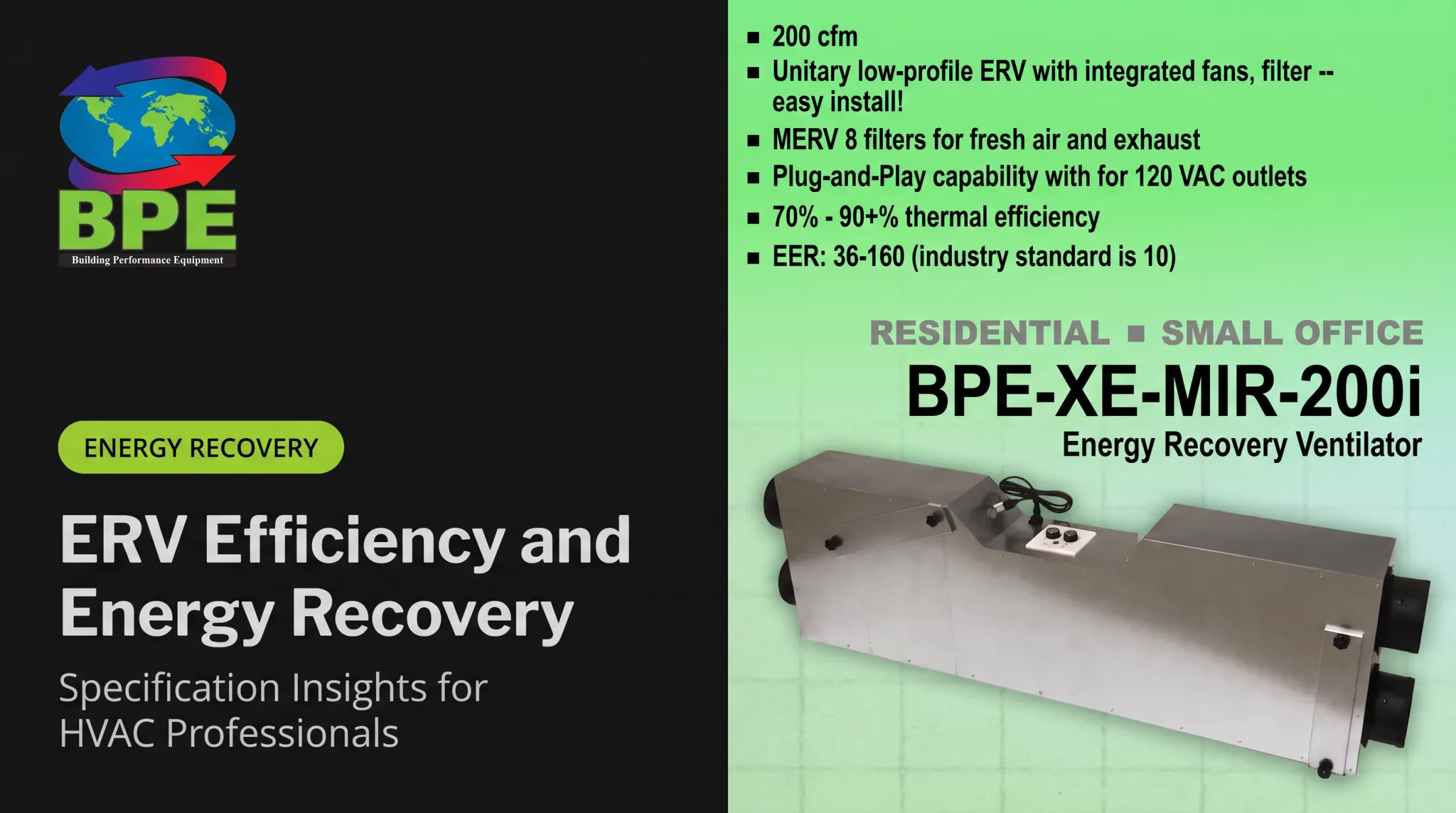
Building Performance Equipment's residential unit, the BPE-XE-MIR-200i, ships with integral MERV 8 filtration on both the fresh-air and exhaust sides.
How to Choose the Right ERV Filter
Start with the owner's manual or equipment label, not guesswork. Manufacturer documentation specifies approved dimensions, material, orientation, cleanable-versus-disposable status, and the replacement part number. Buying a filter that "looks right" without checking this risks poor sealing or reduced airflow.
Washable or Disposable?
Not every ERV uses the same filter type, and swapping one for the other isn't always safe:
- Washable filters need periodic rinsing or vacuuming, full drying before reinstallation, and regular inspection for sagging media
- Disposable filters offer simple swap-and-go convenience, but you must keep the correct replacement on hand Never substitute a different filter construction unless the manufacturer confirms compatibility. Thicker or denser media than specified can starve the fans of airflow.
Understanding Filtration Ratings
MERV, ISO ePM, and manufacturer-specific ratings describe how well a filter captures particles, not how much air it lets through. ASHRAE notes that higher filter efficiency often increases airflow resistance at the same flow rate. The highest-rated filter is not automatically the best choice. A rating above what your ERV's fans were designed to overcome can choke airflow even when the media looks "cleaner" on paper. Building Performance Equipment (BPE) standard units ship with MERV 8 filtration and offer MERV 13 upgrades on request. Choose the upgrade only when it matches the unit's fan capacity, not in isolation.

Buyer Checklist
Before purchasing a filter, confirm:
- Exact dimensions and thickness match the manufacturer's spec
- Correct airflow direction (check the arrow printed on the frame)
- Frame quality and gasket fit (gaps let unfiltered air bypass the media)
- Replacement availability from the manufacturer or an approved supplier
- Compatibility with your specific ERV model number Selecting a full ERV system, not only a replacement filter, adds recovery performance, airflow targets, pressure drop, and controls to the same decision. Building Performance Equipment treats that as an engineering evaluation rather than a parts list, whether the job is a single-family retrofit or a 20,000 CFM industrial system.
How to Clean, Replace, and Maintain ERV Filters
Safety Sequence
Follow the same basic steps regardless of model:
- Review the manual for your specific unit's filter location and orientation.
- Turn off power at the ERV and, if applicable, at a secondary disconnect switch.
- Open the access panel and note the filter's position and airflow arrow before removing anything.
- Remove the filter carefully without disturbing the recovery core.
- Inspect for loading, tears, collapsed media, moisture, or damaged seals.

Visible mold-like growth, repeated moisture, or chemical residue calls for professional assessment, not a routine wipe-down.
Cleaning vs. Replacing
For washable filters, vacuum gently or rinse only if the manufacturer permits it. Skip harsh chemicals and aggressive scrubbing; the media can tear. Let it dry completely before reinstalling; a damp filter invites mold growth inside the cabinet.
For disposable filters, confirm the replacement matches the specified dimensions and rating, install it facing the correct airflow direction, and seat the access panel fully so air can't bypass the filter around the edges.
Never wash, scrub, or apply chemicals to the recovery core itself unless the manufacturer explicitly allows it. Filter maintenance and core maintenance are two different tasks.
Setting an Inspection Schedule
There's no single universal interval; it depends on your model, occupancy, and surroundings. BPE generally recommends inspecting units about once a year for filter-changing needs in typical school or office environments, where changing the filter is often the only maintenance required.
In greasy or process-heavy environments (kitchens, workshops, light-manufacturing spaces), clean or replace as soon as performance drops by roughly 10%, rather than waiting for a calendar date.
Factors that shorten the interval:
- Continuous operation
- Pets, smoking, or heavy cooking
- Nearby construction or renovation dust
- Wildfire smoke or heavy outdoor pollution
- High occupancy (schools, offices)
Some BPE control packages include smart change/check reminders tied to actual run time rather than a fixed calendar, so you change filters when needed, not by guesswork.
Keep a simple maintenance log with:
- Inspection dates and filter condition
- Replacement part details
- Notes on airflow, odor, humidity, or noise changes
That record makes it much faster to spot patterns when performance slips later.
Signs Your ERV Filter Needs Attention
Visible indicators are the easiest to catch during a quick inspection:
- Darkened or heavily loaded filter media
- Dust accumulation beyond the filter frame
- Torn, collapsed, or warped media that no longer seals
- Wetness or gaps around the frame
Performance symptoms are subtler but still worth tracking:
- Weaker supply airflow than usual
- Persistent stale odors indoors
- Uneven ventilation between rooms or zones
- Unusual fan noise
- Worsening condensation or humidity swings
- Unexpected jumps in energy use
These symptoms point toward the filter, but they don't prove it's the only cause. Other issues can look nearly identical:
- Blocked exterior hoods
- A dirty energy-recovery core
- Clogged ducts
- A failing fan
- Airflow-balancing problems
Rule those out before assuming the filter alone is at fault.
Stop and call a qualified HVAC or ventilation professional if you notice:
- Suspected biological growth or chemical contamination
- Repeated moisture intrusion or electrical damage
- Persistent low airflow even after a filter change
The same applies when the ERV serves a sensitive or regulated space. A lab, cleanroom, or healthcare environment is not the place for trial-and-error troubleshooting.
Indoor ERV Filter Considerations by Building Type
Filter needs shift depending on who's breathing the air and what's generating the particles.
Homes and multifamily housing: Expect occupant-generated dust, pet dander, cooking residue, and seasonal pollen. Residents need simple, clearly labeled replacement instructions they can follow without a technician on-site. BPE's plug-and-play residential units are built with that in mind.
Schools, universities, offices: Higher occupancy and longer operating hours mean faster loading. ASHRAE's 2025 addendum to its ventilation standard calls for documented maintenance schedules and filter checks tied to the equipment's O&M manual, including fit, seal integrity, and maximum allowable pressure drop.
Schools across central New Jersey have run BPE ERVs in classrooms using displacement ventilation, where documented filter upkeep keeps thermal effectiveness around 91.5%.
Industrial, lab, and process environments: Standard particulate filters won't touch chemical vapors or hazardous fumes. A tannery, fragrance manufacturer, or welding shop needs a qualified industrial ventilation professional to determine filtration, exhaust, and worker-safety requirements — not just a finer MERV rating.
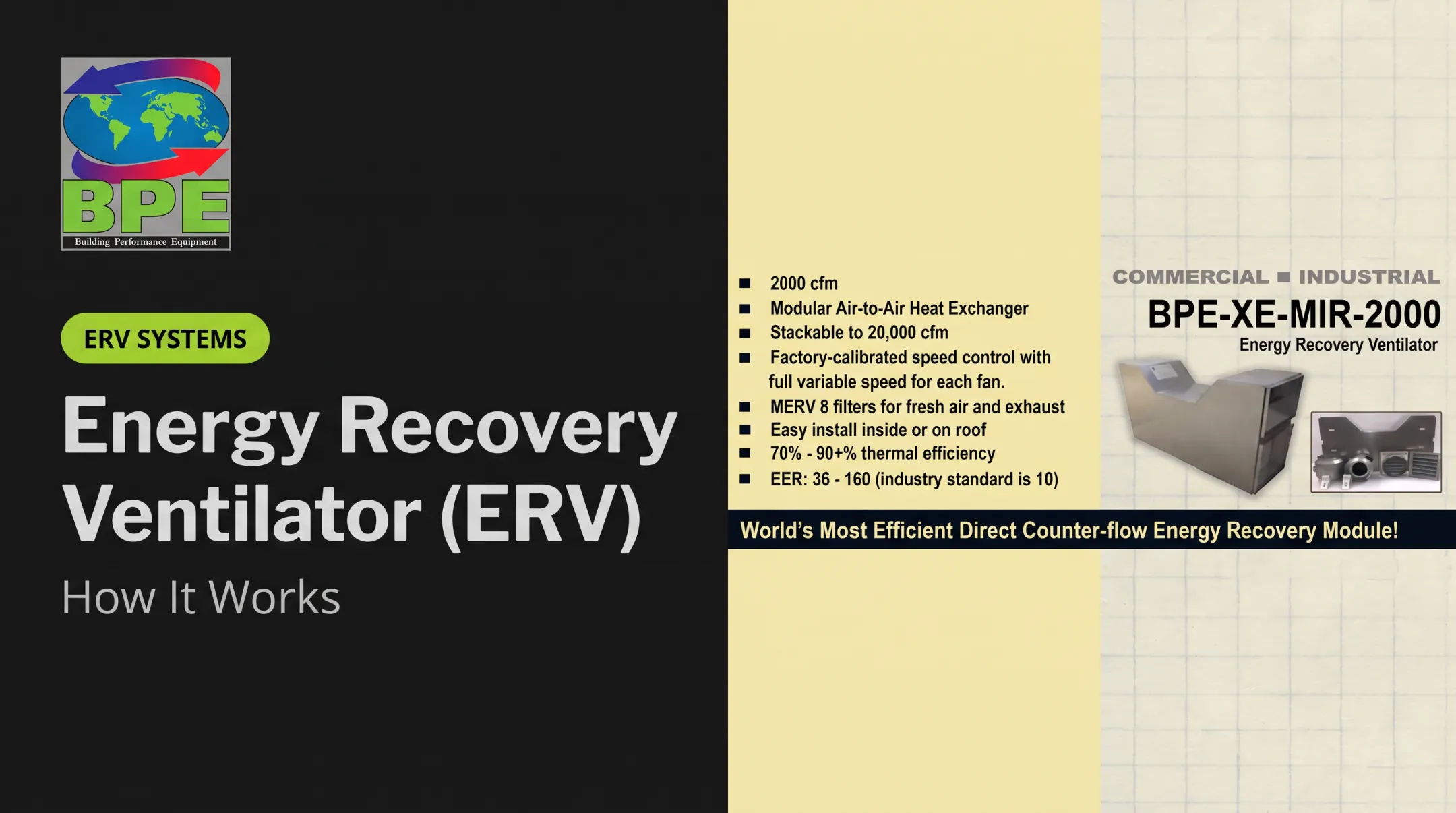
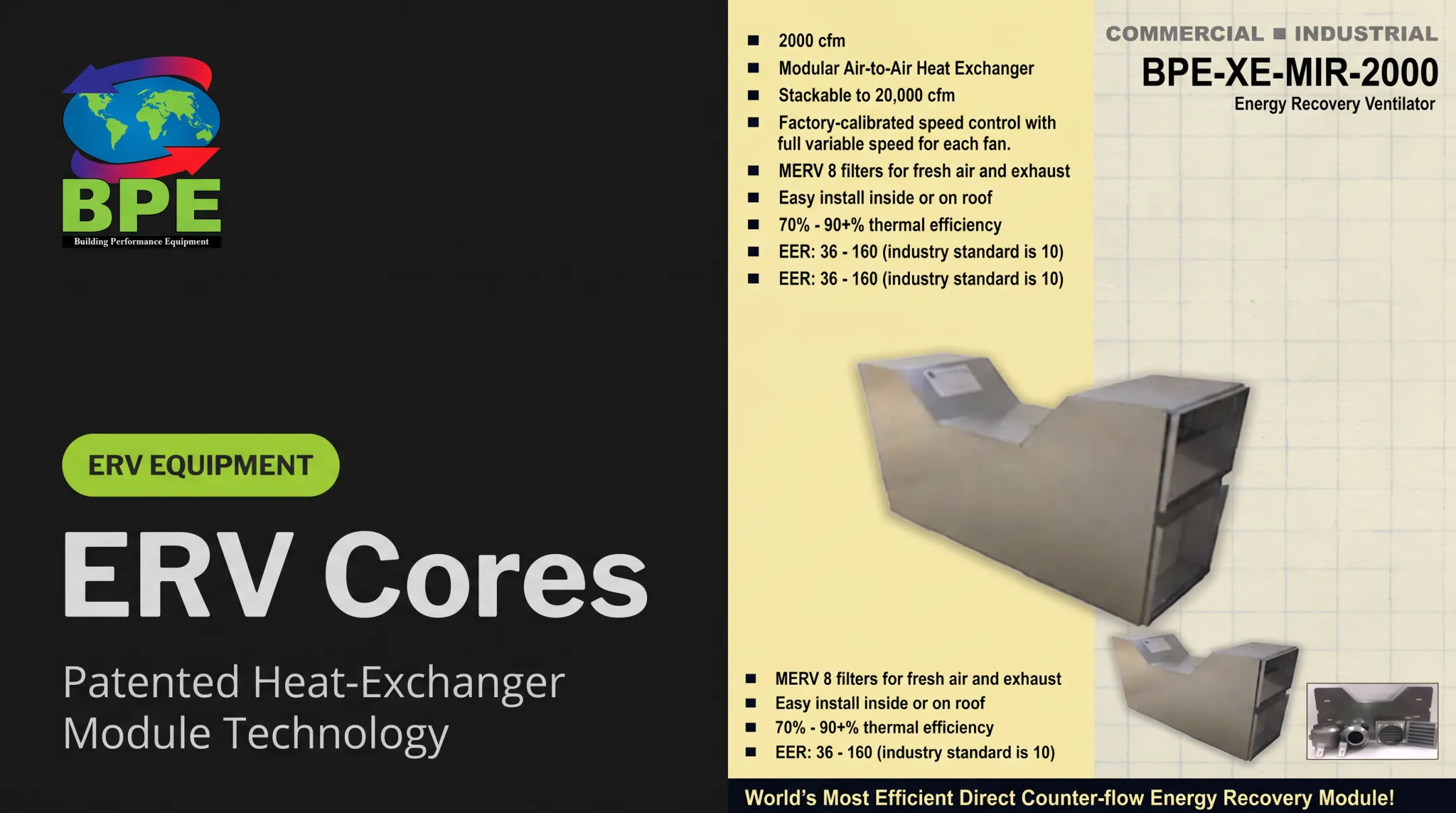
One workshop case sent welding and paint fumes through a dedicated exhaust filter and a BPE-XE-MIR-2000 ERV before venting outdoors, addressing the fumes at the source rather than relying on filtration alone.
High-performance, net-zero, and cold-climate buildings: Filter pressure drop, balanced airflow, frost behavior, and energy-recovery performance need evaluation together. Optimizing filtration in isolation can throw off the rest of the system.

Frequently Asked Questions
What are ERV filters?
ERV filters are removable media that protect the recovery core and capture dust in the supply and exhaust airstreams. Exact type and thickness depend on your ERV model.
How often should you change ERV filters?
Follow the manufacturer’s interval and your site conditions. Check filters when they look loaded or airflow drops, and inspect more often in dusty, smoky, high-occupancy, or continuously running buildings.
What does ERV stand for?
ERV stands for energy recovery ventilator. It exchanges indoor and outdoor air while transferring heat and moisture between two separate airstreams.
Can you wash an ERV filter?
Some ERV filters are washable, others are disposable only — check your model's manual first. If washable, avoid harsh chemicals and dry it completely before reinstalling.
What happens if you don't change an ERV filter?
Airflow gets restricted, fans strain harder, ventilation weakens, and the core can become contaminated over time. Other system faults can cause similar symptoms, so a filter check is the first step, not the only one.
How do you choose the right ERV filter?
Verify your model, dimensions, airflow direction, filter type, approved efficiency rating, and pressure-drop limits in the manufacturer's documentation before buying a replacement.