
An energy recovery ventilator, or ERV, is a balanced mechanical system built to help. It exhausts stale indoor air and supplies filtered outdoor air at the same time, running both streams through a core that transfers heat—and often moisture—between them before the air ever reaches your basement.
This article answers the questions homeowners and contractors actually ask: Is an ERV right for this basement? Where should it go? What problems will it solve, and which ones will it leave untouched? We'll also cover selection and installation basics so you don't end up with an undersized unit buried behind a finished wall.
Key Takeaways
- An ERV improves basement air exchange and cuts ventilation energy cost, but won't fix water intrusion, humidity overload, or radon alone
- Prioritize unit placement for accessibility, protected temperatures, and short, low-resistance duct runs
- Insulated outdoor ducts, correct terminations, and commissioning determine whether the system performs as rated
- Building Performance Equipment manufactures high-efficiency air-to-air energy recovery equipment for better IAQ, comfort, and energy performance
How an ERV Works in a Basement
An ERV runs two separate airstreams through the building at once. One fan pulls outdoor air in; another pulls stale indoor air out. The two streams pass through a counter-flow heat-exchange core, transferring sensible heat and, depending on the core design, moisture without mixing.
Incoming winter air gets pre-warmed before it reaches a register; incoming summer air gets pre-cooled and partially dried.
Core components you'll find in most basement installations:
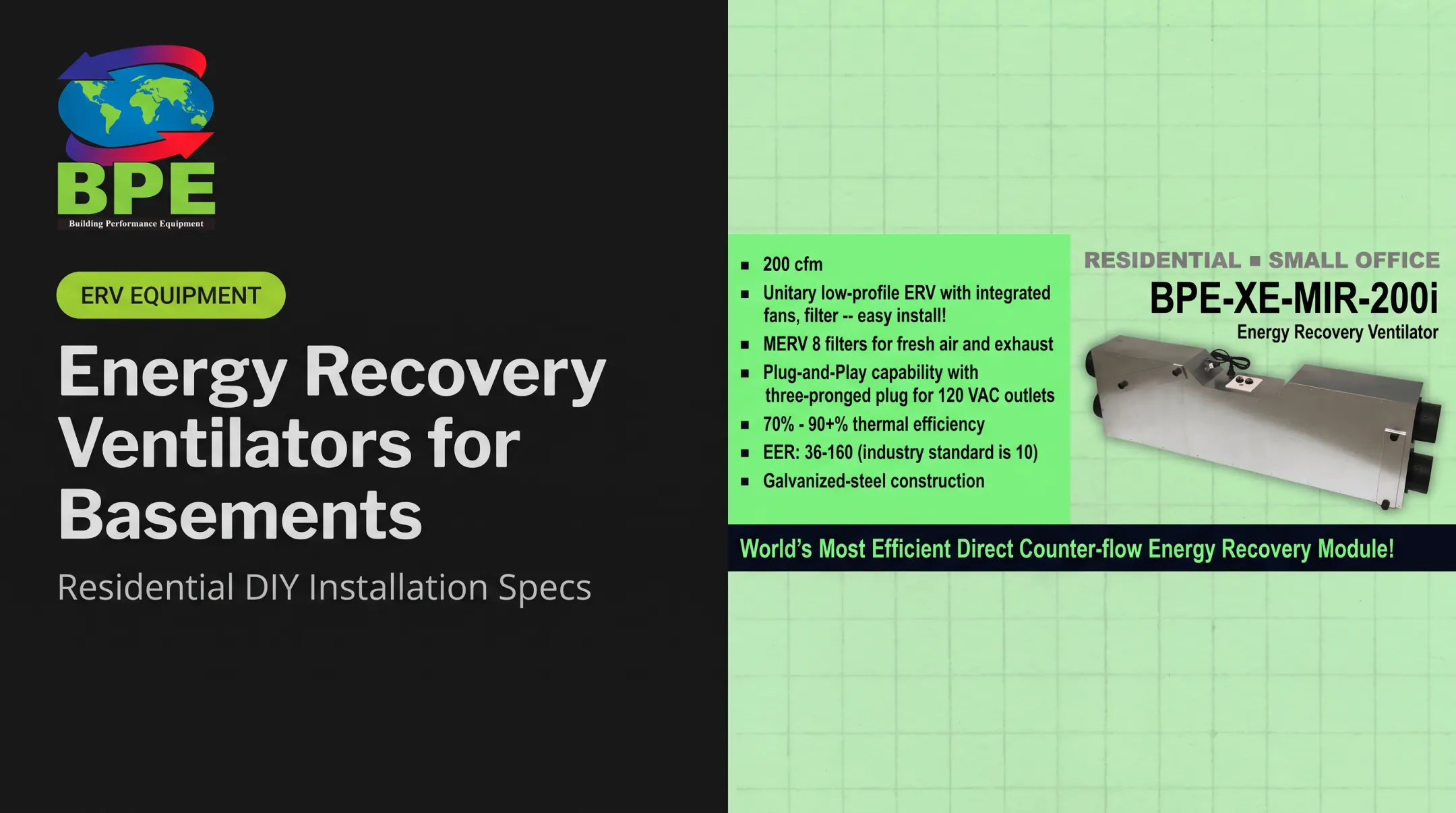
- Supply and exhaust fans (often a matched pair, such as Building Performance Equipment's BPE-XE-MIR-200i with two 200 CFM fans and integral MERV 8 filters)
- A fixed-plate or polymer heat-exchange core
- Filters on both airstreams
- Controls and sensors (some BPE units use a CO2 sensor with an adjustable 600 ppm-on, 500 ppm-off setpoint to trigger ventilation automatically)
- Exterior intake and exhaust terminations, screened against pests and weather
Why Balanced Beats Exhaust-Only in a Basement
A standalone exhaust fan pulls air out of the building without supplying anything back. That depressurizes the space, and the makeup air has to come from somewhere, often through foundation cracks, sump openings, or gaps around basement penetrations. That pathway can draw in soil gas and moisture along with the air.
A balanced ERV avoids this by supplying roughly as much air as it removes. BPE's specifications call for positive pressure on the fresh-air side and negative pressure on the exhaust side through the core, with the two streams flowing in true opposition. Concurrent flow sharply reduces recovery efficiency. That opposition keeps the system balanced rather than fighting the building's pressure field.

Basement Problems an ERV Can and Cannot Solve
An ERV continuously dilutes stale basement air with filtered outdoor air. That helps with musty odors, elevated CO2, and general staleness from a space that rarely gets natural airflow.
How well it handles airborne particulates and VOCs depends entirely on the filter rating installed: MERV 8 catches different things than MERV 13, and devices built for particles don't necessarily touch gases or certain odors.
Here's where the limits show up:
| Basement issue | What an ERV does | What it doesn't do |
|---|---|---|
| Stale air, odors, CO2 buildup | Continuously dilutes with fresh air | N/A |
| Everyday humidity | Transfers some moisture via the core | Doesn't replace a dehumidifier in damp basements |
| Foundation leaks, bulk water | Nothing | Must be diagnosed and repaired separately |
| Radon and soil gas | May affect dilution or pressure | Not a substitute for testing or mitigation |
| Mold already present | Nothing | Requires source correction and remediation |
On humidity: Latent-transfer cores can meaningfully reduce the moisture a basement would otherwise absorb from ventilation air. Building Performance Equipment's Regenerative Condensate Return Technology, for example, is rated for 34% latent efficiency in hot, humid conditions.
That's real, but it's moisture moderation, not drying out a chronically damp slab. A basement that stays wet after a storm needs a dehumidifier and a look at the source, not a ventilation upgrade.
On radon: The EPA's radon guide recommends fixing any home at 4 pCi/L or above, and testing the lowest lived-in level, including an unfinished basement before you convert it to living space.
An ERV is not a tested radon-removal method. If your basement has elevated radon, you need a dedicated, code-compliant mitigation system, full stop. Ventilation might change dilution or pressure dynamics slightly, but that's a side effect, not a plan.
Combustion safety, carbon monoxide, and chemical fume control fall into the same category: they need dedicated detection and controls, not a general ventilation upgrade.
Where to Install a Basement ERV
Pick a mechanical area that stays within the unit's rated operating temperature range and gives you a clean shot for both supply and exhaust ductwork. Burying the unit behind a finished wall or stuffing it into a crawlspace you can't reach later is the single most common installation mistake.
Clearance and Access
Plan for real service space, not a token gap. Building Performance Equipment's layout guidance recommends roughly 3 feet of perimeter clearance around mid-size units and up to 4 feet around its largest commercial platforms. That space is enough to pull filters, inspect the core, and swap a fan without disassembling surrounding ductwork. You'll also want:
- A drain pan at least 2 inches deep and 3 inches larger than the unit in both directions, sloped at least 1% toward the drain
- Drain piping of at least ¾ inch for the full run
- An inspection door built into the ductwork itself
Duct Routing and Registers
Keep fresh-air registers away from stale-air exhaust registers to avoid short-circuiting, where air gets pulled right back out before it does any good. Internal guidance from BPE puts fresh-air duct runs at a minimum of 15 feet and recommends placing stale-air exhaust registers 6 to 12 inches from the ceiling in rooms that actually produce contaminants. Never place them in a room with a combustion appliance like a gas water heater or furnace.
Exterior Terminations
Separate your intake and exhaust outlets. BPE's installation parameters call for at least 10 feet between them, or whatever your local code requires, whichever is greater.
The 2024 IRC code sets specific clearances too: exhaust must stay at least 3 feet from the property line, 3 feet from any gravity intake or operable window, and 10 feet from a mechanical intake (with an exception if the exhaust terminates at least 3 feet above it).
Protect both terminations with screens or hoods against snow, leaves, and pests. Keep them serviceable, not buried under a deck addition two years from now.

Ducted vs. Ductless
A ductless, plug-and-play unit works for a single open basement area with a nearby exterior wall. A finished basement with multiple rooms, or a basement apartment, typically needs ducted distribution to get fresh air to each occupied space. Follow the manufacturer's layout guidance either way.
How to Choose the Right Basement ERV
Start with the basics: floor area, ceiling height, occupancy, and whether the ERV is serving only the basement or feeding the whole house. That determines your required airflow. Then check applicable residential ventilation code requirements for your jurisdiction.
The step people skip: rated airflow has to be checked against your actual duct system's external static pressure, not the unit's nominal maximum. A fan rated for 600 CFM in a lab won't deliver that through a long, bendy duct run with a few restrictive fittings.
As a reference point, BPE's airflow data for one residential-scale unit shows exhaust static pressure climbing to 0.85 inches water column and intake static to 0.55 inches at 500 CFM. Those numbers shift the real-world delivered airflow well below the headline spec if your ducting is tight or circuitous.

What to Compare Across Units
- Sensible and latent recovery performance (look for both numbers, not just one)
- Filter type, rating, and how easy it is to find replacements
- Fan efficiency and sound rating: watts per CFM and sones both matter
- Cold-weather operation and defrost strategy, especially in northern climates
- Controls: basic on/off versus CO2 or humidity-sensor-driven operation
- Serviceability: can you actually get to the filters and core?
ERV or HRV?
The U.S. Department of Energy notes that HRVs tend to suit colder, drier climates since they transfer heat only, while ERVs transfer both heat and moisture and work across a wider range of climates, including humid ones. A damp basement in a humid summer climate generally leans ERV. A basement in a very dry, cold region with no moisture concerns might do fine with an HRV, paired with a dehumidifier only if dampness shows up later.
Quick decision path:
- Unfinished storage basement — lower airflow, basic plug-and-play ERV often sufficient
- Finished recreation room — ducted ERV sized to room count and code minimums
- Basement bedroom or office — ducted ERV with dedicated supply/return, per-room airflow checked
- Basement apartment or accessory suite — code-compliant per-unit fresh air, often a compact plug-and-play ERV like BPE's 60–200 CFM residential models
- Basement with separate radon or dehumidification system already installed — ERV sizing proceeds independently, since it's not a substitute for either
Building Performance Equipment works with MEP consultants, contractors, and building owners evaluating air-to-air energy recovery equipment for these scenarios. Always verify current specifications against the manufacturer's published data before finalizing a model.
Installation, Commissioning, and Maintenance
Install according to the unit's listed instructions and your local mechanical, electrical, and fire-safety code. Larger or multi-module systems generally call for a qualified installer. A single compact residential unit is sometimes within reach of someone comfortable installing a bathroom fan, provided a three-prong outlet and basic ducting skills are in play.
Duct best practices:
- Use approved sheet metal or rigid duct, not dryer vent or other improvised material
- Keep air velocities modest, below roughly 500 feet per minute except right at fan and core connections
- Fasten joints with sheet-metal screws spaced about 6 inches apart, and seal every seam
- Insulate any duct section exposed to a temperature difference, particularly outdoor-air runs
- Avoid sharp turns and oversized bend counts that add resistance
Commissioning Before You Walk Away
Don't call the job done until you've measured, not guessed, performance:
- Verify supply and exhaust airflow with a flow hood or equivalent instrument
- Confirm pressure balance between the two streams
- Test control operation, including any CO2 or humidity-sensor triggers
- Inspect exterior terminations for correct clearance and screening
- Document measured airflow against the design target

Ongoing Maintenance
Check filters regularly and replace them on a schedule suited to your dust load, pets, and occupancy. There's no single universal interval, so follow the manufacturer's guidance for your specific unit.
Beyond filters, prioritize these recurring tasks:
- Keep the condensate drain clear (BPE identifies this as the most important recurring task)
- Inspect intake screens for debris
- Check the core whenever measured airflow or efficiency drifts by around 10% from baseline
With clean filters, a clear drain, and intact screens, most units run with minimal fuss for years.
Frequently Asked Questions
Does an ERV dehumidify a basement?
An ERV transfers some moisture through its core and supports general ventilation, but it isn't a dedicated dehumidifier. A persistently damp basement still needs a standalone dehumidifier and a fix for whatever's causing the moisture.
What is the best ERV for a basement?
There's no single best model. Match the unit to airflow needs, basement size and use, climate, duct layout, sound tolerance, and verified static-pressure performance rather than nominal max CFM.
Where should an ERV be installed in a basement?
Choose an accessible, temperature-protected mechanical area with practical duct routes and clear exterior termination paths. Follow the manufacturer's clearance and operating-temperature requirements closely, since they vary by model.
Can an ERV remove radon from a basement?
No. An ERV should never replace radon testing or a dedicated mitigation system. Ventilation may influence air pressure or dilution slightly, but radon control requires project-specific testing and a code-compliant system.
Can an ERV be installed in a finished basement?
Yes, through either a ducted or ductless approach, but the design has to account for wall penetrations, noise transfer, concealed duct routing, and maintenance access. Final airflow balancing still matters just as much as in an unfinished space.