
That mix-up matters more than it sounds. Pick the wrong ventilation approach and you can end up with clammy winters, higher heating bills, or a system that can't keep up with your home's airflow needs. Builders in airtight new construction run into this constantly — so do facility managers retrofitting older schools and offices.
This guide breaks down what separates a general air exchanger from a true HRV, and how climate, building airtightness, and moisture goals should drive your decision for US homes and buildings.
Key Takeaways
- "Air exchanger" means any unit that swaps indoor and outdoor air; an HRV also recovers sensible heat.
- HRVs transfer heat between air streams without intentionally transferring moisture.
- The right system depends on climate, humidity, airflow needs, and ductwork, not the label on the box.
- Industrial applications need extra review for contaminants, exhaust safety, and code compliance.
- Lean on certified performance data and professional design help instead of a single efficiency number.
Air Exchanger vs HRV: Quick Comparison
"Air exchanger" is an umbrella term. It can mean an exhaust-only fan, a supply-only unit, a balanced ventilation system, an HRV, an ERV, or any other air-to-air exchange equipment. Manufacturers use the term loosely, so two products labeled "air exchanger" can perform completely differently.
An HRV is narrower by definition: a balanced ventilation system that transfers sensible heat between the outgoing exhaust stream and the incoming supply stream.
Heat recovery: A generic air exchanger may recover heat, or it may just move air in and out with no recovery at all. An HRV is built specifically to recover that heat and temper incoming outdoor air.
Moisture transfer: This depends entirely on the system type for a general air exchanger. An HRV, by design, does not intentionally move moisture across its core, which is useful when exhausting humid indoor air is the goal.
Ventilation balance: Some air exchangers only exhaust air; others balance supply and exhaust. A properly installed HRV typically delivers balanced airflow once commissioned correctly.
Here's how certified HRV performance stacks up, based on selected entries from HVI's certified directory:
| Metric | Documented range | Rating condition |
|---|---|---|
| Sensible recovery efficiency | 60-92% | Measured at 32°F, varies by rated airflow |
| Net airflow capacity | 85-311 CFM | At 0.4 in. w.g. static pressure |
| Electrical consumption | 22-72 W | At maximum-SRE rated airflow |
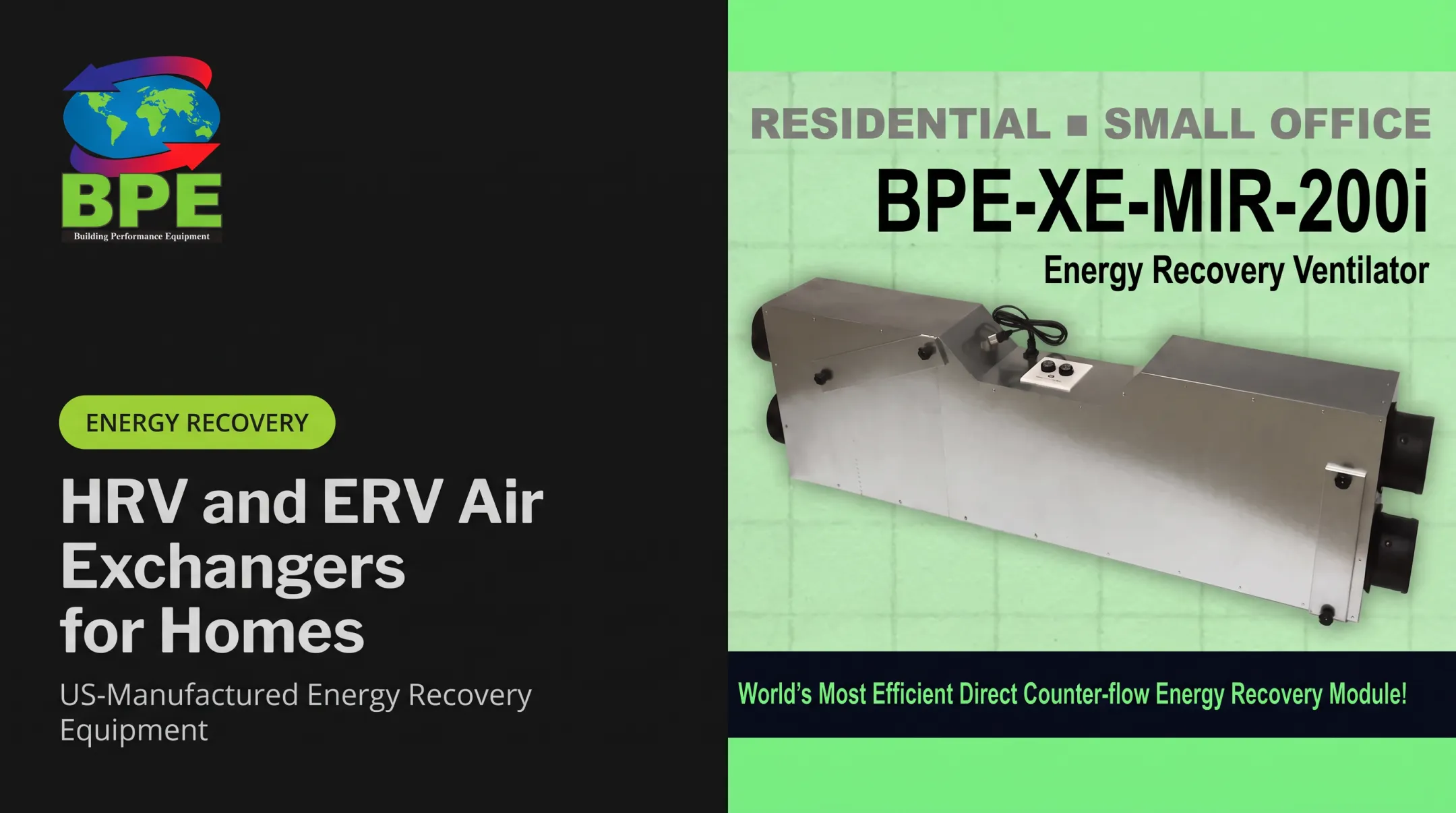
Counter-flow heat exchangers, like the ones Building Performance Equipment builds into its ERV and HRV lines, can push effectiveness as high as 99%, well above the cross-flow (up to 75%) and parallel-flow (around 50%) designs still common in basic air exchangers. That gap alone explains why core geometry matters more than the generic product label.

What Is an Air Exchanger?
Strip away the marketing and an air exchanger simply moves air into and out of a building. It dilutes indoor pollutants, removes stale air, and brings in fresh outdoor air. That's the whole job description: nothing in the term guarantees heat recovery, balanced flow, or moisture control.
Five Configurations, Five Different Jobs
- Exhaust-only: Removes indoor air; replacement air leaks in through gaps or passive vents. Depressurizes the building.
- Supply-only: Pushes outdoor air in mechanically; indoor air exits through available paths. Pressurizes the building.
- Balanced (no recovery): Matches supply and exhaust volumes without conditioning the incoming air.
- HRV: Balanced airflow plus sensible heat transfer.
- ERV: Balanced airflow plus heat and partial moisture transfer.
Air exchangers show up in homes, multifamily buildings, schools, universities, offices, and industrial plants. Each system still has to match the space's required outdoor-air rate and the contaminants present.
Dozens of New Jersey classrooms, for example, have used hundreds of BPE ERVs with displacement ventilation to meet fresh-air needs without overhauling existing HVAC.
One important caveat: an air exchanger does not automatically replace kitchen exhaust, bathroom exhaust, lab fume hoods, or process exhaust for hazardous fumes. Source-control ventilation is often still required on top of whole-building air exchange.
What Is an HRV?
A heat recovery ventilator exhausts stale indoor air and supplies fresh outdoor air while transferring sensible heat through a heat-exchange core. Supply and exhaust air streams pass through the core on separate paths (they never physically mix), but heat still moves from the warmer stream to the cooler one.
Winter and Summer Operation
In winter, outgoing warm indoor air preheats the incoming cold outdoor air before it ever reaches your living space. In summer, the reverse happens: cooler indoor exhaust air tempers the hot incoming air, cutting the cooling penalty of bringing in fresh outdoor air.

That's a meaningful difference from basic exhaust fans, which just dump conditioned air outside and let your furnace or AC do all the work replacing it.
Design Factors That Actually Matter
- Sensible recovery efficiency at the airflow you'll actually run, not just the peak-rated number
- Fan power at operating static pressure, since a high efficiency rating paired with a power-hungry fan can erase the savings
- Frost or defrost control, critical for cold-climate installs
- Condensate drainage, filters, sound levels, and access for maintenance
BPE's own engineering takes a slightly different angle on the HRV-versus-ERV question. Its standard ERVs discharge moisture only to the outside, but they can be fully sealed on request to function strictly as HRVs, which matters for buildings where winter humidity buildup is the chief concern. BPE's CO2-based demand controls, set to a 600 ppm engage point and 500 ppm disengage point, also help match recovery ventilation to actual occupancy under ASHRAE 62.1.
HRVs tend to make the most sense in colder climates, airtight envelopes, schools or multifamily buildings needing continuous outdoor air, and any project where heat recovery matters but moisture transfer doesn't.
Air Exchanger vs HRV: What Is Better?
An HRV may be the better air exchanger when a project needs balanced ventilation plus sensible heat recovery. But "air exchanger" alone is too broad a term to crown a single winner: you have to define the configuration first.
Climate and Indoor Humidity
- Consider an HRV when winter condensation or excess indoor moisture is the primary concern
- Consider an ERV instead when the goal is humidity moderation — that's a separate comparison from air exchanger vs. HRV
Cold climates carry real code weight here. The 2024 IECC requirements mandate balanced recovery ventilation in climate zones 7 and 8, with at least 65% recovery at 32°F at or above the design airflow. If your project sits in one of those zones, the decision is partly made for you.
Matching Capacity to Actual Demand
Don't size equipment off a square-footage rule of thumb. Match unit capacity to:
- Calculated outdoor-air requirements for the space
- Occupancy and operating schedule
- Room-by-room airflow distribution
- Duct static pressure
- Applicable ventilation standards (ASHRAE 62.1 for commercial, 62.2 for residential)
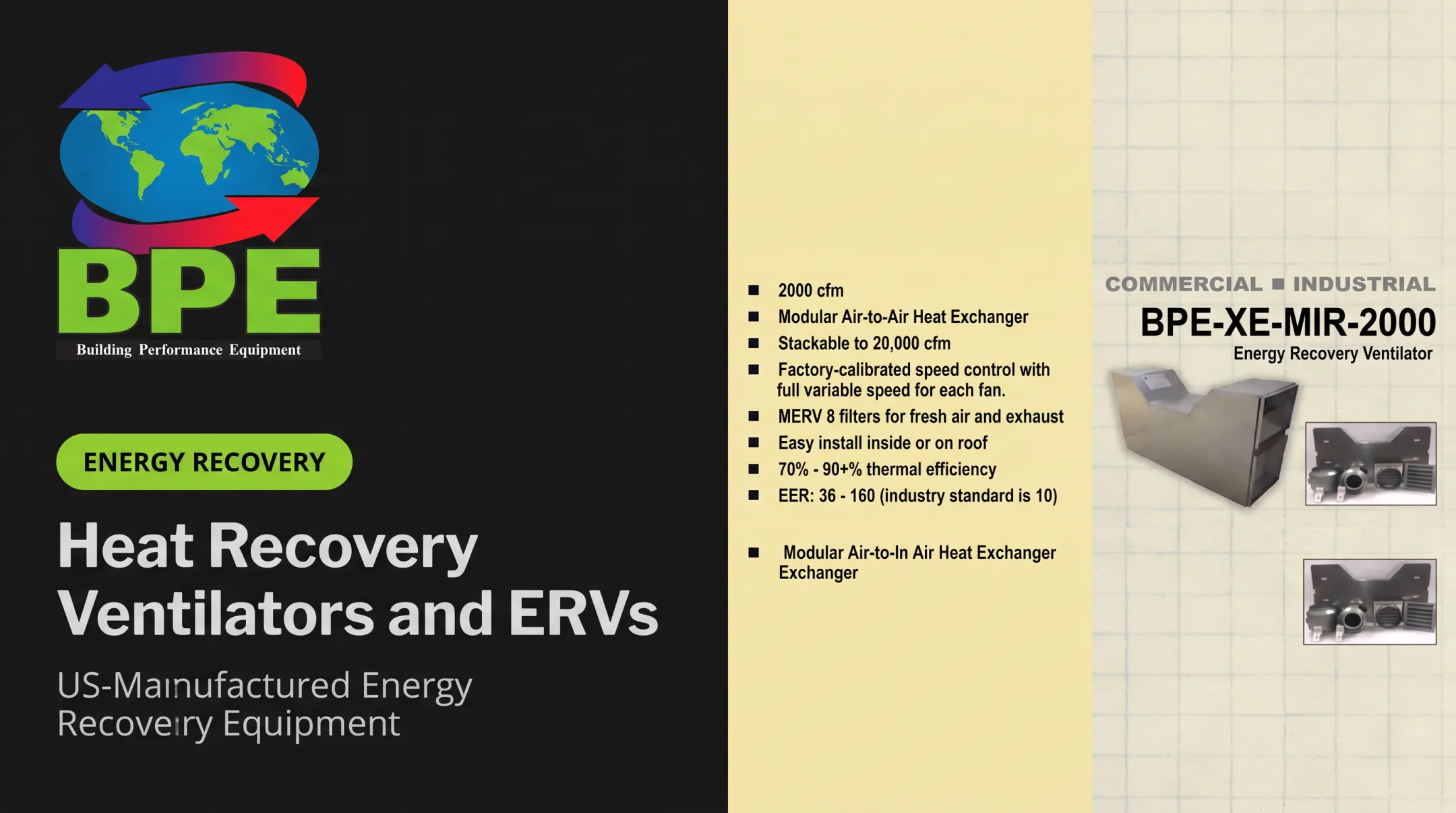
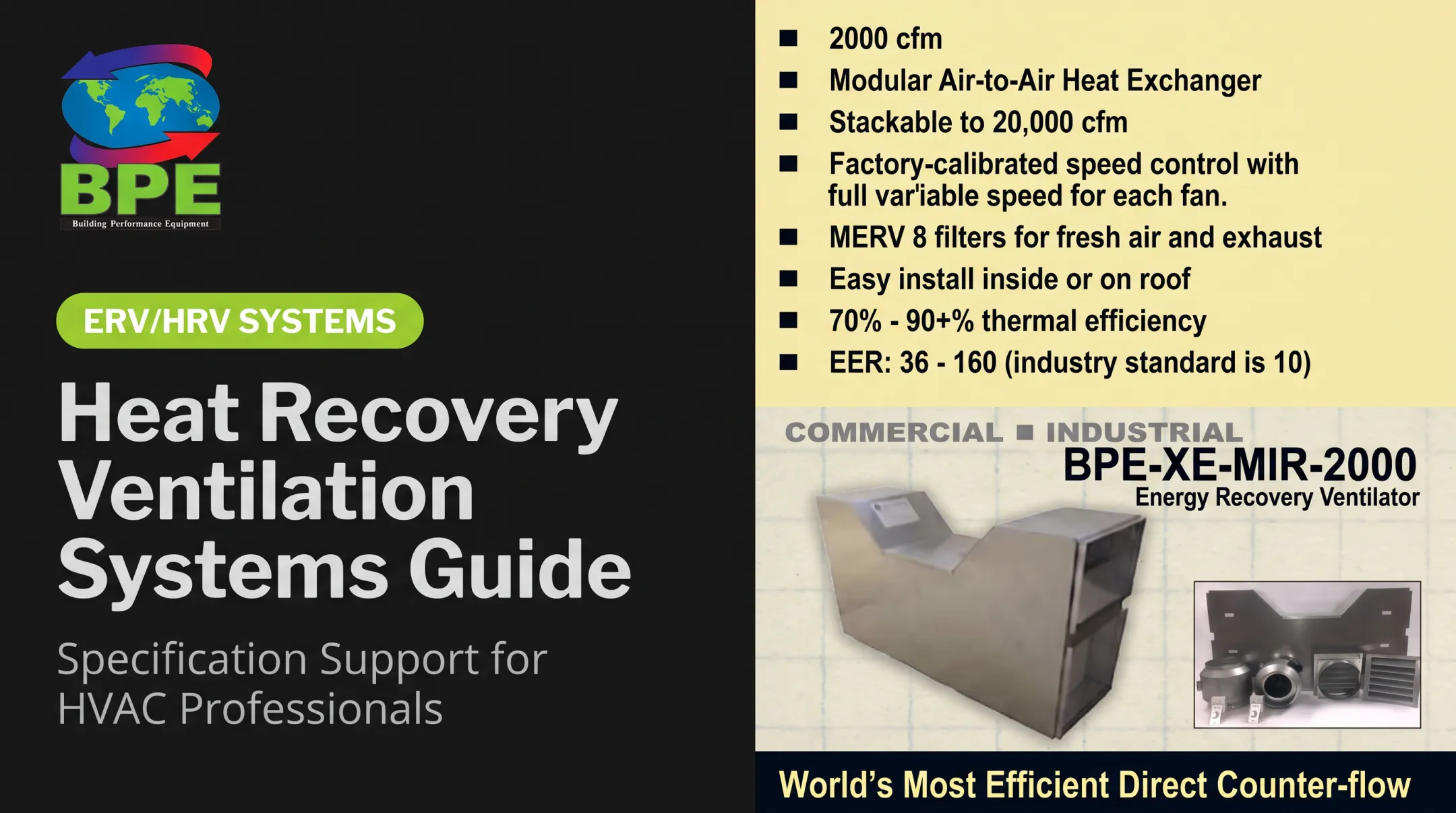
BPE's preliminary sizing guideline starts at 20 CFM per person, scaling from compact 60-200 CFM units for a small office or six-person home up to modular systems stacking to 20,000 CFM for industrial plants. Larger projects still warrant a design professional's review.
Lifecycle Factors Beat Purchase Price
Compare more than the sticker price:
- Installation and ductwork complexity
- Electrical consumption over the operating schedule
- Filter and core maintenance access
- Controls integration (BACnet, CO2 sensors)
- Cost of conditioning the ventilation air itself
When an HRV isn't the right call:
- Incompatible contaminants or specialized exhaust treatment needs
- Inadequate frost protection for the climate
- Humidity goals that call for moisture transfer instead
- Poor duct design that undermines balanced airflow
- Process exhaust such as solvent-laden air in a perfume plant or humid, chemically intensive exhaust from a tannery
For teams weighing these trade-offs, Building Performance Equipment helps project teams evaluate high-efficiency air-to-air energy recovery equipment and integrated controls against the specific performance numbers a project demands, rather than a nominal efficiency percentage on a spec sheet.
Real-World Applications and Case Study Guidance
Numbers tell the story better than generalities. The DOE's Seattle study documented a commercial HVAC conversion that included an HRV as part of a broader dedicated-outdoor-air-system retrofit. Modeled HVAC energy use intensity dropped from 31.2 to 9.6 kBtu per square foot per year (a whole-system result, not an HRV-only figure), but a clear signal of what balanced recovery ventilation can contribute to a retrofit.

BPE's own project history reflects similar patterns across very different building types:
- Hunterdon Regional High School: energy recovery ventilators cut facility energy consumption by 26.7%
- Hopewell Valley School District: 13 classroom retrofits recaptured 80-95% of thermal energy normally exhausted
- Grainger Warehouse: exceeded 94% sensible thermal efficiency without raising energy bills
- Plymouth Cultural Center: four ERVs hit an EER of 27 for cooling and nearly 73 for heating
These projects were chosen over basic exhaust-only air exchangers because the buildings needed continuous outdoor air and a way to avoid paying full HVAC price to condition it.
When Industrial Exhaust Changes the Equation
Not every application is a straightforward swap. The Casella Welding Shop upgraded its BPE ERV system specifically to meet ASHRAE and OSHA ventilation guidelines as welding fumes increased with expanded operations. Process exhaust containing hazardous chemicals (welding fumes, tannery emissions, solvent vapors from fragrance manufacturing) needs engineering review before energy recovery equipment gets anywhere near that airstream.
The real comparison was never "air exchanger versus HRV." It's whether the selected system safely delivers the required air, recovers energy effectively, and holds up over its service life.
If you're weighing options for a school, multifamily property, or industrial facility, Building Performance Equipment can walk through project-specific airflow, recovery, and controls requirements before you commit to equipment.
Conclusion
An HRV is one specific type of heat-recovery air exchanger. "Air exchanger" itself is the broader umbrella term, covering everything from a basic exhaust fan to a fully balanced energy-recovery system. Neither label tells you whether a system fits your building.
The right choice comes down to factors beyond terminology:
- Climate zone and indoor humidity goals
- Building use and required airflow
- Contaminants in the exhaust stream
- Ductwork constraints
- Verified equipment performance data
Before buying or installing anything, get a documented ventilation assessment along with professional sizing, balancing, and commissioning. That groundwork costs far less than correcting an undersized or mismatched system later.
Frequently Asked Questions
Are HRV and air exchanger the same?
No. An HRV is a type of air exchanger, but not every air exchanger is an HRV. Basic exhaust, supply-only, and non-recovery balanced systems are all air exchangers without heat recovery.
What is better, an HRV or an ERV?
Both recover heat; an ERV also transfers moisture, while an HRV doesn't. The better choice depends on your climate, indoor humidity levels, building airtightness, and ventilation goals.
Is an HRV system worth it?
It depends on your indoor-air-quality needs, climate, operating schedule, and installation cost. In colder regions with airtight construction, the energy savings and comfort gains typically justify the investment when properly sized and commissioned.
Should I turn off my air exchanger in the summer?
Not routinely. Operating schedules should follow outdoor conditions, indoor humidity, and your equipment's controls , not a seasonal habit. Follow the manufacturer's instructions and applicable ventilation standards instead.