
The problem is well documented. Tightly sealed buildings without dedicated mechanical ventilation can trap indoor pollutants at levels well above outdoor conditions, according to EPA's indoor air guide. Cracking a window isn't a real fix either. It dumps conditioned air outside and lets in cold, hot, or humid air with nothing to temper it first.
An energy recovery ventilator (ERV) solves this differently. It continuously swaps stale indoor air for filtered outdoor air while recovering a large share of the heat, and often the moisture, from the air leaving the building. This article covers how ERVs work, where they add the most value, how they compare to HRVs, and what to check before specifying or buying one.
Key Takeaways
- An ERV swaps stale indoor air for filtered outdoor air while recovering heat and moisture from the exhaust stream.
- Energy recovery can cut the heating and cooling load tied to ventilation air, not eliminate it entirely.
- Performance depends on airflow balance, core technology, filtration, static pressure, and controls working together.
- ERVs and HRVs serve different moisture goals; climate and occupancy decide which one fits.
- Equipment choice should match building type, code requirements, and the owner's maintenance capacity.
What Is an ERV and How Does It Provide Fresh Air?
An energy recovery ventilator is a balanced mechanical ventilation system with two separate air paths: one bringing outdoor air in, one pushing indoor air out.
That role differs from common alternatives:
- A bathroom exhaust fan, which only removes air
- An air purifier, which recirculates and filters the same indoor air
- HVAC recirculation mode, which rarely adds outdoor air at all
The Fresh-Air Cycle
Outdoor air enters through an intake hood, passes through a filter, crosses the energy-exchange core, and reaches occupied rooms. At the same time, stale indoor air gets pulled out, filtered separately, and routed across the same core before exiting outdoors.
The streams run in opposite directions, trading energy as they pass, but they never physically mix.
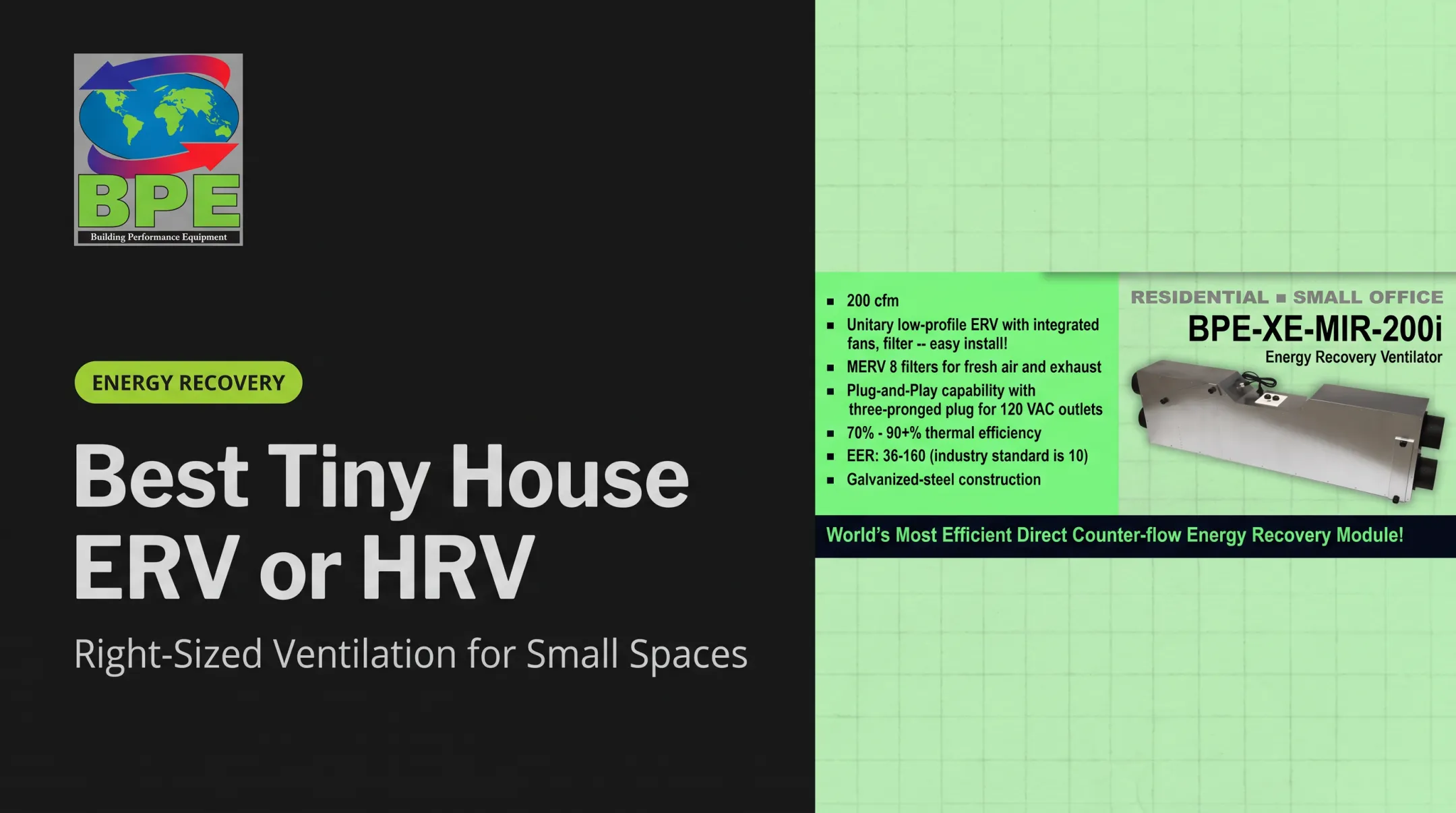
Building Performance Equipment's residential and light-commercial units, for example, use two in-line fans, one pulling fresh air in and one pushing stale air out, with a fixed-plate counter-flow core doing the energy exchange between them.

Core Components
- Supply and exhaust fans move the two air streams at a balanced, measurable flow rate
- Filters capture dust and debris before it reaches the core or downstream ductwork
- The energy-exchange core transfers sensible heat and, on enthalpy or fixed-plate designs, latent moisture
- Dampers, sensors, and controls set airflow targets, manage bypass, and run operating schedules
Why Separation Matters
The two air streams stay physically isolated while energy moves across the core, as DOE's energy saver guide explains. Leakage or cross-contamination between streams defeats the purpose of fresh-air delivery, so sealing and duct construction quality matter as much as a core's rated effectiveness.
Fixed-plate designs, like the counter-flow core BPE uses, separate the streams with a solid membrane rather than a rotating wheel. That limits the carryover risk that comes with some wheel-based cores.
Seasonal Operation
- Winter: outgoing warm indoor air preconditions incoming cold outdoor air before it reaches the space
- Summer: outgoing cooler indoor air tempers incoming hot outdoor air, trimming the cooling coil's workload
- Humidity transfer: moisture moves between streams depending on climate, occupancy, and the core's latent rating, moderating indoor humidity rather than controlling it outright
Rated sensible and latent effectiveness vary by product and test condition. Independently tested data matters more than a single headline efficiency number on a spec sheet.
Why Use an ERV for Fresh Air and Building Performance?
Continuous outdoor-air exchange dilutes indoor-generated pollutants: odors, carbon dioxide, VOCs, excess moisture. That's standard indoor air quality practice. Dedicated source control and spot exhaust are still necessary for hazardous or concentrated contaminants. An ERV dilutes background pollutant levels; it doesn't replace exhausting a chemical process directly at the source.
Energy Savings Are Real, But Not Universal
Preconditioned outdoor air reduces the heating or cooling work your HVAC system does after that air enters the building. A Sustainability journal study found calibrated heating-period energy savings of roughly 18% to 19% when comparing ERV recovery mode against bypass mode in a classroom setting. Those figures describe heating-equipment electricity under specific test conditions, not a universal whole-building savings number for every project.
BPE's own field data points the same direction. A strip-mall renovation using BPE's ERV system delivered 100% outdoor-air ventilation at under 0.75 W/CFM and hit apparent sensible heat-recovery effectiveness above 86%. Supply air stayed in the 60s on a 24°F design day, eliminating the need for a separate reheat system entirely.

Humidity and Comfort
Latent-energy transfer can help in humid summers and dry winters, but an ERV doesn't replace dedicated humidification or dehumidification once building loads exceed its capacity. BPE's Regenerative Condensate Return technology, for instance, is rated for up to 34% latent effectiveness in hot, humid conditions. That takes the edge off summer humidity without acting as a standalone dehumidifier.
Where ERVs Help Most
- Airtight homes and high-performance buildings with little uncontrolled air leakage to rely on
- Schools, offices, and multifamily buildings with high or variable occupancy
- Healthcare and senior-living facilities where outdoor-air rates aren't optional
- Retrofit projects needing higher outdoor-air rates without a full HVAC replacement
What an ERV Won't Fix
An ERV won't fix:
- Poor duct design or unbalanced airflow
- Dirty filters or a badly placed outdoor-air intake
- Excessive static pressure
- A control sequence nobody actually commissioned
The equipment is only as good as the system it's dropped into.
ERV vs. HRV: Which System Is Better?
Both systems exchange stale indoor air for fresh outdoor air and recover heat. The difference comes down to moisture: an ERV transfers heat and moisture between air streams, while an HRV recovers sensible heat only.
Neither is universally better. The right choice depends on climate, indoor moisture generation, envelope airtightness, occupancy, and code requirements.
| Condition | ERV Behavior | HRV Behavior |
|---|---|---|
| Cold, dry winter | Returns some exhaust moisture to incoming air, offsetting low indoor humidity | Recovers heat only; no moisture return |
| Hot, humid summer | Transfers incoming moisture to outgoing air, easing the cooling system's latent load | No latent recovery; cooling handles all incoming moisture |
| Mild climate, small loads | Recovery benefit may not outweigh fan energy cost | Same fan-energy trade-off applies |
A Quick Decision Checklist
- Indoor humidity problems – Is the building too dry in winter or too humid in summer?
- Winter design conditions – How cold does it get, and is frost protection built in?
- Summer latent loads – How much moisture does the cooling system already remove?
- Occupancy and building use – Does occupancy swing enough to change moisture generation significantly?
- Contaminant control – Are there pollutants that shouldn't cross between streams at all?
- Code and engineering review – Have a qualified mechanical engineer confirmed local code and project-specific loads before you lock the choice?
Some product lines bridge the gap. BPE's ERVs, for example, can be fully sealed to operate as HRVs on request. That lets a project team standardize on one core platform while still choosing different moisture strategies building by building.
How to Select, Install, and Maintain an ERV
Start With Ventilation Requirements
Outdoor airflow requirements come from the applicable building code, ASHRAE 62.1 for commercial buildings, 62.2 for residential, or 170 for healthcare, combined with actual occupancy and room use. BPE's preliminary sizing rule, for instance, starts at 20 CFM per person, then adjusts for room type and code minimums.
Also factor in building size, occupancy schedules, zoning, duct routing, and whether the project is new construction or a retrofit.
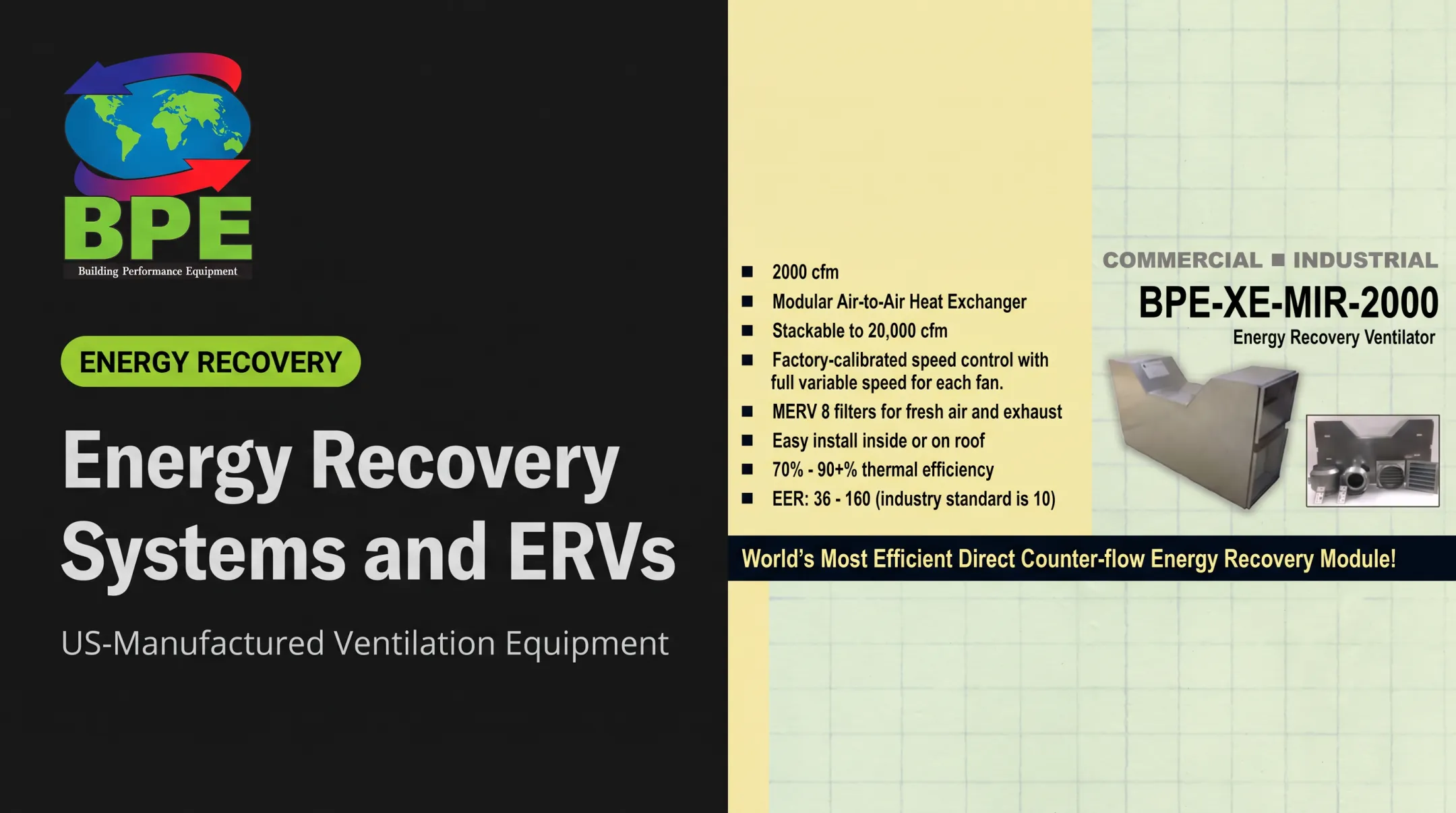
Schools and multifamily buildings often favor modular, stackable units that move through a standard doorway without crane picks. BPE's commercial and industrial packages are designed to fit through a 36-inch door and assemble with two people and standard dollies.
Compare Specs, Not Headlines
- Supply and exhaust airflow at the actual operating static pressure, not just rated conditions
- Sensible and latent effectiveness, fan energy, and sound levels
- Filtration options (MERV 8 is standard on many units; MERV 13 is available for finer particulate control)
- Frost-protection logic for cold climates
- Outdoor-air and exhaust-air leakage performance, confirmed through independent testing such as AHRI 1060
Installation Essentials
- Locate intake and exhaust hoods away from vehicle exhaust, dumpsters, or chemical storage
- Insulate and seal ductwork with mastic, not tape, especially in unconditioned spaces
- Keep duct runs short and straight, with linear flow rates under 500 feet per minute to cut noise and pressure loss
- Plan filter and core access clearance before the unit goes in, not after
- Confirm electrical requirements and condensate management where the design calls for it
Balancing and Controls
Verify that supply and exhaust airflow are balanced, or intentionally offset, according to the design, not just assumed because the unit powers on.
Controls should cover:
- Occupancy schedules
- Demand-control ventilation tied to CO2 sensors
- Humidity interlocks with the main HVAC system
- Cold-weather operating logic
Commissioning should confirm actual delivered airflow and pressure, not just that the fans spin.

Maintenance Expectations
- Inspect intake and exhaust openings for debris or blockage
- Replace or clean filters on a schedule tied to loading, not just the calendar
- Inspect the core and fans for fouling, frost damage, or gasket wear
- Verify dampers and sensors are reading and responding correctly
- Schedule professional service based on manufacturer guidance and actual operating conditions
BPE builds its ERVs around a fixed-plate core with no moving parts, which simplifies upkeep. Expected service life runs more than 20 years with reasonable maintenance.
If you're specifying or buying equipment, Building Performance Equipment supplies air-to-air energy recovery equipment and building-performance solutions for commercial, institutional, multifamily, and challenging-climate projects. Review BPE's current submittals for verified airflow, efficiency, static-pressure, and controls data, and involve an engineer or contractor before finalizing selection.
Frequently Asked Questions
What does an energy recovery ventilator (ERV) do?
An ERV brings in filtered outdoor air, exhausts stale indoor air, and transfers heat and typically moisture between the two separate streams. This cuts the conditioning load your HVAC system would otherwise carry alone.
Is an HRV or ERV better?
Neither wins outright. Compare moisture transfer needs, climate, indoor humidity, occupancy, and building use before choosing one over the other.
Does an ERV bring in fresh air?
Yes, an ERV is designed to supply outdoor air while exhausting indoor air. "Fresh" still depends on intake location, filtration, correct airflow, and actual outdoor air quality at your site.
Where are ERVs commonly used?
Airtight homes, schools, universities, multifamily buildings, offices, and retrofit projects all use ERVs regularly. Industrial process exhaust needs specialized engineering review beyond standard ERV selection.
How often does an ERV need maintenance?
Filters, cores, fans, ducts, dampers, and controls all need periodic inspection and cleaning or replacement. Follow the manufacturer's schedule and adjust for your building's actual operating conditions.