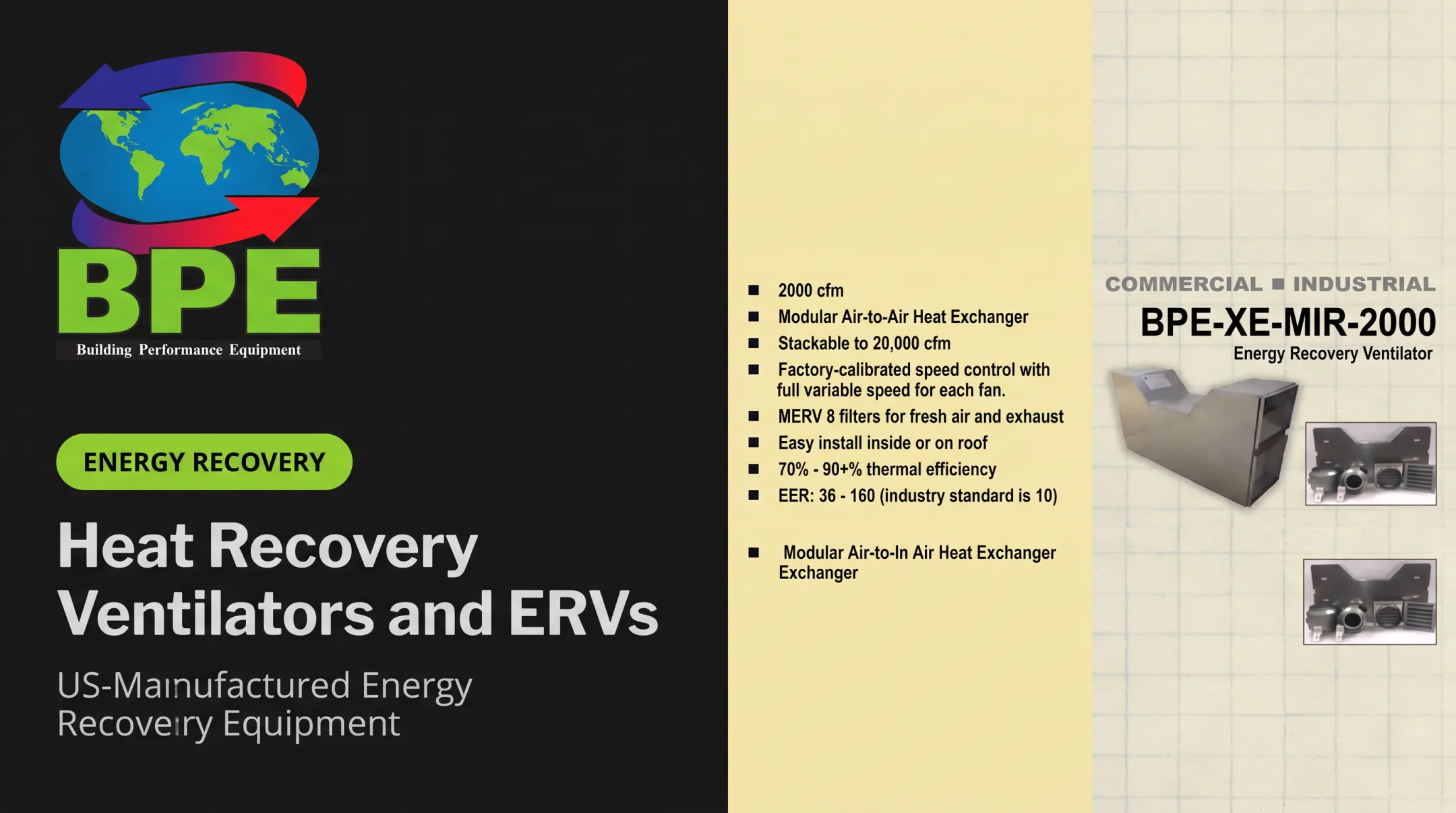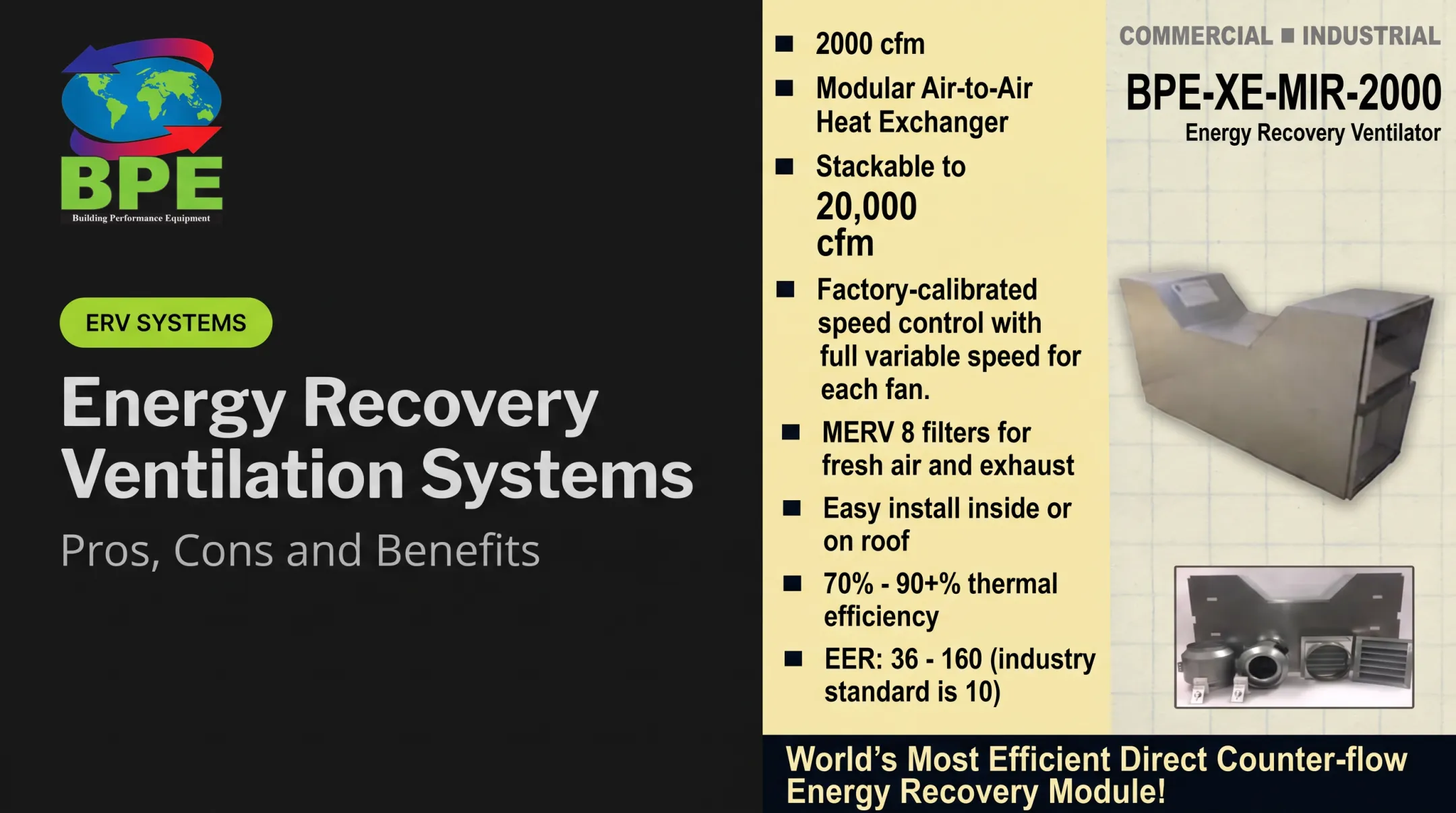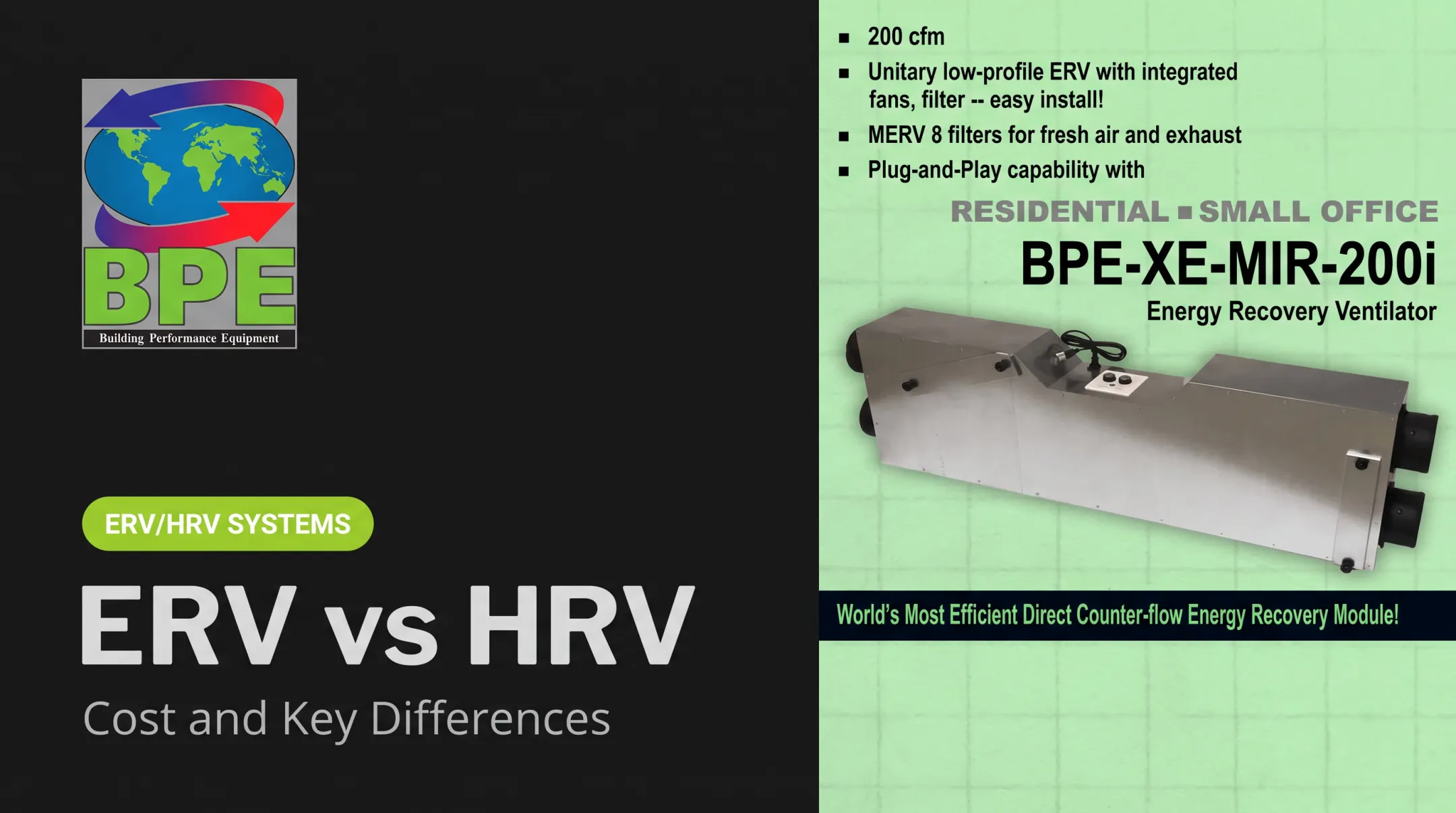

This is where the choice between an Energy Recovery Ventilator (ERV) and a Heat Recovery Ventilator (HRV) becomes critical. Choosing the wrong system can lead to poor indoor humidity control, higher utility bills, and even moisture damage to the building itself. This guide breaks down the core differences, use cases, and decision criteria to help you select the right ventilation strategy for your facility or high-performance home.
Key Takeaways
- HRVs transfer only sensible heat (temperature), making them best for cold climates where the primary goal is to exhaust excess indoor moisture.
- ERVs transfer both sensible heat and latent heat (moisture), allowing them to retain humidity in dry winters and block it in humid summers.
- The right choice depends on your climate zone, building occupancy, and how airtight the structure is.
- Advanced ERVs, like the patented systems from Building Performance Equipment, can achieve over 90% thermal recovery, maximizing energy savings and minimizing the need for costly defrost cycles in cold weather.
ERV vs. HRV: Quick Comparison
Both ERVs and HRVs are balanced ventilation systems that exhaust stale indoor air and supply fresh outdoor air at the same time. The key difference is how they handle moisture.
Core Composition and Mechanism
- ERV (Energy Recovery Ventilator): Uses an enthalpy core, often a semi-permeable membrane, to transfer both heat and water vapor between airstreams. Building Performance Equipment (BPE) designs use counter-flow heat exchangers to maximize that transfer.
- HRV (Heat Recovery Ventilator): Uses an impermeable aluminum or plastic core that transfers only sensible heat (temperature) and keeps the airstreams separate so moisture cannot cross.
Moisture & Humidity Management
- ERV: Balances indoor humidity year-round. In winter, it moves moisture from outgoing air into incoming dry air; in summer, it removes moisture from incoming humid air before it enters the building.
- HRV: Does not transfer moisture. In cold weather, excess indoor humidity condenses and drains away—useful with high internal moisture loads, but it can overdry air during long heating seasons.
Climate Suitability
- ERV: Best suited to climates with hot, humid summers and cold, dry winters, where year-round humidity stability matters.
- HRV: Often chosen for consistently cold climates that need continuous moisture exhaust to limit condensation. Building tightness and occupancy can matter more than climate alone, as noted in a Building Science Corporation report.
Cost and Initial Investment
- ERV: Slightly higher upfront cost because of the enthalpy core, often offset by lower cooling and dehumidification loads over time.
- HRV: Lower initial purchase price, but may need supplemental humidification or dehumidification depending on climate, which raises lifecycle cost.
Maintenance & Condensate Requirements
- ERV: Little to no condensate under most conditions, which simplifies installation and lowers drain freeze-up risk in winter.
- HRV: Produces condensate in cold weather, so it needs a trapped drain line and frost-control cycles that can use extra energy.
What Is an Energy Recovery Ventilator (ERV)?
An Energy Recovery Ventilator (ERV) is a ventilation device that preconditions incoming fresh air using the energy from the outgoing exhaust air. It recovers and transfers both sensible heat (temperature) and latent heat (moisture), which cuts the load on your primary HVAC system.
By tempering outdoor air before it reaches your air conditioner or furnace, an ERV can:
- Cut energy use for heating, cooling, and dehumidification
- Allow smaller, lower-cost primary HVAC equipment on new construction
- Help hold indoor relative humidity (RH) between 40–60% year-round
Building Performance Equipment (BPE) high-efficiency ERVs are engineered to precondition fresh outdoor air to within 10°F of room temperature in a single pass, without extra mechanical heating or cooling.

Use Cases of ERVs
ERVs fit most climates and building types that need strong performance and indoor air quality (IAQ).
- Commercial & institutional: Schools, offices, and healthcare facilities use ERVs to meet ASHRAE 62.1 ventilation rates without driving energy costs up.
- Multifamily housing: Apartments and condos get continuous fresh air with energy recovery, a common path to modern code compliance.
- High-performance & net-zero homes: Essential in airtight homes for solid IAQ with minimal energy penalty.
- Specialized facilities: Server rooms and manufacturing plants that move large outdoor-air volumes for cooling or process exhaust recover a large share of that exhaust energy.
Research from Lawrence Berkeley National Laboratory found that membrane-based enthalpy recovery in office buildings can yield annual HVAC energy savings of 11–17% in a humid climate like Miami.
BPE’s proprietary Regenerative Condensate® Return Technology delivers up to 34% latent (moisture) efficiency in hot, humid summer conditions, which further trims cooling load.
What Is a Heat Recovery Ventilator (HRV)?
A Heat Recovery Ventilator (HRV) is a mechanical ventilation system that uses exhaust air to precondition incoming fresh air and recovers only sensible heat (temperature). Its impermeable core keeps moisture from transferring between the airstreams.
The primary function of an HRV is to provide fresh air while efficiently capturing waste heat during the heating season. That recovered heat helps prevent condensation on windows and inside wall assemblies—a serious risk in tightly sealed buildings in cold regions.
Use Cases of HRVs
HRVs fit specific scenarios, almost exclusively cold climates where excess indoor humidity is the main challenge.
- Vent moisture from airtight, high-occupancy homes in northern cold climates
- Exhaust extreme humidity from commercial laundries, indoor pools, and kitchens
- Keep contaminated process exhaust out of supply air in industrial facilities
To ensure performance in these conditions, products must meet strict standards. For example, to earn an ENERGY STAR rating in Canada, an HRV must demonstrate a minimum of 60% sensible recovery efficiency at -13°F (-25°C), according to Natural Resources Canada's technical specification.

For facilities that truly require an HRV, Building Performance Equipment can modify its ERVs with fully sealed cores to function as high-efficiency HRVs on request.
ERV vs. HRV: What Is Better?
The better choice depends on matching the equipment to your building’s climate, airtightness, and occupancy—not on one technology winning in every case. A few engineering and site factors drive the decision.
1. Climate and Humidity
This is the most important factor.
- Choose an ERV if: You are in a mixed-humid, hot-humid, or hot-dry climate—or anywhere you run AC in summer and heat in winter.
- Consider an HRV if: You are in an extremely cold climate and fight excess indoor humidity, such as window condensation all winter.
2. Building Airtightness and Occupancy
A very tight building with many occupants (like a small apartment) traps more moisture than a leaky building with few people. That can make an HRV viable even in a mixed climate—or make an ERV a poor fit in a cold climate if it holds too much moisture.
A proper building assessment is the only reliable way to settle that call.
3. The BPE High-Efficiency ERV Advantage
Historically, ERVs in cold climates were prone to frosting and needed energy-intensive defrost cycles. Many projects chose HRVs to avoid that problem.
High-efficiency designs have closed much of that gap. Building Performance Equipment’s ERVs achieve over 90% thermal efficiency, so they can run in freezing conditions without electric resistance preheaters. They precondition frigid outdoor air enough that core frosting risk drops sharply.
That removes the parasitic energy loss of traditional defrost strategies. A high-efficiency ERV can be more energy-efficient—and more effective—than an HRV, even in the cold.

Real-World Example: Hopewell Valley Regional School District
When the Hopewell Valley Regional School District in New Jersey needed better indoor air quality across six schools, it faced a familiar challenge. The district had to bring in significantly more fresh air without overloading existing HVAC systems or launching a costly structural retrofit.
The Solution: The district retrofitted thirteen classrooms with modular BPE Energy Recovery Ventilators. The modular units assemble on-site in existing mechanical rooms, so crews avoid cranes and major rooftop modifications.
The Results: The BPE ERVs delivered:
- Over 80% heat recovery efficiency, capturing energy that would otherwise be exhausted
- A 30% to 40% reduction in heating and cooling loads
- 758,435 kWh less electricity use annually—a 25% savings
High-efficiency ERVs met code-compliant ventilation needs while cutting energy use enough to support a strong payback.
Engineers, facility managers, and contractors aiming for similar results can get custom ERV sizing, technical schedules, and energy recovery engineering support from Building Performance Equipment. Contact us at 201.722.1414 to discuss your project.
Conclusion
The ERV vs. HRV decision comes down to moisture. An HRV is a specialized tool for exhausting excess humidity in cold climates. An ERV transfers both heat and moisture year-round, which fits most mixed and humid U.S. climates.
Choosing the right ventilation strategy helps you:
- Improve indoor air quality with controlled fresh-air exchange
- Cut heating and cooling energy use through recovery
- Protect the building from moisture-related damage
For most applications outside the coldest, driest regions, a high-efficiency ERV offers the stronger long-term balance of comfort, IAQ, and energy performance.
Frequently Asked Questions
What is the difference in cost between an HRV and an ERV unit?
ERVs can have a higher initial equipment cost due to their advanced moisture-transferring core. However, lifecycle savings on cooling and dehumidification often offset that cost.
Should I run my ERV or HRV year-round?
Yes, continuous balanced ventilation is recommended whenever the building is occupied. This ensures consistent indoor air quality by removing indoor pollutants and properly tempering all incoming fresh air.
Should I use an ERV or HRV?
For most climates with both a heating and cooling season, an ERV is the better choice for balancing moisture. An HRV is best suited for very cold climates where the primary goal is to remove high levels of indoor humidity.
Is HRV or ERV better in cold climates?
HRVs traditionally vent excess moisture in cold climates, but advanced ERVs like those from BPE often perform better. They keep indoor air from getting too dry and run at high thermal efficiency, which reduces frost and defrost energy use.
Do I need a dehumidifier if I have an ERV?
In extremely humid climates, yes. An ERV reduces moisture entering the building but does not remove moisture already inside. A dehumidifier or air conditioner may still be needed for extreme humidity or internal moisture gains.
Where should an ERV be installed?
ERVs are best installed in a conditioned or semi-conditioned space like a mechanical room, basement, or utility closet. Placing them near an exterior wall allows for shorter, more efficient duct runs to the outside.