
For U.S. homeowners, builders, HVAC contractors, and facility managers, picking between the two affects more than comfort. It shapes equipment cost, installation complexity, humidity control, HVAC sizing, and what you'll spend on operation over the next 20 years.
The core distinction is simple: an HRV transfers sensible heat only. An ERV transfers sensible heat and some moisture. That one difference drives almost every decision covered below.
Key Takeaways
- HRVs suit buildings where exhausting excess indoor moisture is the priority
- ERVs often work better where seasonal or year-round humidity balance matters
- Cost depends on capacity, ductwork, controls, labor, and commissioning, not just sticker price
- Both systems cut HVAC loads and improve air quality when properly sized; airtightness, occupancy, and frost risk matter as much as climate
- Building Performance Equipment supplies high-efficiency air-to-air energy recovery equipment for projects where ventilation, comfort, and energy performance all need to work together
ERV vs HRV: Quick Comparison
Cost
ERVs typically carry a higher equipment price than HRVs because their core transfers moisture in addition to heat, which requires different membrane or plate materials and often more sophisticated controls.
PickHVAC's market estimates put typical U.S. residential installed costs between $1,200 and $6,000 for homes under roughly 3,000 square feet, with unit prices commonly falling between $700 and $2,500 before installation.
HRVs can cost less upfront since the design is simpler: no latent-transfer core and no condensate strategy tied to moisture recovery. That said, cold-climate HRVs often need added defrost controls, which can close some of that cost gap.
Installation scope
Both systems need:
- Ductwork and insulated outdoor hoods
- Controls and electrical connections
- Airflow balancing and commissioning
- Integration with existing HVAC equipment
ERVs may require condensate management where latent transfer produces moisture buildup. HRVs in cold climates need dedicated defrost provisions and drainage, since frost on the core can restrict airflow if it isn't managed.
Heat and moisture transfer
An ERV's core transfers sensible heat and a portion of moisture between the two airstreams. It helps balance loads but does not replace a dedicated humidifier or dehumidifier.
An HRV transfers sensible heat without intentionally moving moisture. That can help exhaust excess indoor humidity in summer, but it may contribute to dry indoor air during winter in some climates.
Climate and building fit
ERVs tend to work best in humid, mixed, or moisture-sensitive buildings, where retaining or rejecting some moisture eases the HVAC system's latent load. HRVs fit cold or dry climates where heat recovery and moisture removal are the main goals.
Operating and lifecycle cost
Lifecycle cost comes down to fan electricity use, how much heating and cooling load the system removes, filter and core maintenance, and expected service life. Fan power matters more than most buyers realize. Industry guidance targets roughly 1 W/CFM or less for efficient operation.

Routine maintenance adds predictable cost over the equipment's life:
- Filter changes every 1-3 months
- Core cleaning around every six months
- Annual professional service
Utility incentive programs can offset some of that, though terms vary by state and program.
What is an ERV?
An energy recovery ventilator is a balanced mechanical ventilation system. It exhausts stale indoor air and supplies outdoor air simultaneously, using two separate fans. While the fans move air, a dedicated core transfers sensible heat and some moisture between the airstreams. The airstreams never mix: moisture transfer happens through the core material, not through air blending.
A typical residential unit includes:
- An energy-recovery core (often a counter-flow design)
- Supply and exhaust fans
- Filters (commonly MERV 8) on both airstreams
- Speed controllers and duct connections
- Optional CO2 or humidity sensors for demand-based control
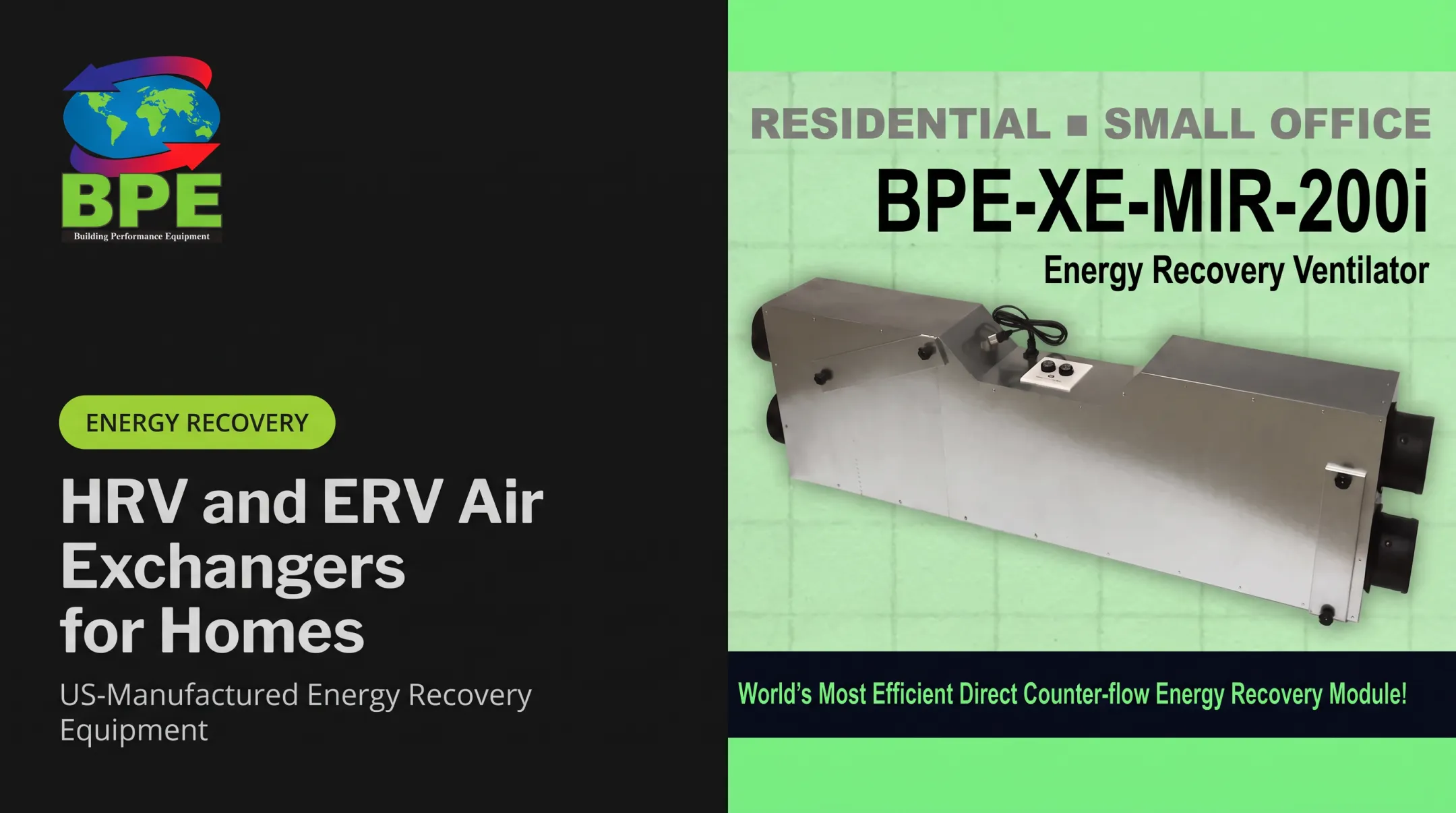
Building Performance Equipment's plug-and-play residential model, for example, ships factory-wired with two MERV 8 filters, dual speed controllers, and 6-inch duct attachments, ready to connect to a standard outlet.
Benefits when properly selected and commissioned:
- More reliable outdoor-air delivery than exhaust-only ventilation
- Lower heating and cooling load from ventilation air
- More stable indoor humidity across seasons
- Better occupant comfort
ERVs don't heat or cool a building independently, and they don't eliminate the need for dedicated kitchen or bathroom exhaust. They're a ventilation component, not a full HVAC replacement. Performance is typically rated using sensible and latent effectiveness figures, along with metrics like Exhaust Air Transfer Ratio, certified through AHRI's testing program.

Where ERVs make sense
ERVs suit humid and mixed-climate homes, high-performance and net-zero buildings, multifamily housing, schools, and commercial spaces where fresh-air codes would otherwise drive up HVAC loads. In industrial settings such as tanneries, fragrance manufacturing, and chemical processing, exhaust chemistry matters. Some processes need specialist separation or treatment rather than a standard ERV core.
Retrofits are a strong use case. At a Carmelite monastery, five BPE-XE-MIR-3000 units were installed to protect CNC equipment from dust while controlling humidity in the surrounding workspace—a practical example of an ERV solving both a contamination and moisture problem in one retrofit.
What is an HRV?
A heat recovery ventilator is a balanced ventilation system that transfers sensible heat between outgoing and incoming air without intentionally moving moisture. The core preheats incoming winter air or precools incoming summer air, while keeping supply and exhaust physically separate.
Main benefits:
- Continuous outdoor-air ventilation
- Reduced ventilation-related heating and cooling demand
- Lower risk of pressure imbalance compared to exhaust-only systems
- Exhausts excess indoor moisture without returning it to the supply air
Common cost drivers and limitations:
- Winter condensation and drainage requirements
- Frost-control or defrost cycles in cold climates (these typically engage once outdoor temperatures drop near freezing)
- Potential for dry indoor air in winter
- Fan energy, filters, ductwork, and commissioning costs
Building Performance Equipment's ERV platform can be configured to function as an HRV when a building runs overly humid in winter. That option suits projects where the moisture-transfer feature of a standard ERV isn't wanted. BPE's heat-recovery units are built for service life beyond 20 years with routine maintenance.
Where HRVs make sense
HRVs fit cold or dry U.S. climates, airtight homes, Passive House-style projects, schools, and multifamily buildings where moisture needs to be exhausted while heat is recovered. They're often the better call for condensation-prone or mold-sensitive buildings.
One caveat: don't apply blanket climate rules. A building in a cold region can still run humid indoors due to occupancy or activities like cooking and showering. HRVs also make sense when a building already has dedicated humidification or dehumidification equipment, leaving the ventilation system to focus purely on heat recovery.

ERV vs HRV: What is Better?
There's no universal winner. The right choice depends on moisture direction, climate, building airtightness, occupancy, required ventilation rate, exhaust contaminants, equipment location, and lifecycle cost, together, not in isolation.
Cost factors to compare
Separate equipment price from the full installed cost:
- Ductwork, electrical work, and controls
- Outdoor hoods and drainage
- Structural modifications where needed
- Balancing, commissioning, and startup
- Ongoing maintenance and replacement parts
Lifecycle thinking matters more than base price. If an ERV core has a projected 4-year life span, add the cost of five replacement cores and their installation labor to the base price for an accurate 20-year comparison.
A cheaper unit with a short core life can cost more over time than a pricier unit built for two decades of service.
Climate and humidity decision rules
- Choose an HRV when the building sits in a cold or dry climate and the main objective is heat recovery plus exhausting unwanted indoor moisture
- Consider an ERV when the building faces humid summers, mixed seasonal conditions, or needs moisture moderation alongside heat recovery
- Watch for exceptions: a cold-climate building with unusually dry interiors, or a humid building with condensation concerns, won't follow the general rule. Measure actual indoor relative humidity before deciding
Technical and project-selection criteria
Airflow requirements should come from occupancy, floor area, and room use, checked against applicable codes, not floor area alone. ASHRAE's residential ventilation formula (Qtot = 0.03 × floor area + 7.5 × (bedrooms + 1), measured in CFM) from ASHRAE's Standard 62.2 gives a starting point, but professional sizing also accounts for duct resistance and boost ventilation needs.

Also compare fan curves at expected static pressure, sound levels, filtration, frost protection, and compatibility with existing HVAC equipment. Specialized environments (chemical exhaust lines, tanneries, fragrance manufacturing, server farms) need an engineer to confirm contaminant separation and code compliance before any standard ERV or HRV gets specified.
A real-world example: hot yoga studio ventilation
A 300-square-foot hot yoga studio in Woodstock, NY, faced a specific problem: 90-105°F classes generate heavy CO2 buildup and moisture from student exertion. Without proper ventilation, poor air exchange risked exposing clients to airborne pathogens.
The space had 11-foot ceilings, 3,200 cubic feet of air volume, and needed 12-inch ductwork, plus near-silent operation for the meditative setting.
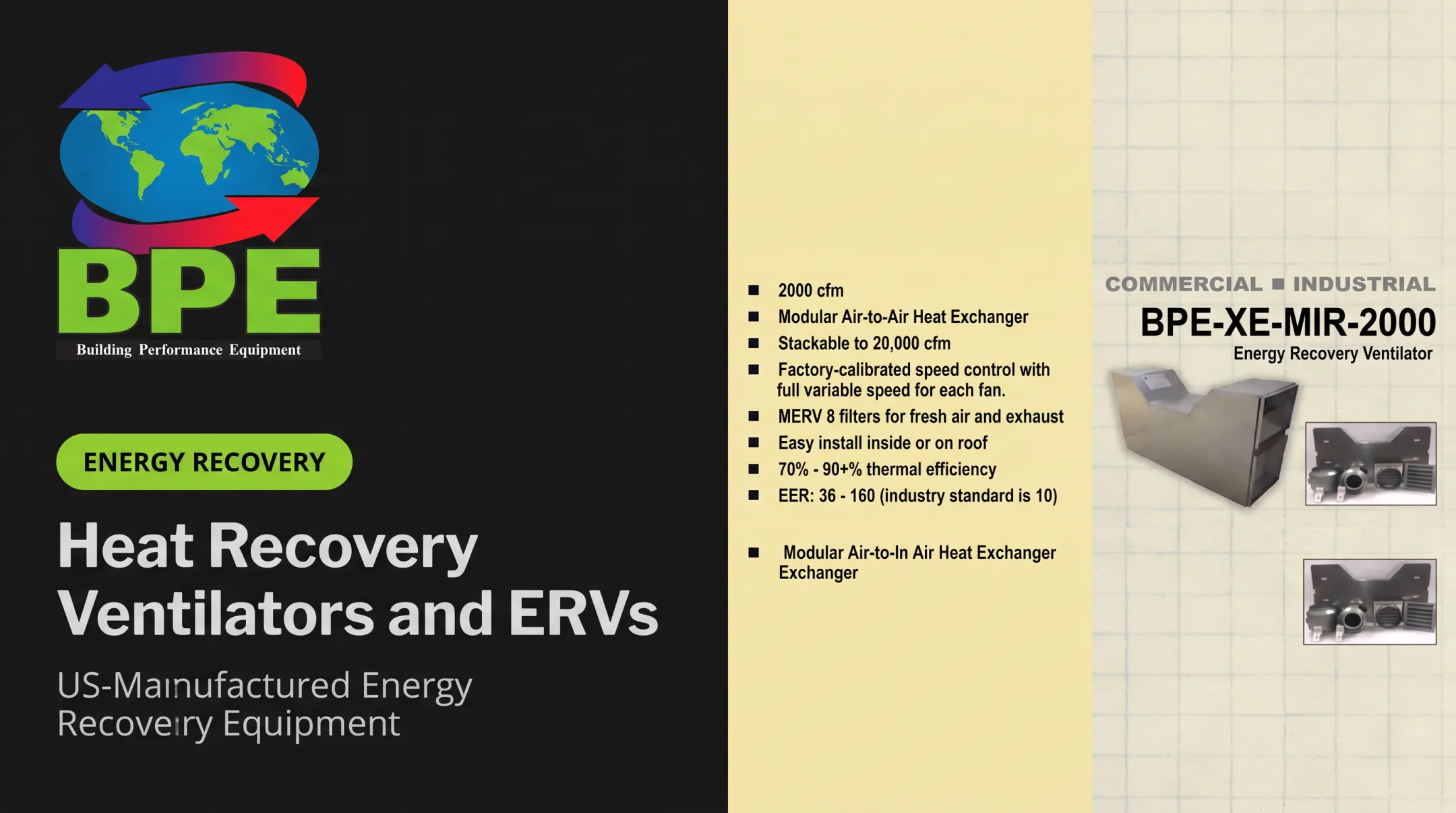
The project team selected a BPE-XE-MIR-2000 ERV, delivering up to 2,000 CFM through two in-line fans, rather than an HRV. The moisture-transfer capability of the ERV core was the deciding factor, given the humidity load generated by a room full of sweating students.
Situational takeaway: when occupancy drives both heat and heavy moisture output, an ERV's dual transfer function solves a problem an HRV can't.
Selection pathway
- Shortlist an ERV if your climate is humid, mixed, or the building has a meaningful moisture load to manage
- Shortlist an HRV if your climate is cold and dry, and moisture removal (not retention) is the goal
- Get an engineered comparison if your building has contaminant exhaust, unusual occupancy patterns, or mixed indoor humidity readings that don't match the regional climate norm
If you're planning a retrofit, new build, or high-performance ventilation project, reach out to Building Performance Equipment for help evaluating airflow requirements, controls, and system integration.
Conclusion
Both ERVs and HRVs deliver balanced, energy-conscious ventilation. The difference comes down to moisture: ERVs transfer it along with heat, while HRVs focus purely on heat recovery and let moisture exhaust with the stale air.
That one distinction affects installed cost, humidity performance, HVAC sizing, indoor air quality, and long-term maintenance. Skip the unit-price comparison and look at lifecycle outcomes instead: capacity, controls, ductwork, commissioning, and how the system performs in your building over 15–20 years.
Frequently Asked Questions
How much does it cost to install an HRV or ERV system?
U.S. installed costs vary by unit capacity, equipment type, ductwork, controls, electrical work, labor, and commissioning. Request an itemized estimate from a contractor using current local pricing rather than relying on a national average.
Should I replace my HRV with an ERV?
Replacement depends on indoor humidity, climate, building airtightness, the condition of your existing system, and your ventilation goals. Get an assessment before swapping out a functioning HRV.
What size ERV do I need for a 2,000 sq ft house?
Floor area alone isn't enough. Sizing depends on occupancy, bedroom count, required outdoor-air rates, room distribution, boost ventilation needs, duct resistance, and applicable codes like ASHRAE 62.2.
What's the main difference between an ERV and an HRV?
Both recover sensible heat, but an ERV also transfers some moisture between airstreams. That difference affects indoor humidity control, climate suitability, and how much latent load your HVAC system handles.
Is an ERV or HRV better for a cold climate?
HRVs often suit cold, dry conditions since there's no need to retain moisture. However, a cold climate with unusually dry interiors, or meaningful seasonal humidity, may still favor an ERV. Check measured indoor conditions, not just regional climate labels.
Do ERV and HRV systems save money on energy bills?
Both can reduce ventilation-related heating and cooling loads when properly sized and commissioned. Actual savings depend on climate, operating schedule, fan power, building airtightness, and maintenance. Ask for sourced data on any specific savings claim.