
That combination is why ERV manufacturers are getting a harder look than they used to. New residential leakage limits are tightening from 5 to 4 ACH50 in warmer climate zones and from 3 to 2.5 ACH50 in colder ones, according to the 2024 IECC presentation. Tighter buildings need mechanical ventilation that doesn't waste energy doing it.
This guide won't crown a "best" manufacturer. The right choice depends on your building type, airflow needs, climate, contaminants, installation constraints, and how much technical support you actually need after the sale. We'll walk through evaluation criteria, a shortlist of manufacturers active in the US market, application-specific guidance, and the questions worth asking before you specify anything.
Key Takeaways
- Brand reputation tells you little; compare the specific model's certified airflow, recovery data, and service requirements
- Residential, institutional, cold-climate, and industrial ERV applications call for different equipment entirely
- Confirm installation access, frost control, filtration, and warranty terms before you commit to a purchase
- Treat contaminated industrial exhaust as an engineering and safety question first, standard ERV application second
What Does an Energy Recovery Ventilator Manufacturer Provide?
An ERV is a balanced ventilation system. It exhausts stale indoor air and brings in outdoor air simultaneously, transferring heat and, depending on the core, moisture between the two airstreams. That's the baseline definition, but it undersells what you're actually buying.
ERV vs. HRV: Why the Distinction Matters
An HRV recovers heat only. An ERV recovers heat and a portion of water vapor, which matters directly for humidity control.
In practice, some manufacturers build flexibility into the same hardware. BPE's ERV cores, for instance, can be fully sealed on request to function as HRVs when a project doesn't need moisture transfer. That's a useful option if your humidity strategy changes mid-design.
The Equipment You'll Actually Encounter
Manufacturers package this technology differently depending on scale:
- Compact residential/light-commercial units - plug-and-play designs serving roughly 60-200 cfm, built for homes up to six occupants or small offices
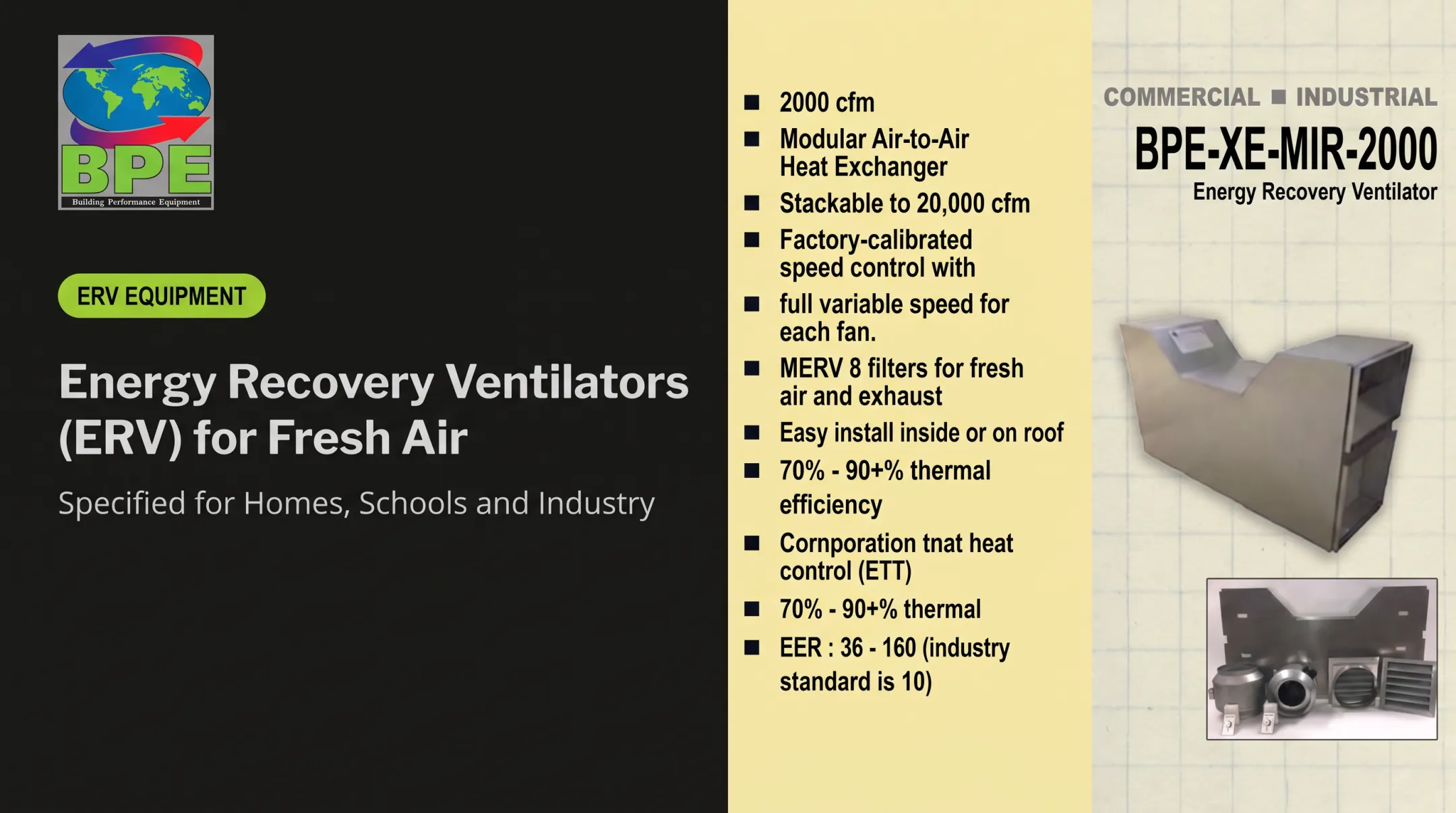
- Modular energy recovery modules - cores without integrated fans, often 400-1,100 cfm, designed for flexible duct integration
- Unitary systems - pre-wired packages with fans, filters, and controls built in, commonly 500-3,500 cfm
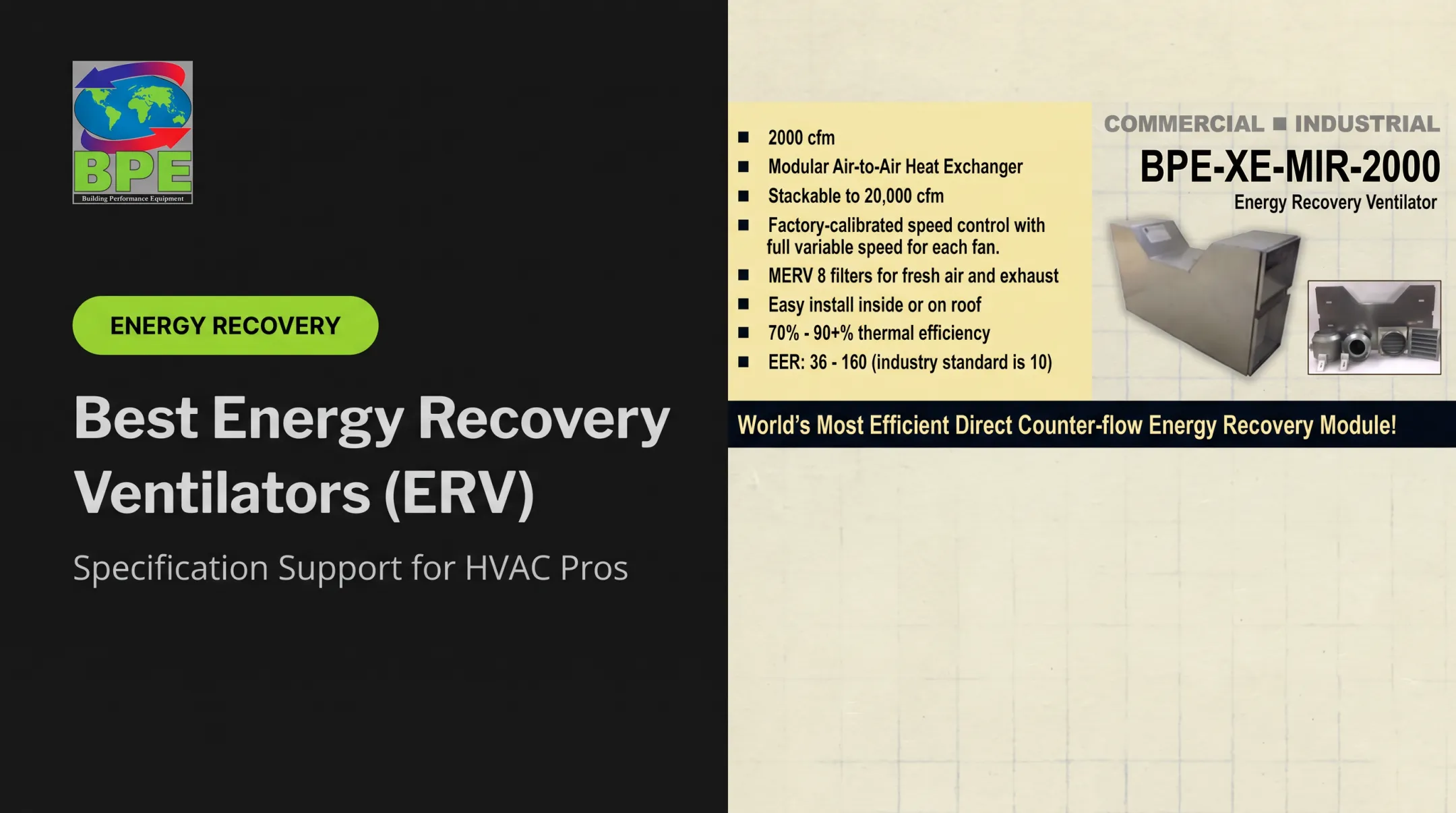
- Stackable commercial/industrial systems - modules that combine into configurations from 4,000 up to 20,000 cfm for large facilities
The Manufacturer's Job Doesn't End at the Cabinet
A manufacturer's real value shows up in the paperwork and support around the box: engineering documentation, AHRI 1060 performance data, installation and maintenance guides, AutoCAD files, and warranty terms. A unit with great specs but no usable submittal package creates headaches during permitting and commissioning. Ask for the documentation before you ask for a price.
How to Compare Energy Recovery Ventilator Manufacturers
Brand-level efficiency claims are marketing. Model-specific, certified performance data is what actually predicts how a unit behaves on your project.
Airflow at Your Actual Static Pressure
Nominal maximum airflow is close to meaningless if your ductwork runs it at a higher external static pressure. Pressure drop climbs as airflow increases, and that relationship isn't linear.
One commercial unitary model, for example, shows intake pressure rising from 0.15 in. W.C. at 400 scfm to 0.72 in. W.C. at 1,100 scfm. The number that matters is airflow at your design pressure, not the catalog maximum.
Certified Metrics vs. Marketing Numbers
AHRI's certification program for air-to-air ERVs covers models rated between 50 and 5,000 scfm, and it certifies specific ratings, not a general efficiency score. According to AHRI's certification program, certified ratings include:
| Metric | What it tells you |
|---|---|
| Sensible effectiveness | Heat transfer performance |
| Latent effectiveness | Moisture transfer performance |
| Supply/exhaust pressure drops | Fan energy implications |
| EATR (exhaust air transfer ratio) | How much exhaust air leaks into supply |
| OACF (outdoor air correction factor) | Airflow correction for real conditions |
Total effectiveness and fan electrical input are reported separately and shouldn't be confused with the certified exchanger ratings. Always pull the actual directory listing for the exact model, not a brand-wide claim.
Cold-Climate and Frost Performance
Frost risk depends on exhaust humidity, exchanger type, and outdoor temperature. According to ASHRAE's 2024 Handbook, sensible-only devices can see frost around 23°F, while total-energy devices may hold out to roughly -5°F.
Some manufacturers set their own application thresholds. BPE's larger commercial module, for example, recommends direct consultation below -10°F or 40% relative humidity rather than guessing at a blanket number.
Defrost strategy matters almost as much as the threshold. Exhaust-only or recirculation defrost can stop outdoor-air delivery entirely during a cycle, which defeats the purpose if your occupancy requires continuous fresh air.

Installation and Service Realities
Before specifying, confirm:
- Cabinet orientation and clearance - ceiling, wall, or roof-truss mounting changes structural requirements
- Access for filters and cores - sealed, removable panels should be standard, not an upgrade
- Modular assembly needs - some systems fit through a standard 36-inch door and assemble without a crane; others don't
- Duct connection sizing - diameter varies by airflow tier, so confirm it matches your ductwork plan
Energy Recovery Ventilator Manufacturers to Consider in the US Market
This is a non-ranked shortlist. Verify current US availability, certifications, and model documentation directly with each manufacturer before specifying.
Residential and light-commercial portfolios:
- Broan-NuTone
- Panasonic (recently launched its Intelli-Balance Elite series)
- Fantech
- Venmar (now operating under Broan-NuTone)
- Lifebreath
- RenewAire
Large HVAC and integrated commercial suppliers:
- Carrier
- Daikin
- Mitsubishi Electric
- Honeywell Home/Resideo
- Swegon
- TROX (US corporate presence confirmed; a specific current balanced ERV/HRV model was not independently verified at research time)
These integrated suppliers can make sense when a project already runs their rooftop units or controls platform, since airside integration gets simpler.
International and North American suppliers worth a closer look (pending verification of US distribution and support):
- Zehnder
- Vents-US
- Exinda
- Shanghai Airko
Confirm compliance documentation and local technical support before committing to any of these for a US project.
Building Performance Equipment is a New Jersey-based manufacturer worth including for its engineering-led approach. The company's founder chaired two ASHRAE technical committees, including the one on air-to-air energy recovery, and holds multiple patents on recovery devices and controls.
BPE's range runs from 60-cfm residential plug-and-play units through 20,000-cfm stackable industrial systems. Units use counter-flow heat exchanger technology and, on some models, Regenerative Condensate Return technology that reaches roughly 34% latent effectiveness without a condensate drain.

Verify specific model documentation for any project before specifying.
Which ERV Manufacturer Fits Your Building Type?
Homes, Multifamily, and High-Performance Construction
Prioritize compactness, airflow range, sound levels, and simple duct configuration. Compact units built for Passive House or net-zero targets, with MERV 8 filtration and factory-calibrated variable speed controls, reduce commissioning headaches on single-family and small multifamily jobs.
A 60-200 CFM unit that plugs into a standard outlet and connects to existing ductwork is a very different installation project than a ducted whole-house system.
Schools, Universities, and Commercial Retrofits
Outdoor-air capacity and modularity matter more here than raw compactness. Schools often need to raise ventilation rates without structural changes to rooftops, which is where stackable modules that assemble without crane picks earn their keep.
Hopewell Valley Regional School District cut energy consumption by more than 32% over five years while improving both thermal comfort and indoor air quality. That outcome depended as much on commissioning and controls integration as on the hardware itself.
Industrial Facilities, Server Farms, and Process Environments
This is where a standard ERV spec stops being sufficient. ASHRAE's guidance identifies high temperatures, condensable gases, corrosives, and contaminants as factors that change equipment selection entirely.
A January 2011 ASHRAE interpretation treats certain classified exhaust streams, like laboratory fume hoods, as prohibited from any recirculation, including leakage through recovery equipment.
That doesn't rule out energy recovery for industrial exhaust. It means the exhaust stream needs engineering review first:
- What contaminants are present, and at what concentration?
- Does the exchanger material resist those contaminants and avoid cross-contamination?
- Are corrosion-resistant exteriors (galvanized or stainless steel) required?
- Does the application need enhanced filtration, such as 30% DSE or boar's-hair pre-filters at higher airflows?
BPE has supplied equipment for tanneries, perfume manufacturing, and machine shops where fumes need to be exchanged with outdoor air without cross-contaminating the supply stream. The same approach applies to server farms, where continuous, precise ventilation protects equipment.
Treat these as engineering projects, not catalog purchases.
How to Choose the Right Energy Recovery Ventilator Manufacturer
Start With a Project Brief
Before contacting any manufacturer, document:
- Building type and climate zone
- Required outdoor-air volume and occupancy schedule
- Duct and mounting constraints
- Humidity targets
- Available electrical service
This saves everyone time and gets you comparable quotes.
Request a Real Submittal Package
Ask for:
- Certified performance data and fan curves at your actual static pressure
- Sensible and latent recovery effectiveness under comparable test conditions
- Sound data, dimensions, weight, and clearance requirements
- Frost-control strategy and application limits
- Installation and commissioning instructions
Check Compliance and Lifecycle Details
A solid guide specification typically requires:
- AHRI 1060 certified performance testing
- Sensible effectiveness above 80% and latent effectiveness above 30%
- UL 507-listed fans
- A meaningful warranty (often limited lifetime, with about 10 years against heat-exchanger corrosion)
If a unit needs replacement heat-exchanger cartridges on a short cycle, build that cost into your bid comparison rather than discovering it later.
Compare Total Cost of Ownership, Not Sticker Price
Installation complexity, ductwork, controls, and ongoing fan electricity all affect the real cost. According to DOE's ventilation guidance, recovery economics are strongest in extreme climates and high-fuel-cost regions. In mild climates, extra fan energy can exceed what you save in recovered heat. Run the numbers for your climate before assuming a high-effectiveness unit pays for itself.
One documented commercial retrofit illustrates the stakes: a strip-mall project achieved 100% outdoor-air ventilation at under 0.75 W/cfm and more than 86% sensible heat-recovery effectiveness, eliminating a separate reheat system entirely. That kind of result depends on matching the unit to the building, not just picking the highest-effectiveness number on a spec sheet.

For complex retrofits, cold-climate installations, or industrial exhaust streams, bring in an experienced manufacturer or engineer before finalizing the specification. Building Performance Equipment is one option for project-specific review, though its equipment won't be the right fit for every application, and any manufacturer's input should be weighed against independent engineering judgment.
Frequently Asked Questions
How much does it cost to install an HRV system?
Installation cost varies by equipment capacity, ductwork, electrical and controls work, access, and regional labor rates. HRV and ERV costs aren't interchangeable, so get a project-specific quotation rather than relying on general estimates.
Do I really need an ERV?
Controlled energy recovery ventilation earns its keep in airtight buildings, spaces with high outdoor-air requirements, humidity-sensitive environments, and cold or extreme climates. A qualified design review is still the right first step before specifying anything.
What is the most efficient ERV?
There's no universally "most efficient" unit. Compare certified sensible, latent, and total effectiveness, fan power, pressure drop, and airflow at your actual operating static pressure for the exact model under consideration.
Where do you install an ERV system?
Common locations include mechanical rooms, ceilings, walls, rooftops, and per-unit distributed arrangements in multifamily buildings. The right spot depends on duct routing, drainage, clearances, noise tolerance, and manufacturer installation instructions.
What is the difference between an ERV and an HRV?
Both exchange stale indoor air for outdoor air and recover sensible heat. An ERV also transfers moisture or latent energy, which matters more in humid climates or buildings with strict indoor humidity targets.
How do I choose an energy recovery ventilator manufacturer?
Compare model-specific performance data, certifications, installation requirements, controls compatibility, documentation quality, service support, and total lifecycle cost. Ask for references from similar US projects before finalizing your choice.