
Americans spend about 90% of their time indoors, where some pollutant concentrations run two to five times higher than outdoor air, according to EPA's indoor air report. Energy-efficient construction without enough mechanical ventilation is a documented contributor to that gap.
An energy recovery ventilator (ERV) is built to close it. ERV ventilation services cover the full job: assessing a building's ventilation needs, designing the right system, selecting equipment, coordinating installation, commissioning, and keeping it maintained afterward. Done correctly, an ERV swaps stale indoor air for fresh outdoor air while recovering a share of the heat energy (and some moisture) that would otherwise be lost through an open window or a simple exhaust fan.
This guide covers what these services actually include, which buildings benefit most, how ERVs stack up against HRVs, and what to look for in a qualified US provider.
Key Takeaways
- An ERV is a balanced ventilation system that manages supply and exhaust airflow while recovering energy.
- Sizing, duct design, filtration, and commissioning determine real IAQ and efficiency outcomes.
- ERV systems serve residential, institutional, commercial, multifamily, high-performance, and select industrial buildings.
- Choose a provider that documents performance data and integrates cleanly with existing HVAC infrastructure.
What ERV Ventilation Services Include
Before any equipment is chosen, ERV work begins with an assessment of the building itself.
Assessing the Building and Selecting Equipment
A proper ERV service reviews the building envelope, occupancy patterns, climate exposure, existing HVAC equipment, and any indoor-air-quality complaints before recommending a strategy. From there, equipment selection hinges on several factors:
- Required supply and exhaust airflow, plus sensible and latent recovery targets
- Fan capacity and static pressure at actual duct, filter, and core resistance
- Filtration level, sound output, footprint, and service access clearances
- Control compatibility with the building's electrical and mechanical systems
Installation, Commissioning, and Ongoing Maintenance
Installation involves locating the unit, creating outdoor-air intake and exhaust penetrations, connecting ductwork, and providing drainage or frost protection where the climate demands it.
Commissioning follows: measuring airflow, balancing supply against exhaust, checking control sequences, and confirming sensors and filters are accessible and working.
After handover, maintenance typically covers:
- Filter replacement on a set schedule
- Core inspection and cleaning
- Outdoor hood and condensate (or frost-control) checks
- Fan and control verification, plus troubleshooting of airflow or humidity complaints
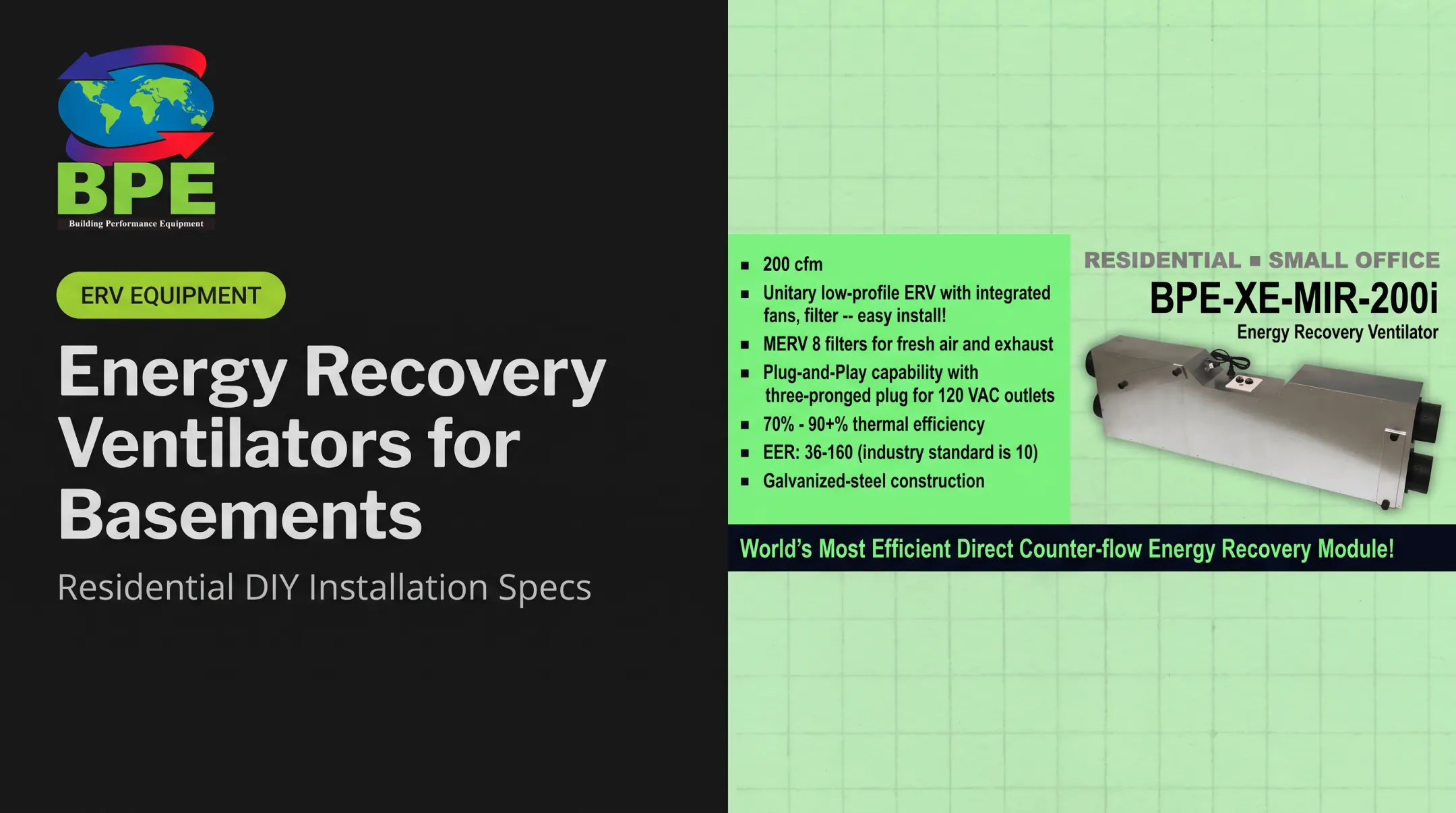
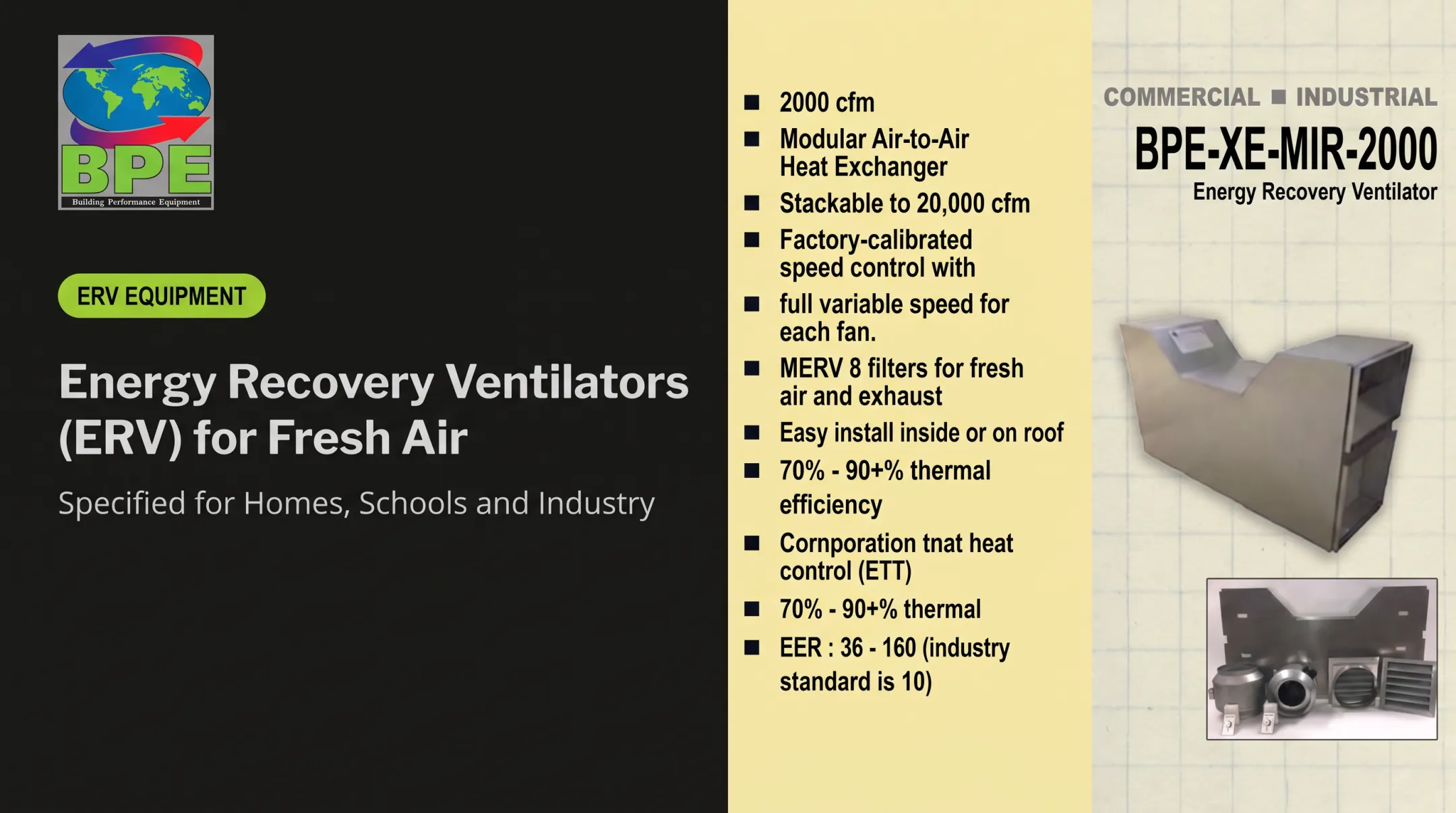
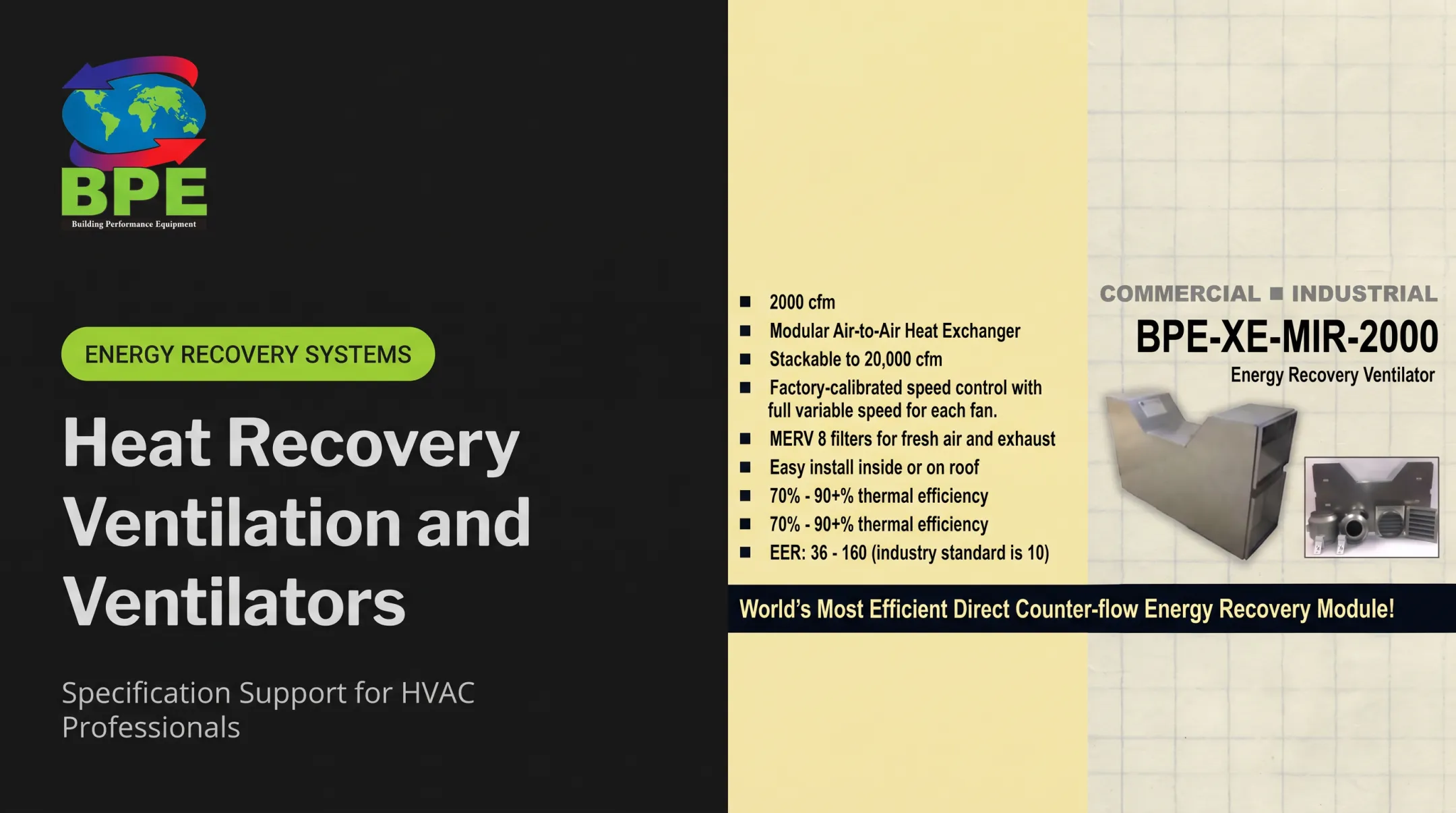
Building Performance Equipment manufactures high-efficiency air-to-air energy recovery equipment and builds integrated controls into its product line. Its guide specifications require more than 80% sensible and more than 30% latent thermal effectiveness under ARI 1060 testing, rather than a generic percentage pulled from marketing copy.
Because airflow needs and contamination risks vary by project, request equipment guidance specific to your building instead of assuming one model fits every application.
How ERV Systems Work and Why Professional Design Matters
An ERV runs two separate air streams: one fan pulls filtered outdoor air into the building, the other pulls stale indoor air out. Both pass through an energy-transfer core without intentionally mixing. BPE's systems, for instance, use two dedicated in-line fans so the fresh and exhaust streams stay thermally linked but physically separate.

Why Sizing and Static Pressure Aren't Optional
Oversized static pressure is one of the most common ways an ERV underperforms. Keep ductwork velocities under roughly 500 feet per minute, and a sharp 90-degree bend can add as much static pressure as an inline filter, eating into fan efficiency and raising noise levels.
Turning vanes placed around a sharp corner can cut that added static pressure by as much as 85%. Skip these details, and you get:
- Inadequate airflow
- Higher fan energy draw
- A system that never hits its design intent
Moisture Transfer Has Limits
An ERV moderates humidity loads by transferring some moisture between the two air streams. It does not replace air conditioning, dedicated dehumidification, humidification, or process-fume controls. Buildings with heavy moisture generation (commercial kitchens, natatoriums) still need those systems alongside the ERV, not instead of it.
Industrial exhaust is its own category entirely. Chemical, solvent, or odor-laden air streams need specialized engineering review before anyone decides whether energy recovery is even appropriate. BPE installed two units at a Massachusetts machine shop specifically to keep chemical fumes and excess humidity away from occupants. A New Hampshire auto shop used a similar unit to route welding and paint fumes safely through an exhaust vent rather than recirculating them.
The ERV Ventilation Service Process
A sound ERV project follows a sequence. Skipping steps is usually where problems start.
Assessment and Code-Based Calculations
The process begins by documenting building size, occupancy, operating hours, climate exposure, envelope tightness, and any existing humidity or ventilation complaints. Engineers then calculate outdoor-air and exhaust-air requirements using the applicable code edition.
ASHRAE's 2025 standards (62.1 for nonresidential buildings and 62.2 for residential units) set the current baseline most US jurisdictions reference, though local amendments can change the numbers. Confirm which edition your authority having jurisdiction has adopted before finalizing any calculation.
Design, Retrofit Planning, and Handover
Design work covers airflow schedules, equipment selection, duct routing, intake and exhaust placement, controls, filtration, and coordination with architectural and MEP drawings. Retrofit projects add another layer:
- Evaluate structural constraints that might rule out a rooftop unit or require a modular, stackable solution instead
- Plan duct tie-ins to existing systems without shutting down the whole building
- Sequence the work in phases if occupied spaces can't go offline all at once
Installation and start-up coordination then verifies equipment orientation, duct sealing, electrical connections, and filter placement before the system goes live.
At handover, a complete service package includes balancing results, controls documentation, maintenance instructions, warranty terms, and operator training, all commissioned to confirm the system performs as designed.

Where ERV Ventilation Is Useful (and the Signs You Need It)
ERV ventilation serves a wide range of building types, each with different drivers.
Building Types That Benefit
- Schools and universities: Classrooms and gyms need outdoor air without a heating and cooling penalty; Hopewell, NJ schools reported energy savings, comfort gains, and an ENERGY STAR rating
- Multifamily and affordable housing: Per-unit or central systems built for repeated installs and consistent tenant comfort
- Commercial and institutional buildings: Offices, retail, and hospitality where occupancy and hours drive design; one strip-mall retrofit delivered 100% outdoor air at under 0.75 W/cfm while exhausting restrooms and a kitchen
- High-performance and net-zero buildings: Energy recovery supports low-load operation in tight, well-insulated envelopes
- Industrial and specialized facilities: Manufacturing, perfume production, and server rooms where process exhaust needs separate contaminant-control review; Chanel Perfumes reported comfort gains with energy savings
Signs You May Need an Upgrade
Watch for these practical indicators rather than treating any single one as proof of the fix:
- Persistent stale or stuffy air, odors, or condensation on windows
- Uneven ventilation between rooms or recurring humidity complaints
- Elevated measured carbon dioxide during occupied hours
- Heavy reliance on open windows, or new complaints after air-sealing or insulation work
ASHRAE's CO2 guidance explicitly rejects treating 1,000 ppm as a universal pass-fail threshold. Occupancy, activity level, and air distribution all matter, and CO2 alone doesn't capture every contaminant.
One yoga studio used CO2 monitors to confirm two ERV units kept levels well-managed throughout class hours. Measure first, then size equipment to match.
Buildings with tight envelopes, high occupancy, or continuous operating hours usually need a deliberate balanced-ventilation strategy, not an isolated exhaust fan bolted on after the fact. Before specifying equipment, a proper assessment should also check filtration, duct leakage, moisture intrusion, combustion safety, and existing HVAC capacity.
ERV Versus HRV: Which Ventilation Approach Fits?
Both systems exchange stale indoor air for outdoor air and recover heat energy. The difference comes down to moisture: an ERV also transfers a portion of water vapor through its energy-transfer core, while an HRV handles heat only.
| Factor | ERV | HRV |
|---|---|---|
| Energy transferred | Heat and moisture | Heat only |
| Typically favored in | Humid climates, moisture-sensitive buildings | Cold, dry climates |
| Condensate/frost management | Often simpler due to moisture transfer | May need added frost protection |
| Common use case | Offices, schools, multifamily with humidity control goals | Dry climates with limited indoor moisture generation |
There's no universal answer here. Climate matters, but so does indoor moisture generation, humidity targets, equipment location, and maintenance access. A qualified designer evaluates the actual building rather than picking a label based on geography alone.
Some ERV cores, including BPE's, can even be sealed to function as an HRV if a building turns out to be too humid in winter. That flexibility helps when conditions shift after installation.
Choosing an ERV Ventilation Services Provider
Not every vendor can carry a project from assessment through commissioning. Confirm the provider can perform or coordinate:
- Building assessment and airflow calculations
- Equipment selection and duct design
- Controls integration and installation coordination
- Balancing, commissioning, and post-installation support
Ask for technical submittals before signing anything:
- Certified sensible and latent effectiveness data
- Fan curves, sound ratings, and filtration specs
- Installation requirements and control sequences
- Warranty terms and maintenance instructions
Experience with your project type matters too. A school retrofit, a multifamily building, and an industrial facility with process exhaust each demand different expertise.
Building Performance Equipment's CEO and Founder, Klas Haglid, P.E., R.A., brings decades of HVAC and energy-recovery experience to equipment design. That background includes time at DuPont Central Research and consulting work tied to US Department of Energy Ecolinks projects.
He is a past chair of two ASHRAE technical committees (Air to Air Energy Recovery, and Owning and Operating Costs) and holds multiple patents on energy-recovery devices and controls.
If you're planning a new ERV project or evaluating a retrofit, contact Building Performance Equipment at 201.722.1414 or info@bpequip.com to discuss equipment options and project-specific requirements.
Frequently Asked Questions
How much does an ERV cost?
Total cost depends on airflow capacity, equipment type, ductwork, controls, electrical work, and retrofit complexity. Request a project-specific estimate rather than relying on a generic price range.
What does ERV in HVAC mean?
ERV stands for energy recovery ventilator or energy recovery ventilation. It brings in outdoor air, exhausts stale indoor air, and transfers heat and some moisture between the two separate streams.
Should an ERV duct be insulated?
Insulation requirements depend on duct location, air temperature, climate, and condensation risk. Follow your project's design documents and the applicable mechanical code for your jurisdiction.
How often should an ERV be serviced?
Routine filter checks, core inspection, and airflow verification are standard, with exact intervals set by the equipment manual and your operating conditions. Facilities with heavier contaminant loads typically need more frequent checks.
Is an ERV suitable for commercial buildings?
Yes, when properly sized and integrated with existing HVAC controls. Specialized spaces — labs, kitchens, or facilities with process exhaust — need additional review of contaminants and pressure relationships before equipment is specified.