
Introduction
Every building needs outdoor air. Occupants exhale carbon dioxide, materials off-gas, and moisture builds up in bathrooms, kitchens, and labs. Without consistent air exchange, indoor air quality drops quickly.
There's a catch, though: every cubic foot of exhausted indoor air takes conditioned energy with it. In winter, that means losing heat you already paid for. In humid months, it means losing cooled, dehumidified air out the exhaust duct.
Energy-efficient ventilation systems solve this trade-off. By pairing incoming outdoor air with outgoing stale air across a heat-exchange core, they recover much of that energy before it leaves the building.
This guide covers how energy recovery ventilators (ERVs) and heat recovery ventilators (HRVs) work, and how to select the right system for your climate and building type. You will also see where these systems fit in residential, commercial, and industrial projects, plus the controls and maintenance that keep them performing year after year.
Key Takeaways
- Energy-efficient ventilation balances outdoor air needs with heat recovery, moisture, filtration, and fan energy.
- HRVs recover sensible heat only; ERVs also transfer moisture, driven by climate and humidity goals.
- Recovery efficiency alone doesn't set performance; pressure drop, fan power, and controls matter equally.
- Schools, multifamily, offices, and industrial sites use energy recovery to offset ventilation loads.
- Size to occupancy and area-based rates, not a single advertised efficiency number.
What Is an Energy-Efficient Ventilation System?
Mechanical ventilation is deliberate, controlled air exchange, distinct from passive leakage through cracks and gaps, operable windows, ceiling fans, or spot exhaust fans in a bathroom. It's also different from simply recirculating HVAC air, which cools or heats the same indoor air without bringing in anything fresh.
Not all mechanical ventilation works the same way:
| Strategy | What it does |
|---|---|
| Balanced | Roughly equal supply and exhaust airflow; doesn't pressurize or depressurize the building |
| Supply-only | Pushes outdoor air in, relying on leaks for exhaust |
| Exhaust-only | Pulls indoor air out, creating slight negative pressure |
| Demand-controlled (DCV) | Adjusts outdoor-air delivery based on occupancy, while holding a minimum floor |
| Energy recovery | Transfers heat (HRV) or heat plus moisture (ERV) between incoming and outgoing air |
Balanced airflow by itself doesn't recover energy. that's a common mix-up. A balanced system with no heat-exchange core still dumps conditioned air straight outside.
Why Tighter Envelopes Changed the Equation
Older buildings leaked enough air through gaps and seams that infiltration handled part of the ventilation job on its own. That's not true anymore. In tightly built structures (think walls and floors near R-40, roofs at R-60 or better), infiltration nearly disappears. Codes now require mechanical ventilation or energy recovery to meet indoor air quality standards instead.
Signs Your Building Needs a Better Strategy
Watch for these red flags:
- Persistent stale air or odors that linger after cleaning
- Excessive humidity or window condensation
- Uneven comfort between rooms or floors
- Rising heating and cooling bills tied to ventilation load
- Occupant complaints about stuffiness, especially in crowded spaces
If several of these sound familiar, it's worth reviewing whether your current setup is actually managing fresh-air exchange, or just hoping leaks will handle it.
How Do ERVs and HRVs Recover Energy?
Both technologies rely on the same basic setup: one fan pulls outdoor air into the building while a second fan exhausts stale indoor air. Between them sits a heat-exchange core that transfers energy from one stream to the other without letting the two airstreams physically mix.

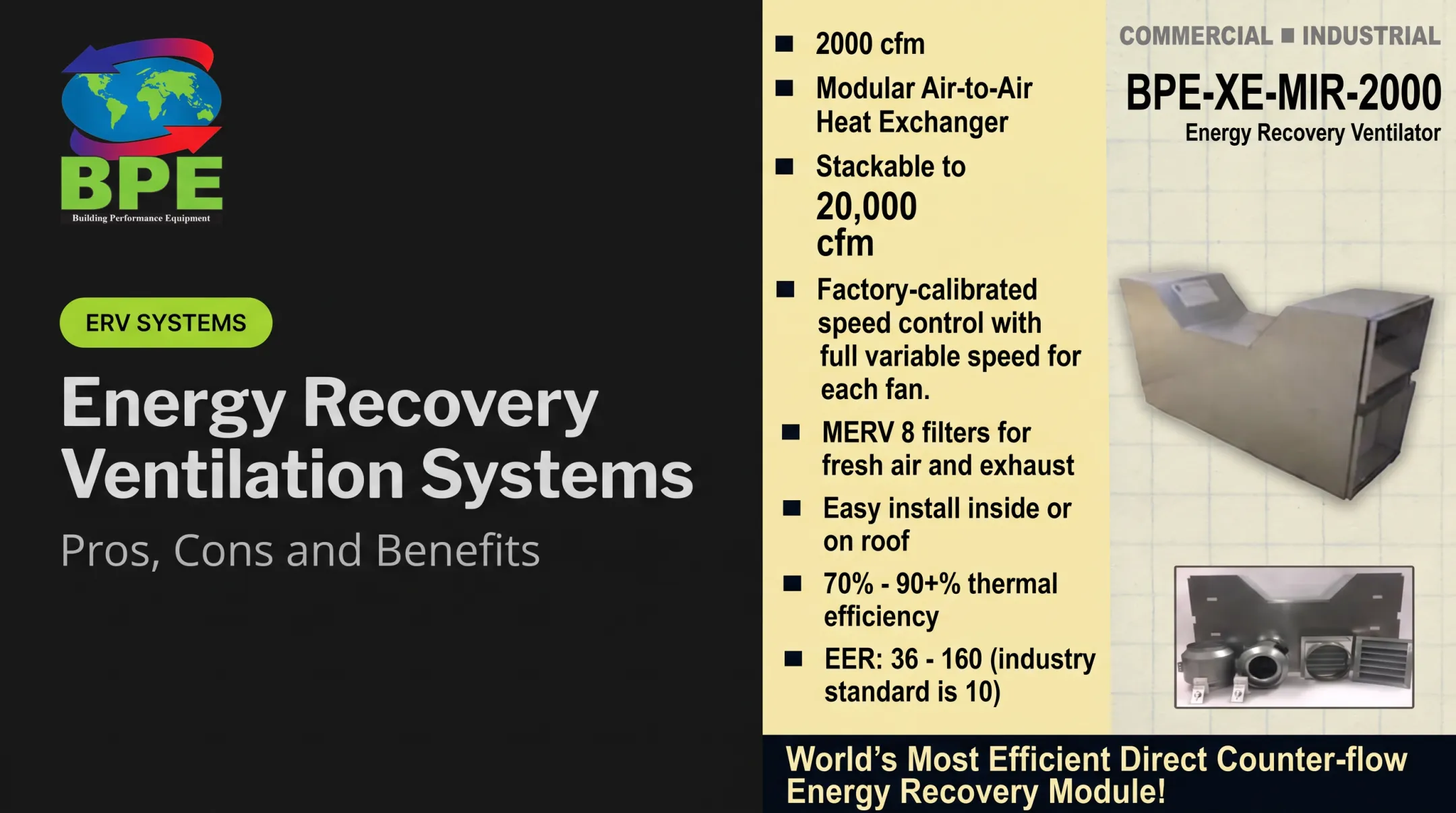
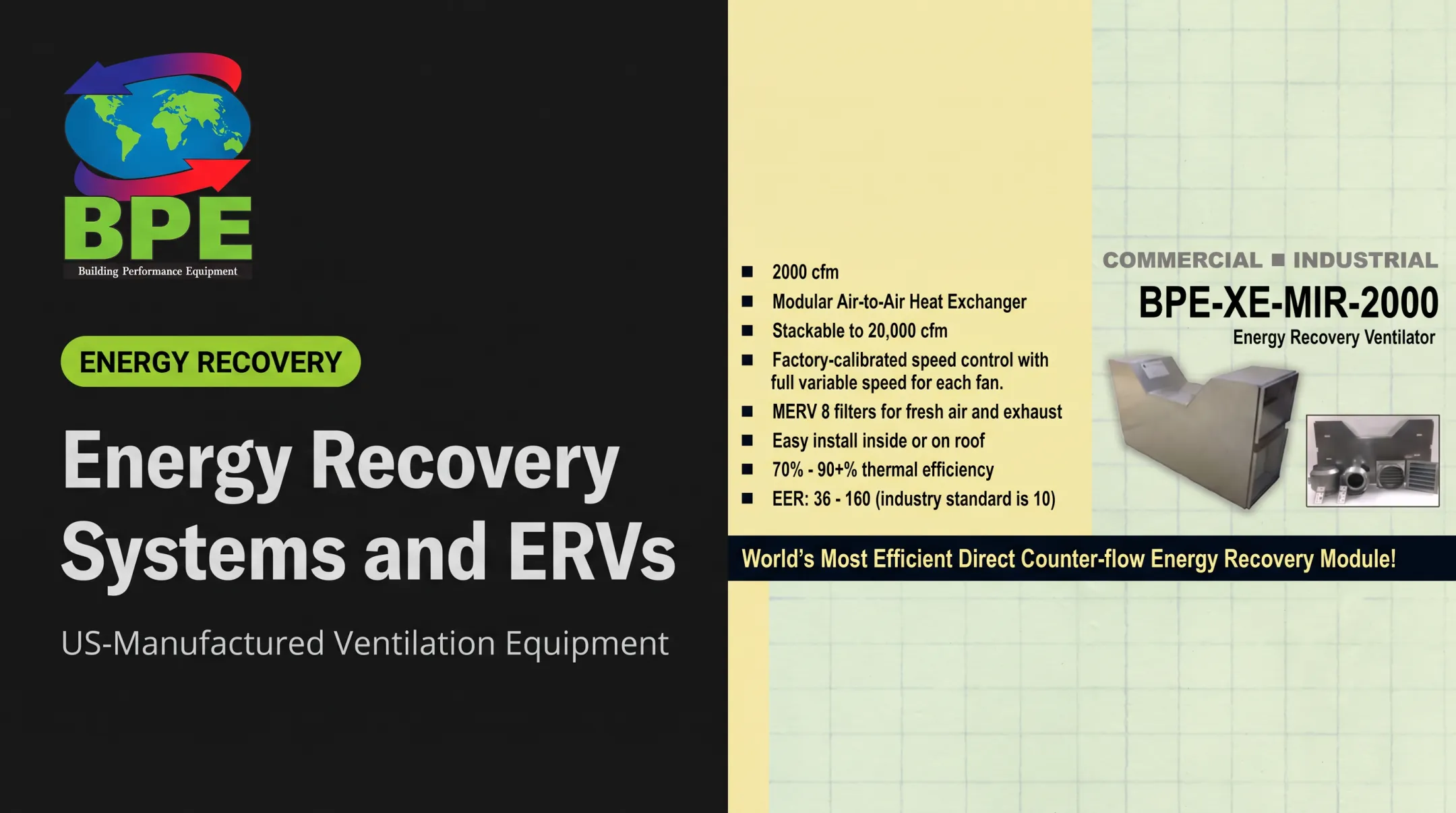
A BPE-XE-MIR-3000 unit, for example, brings in 3,000 cfm of fresh outdoor air while stale air exits through the same core, circulating 6,000 cfm total, but only half of that volume needs new thermal conditioning, since the core has already done most of the work.
Sensible Heat vs. Total Energy Recovery
HRVs transfer sensible heat only. Heat passes through separating plates, but the plates don't intentionally let water vapor cross over. That's the right call when moisture transfer isn't wanted, such as a building that's already too humid in winter.
ERVs transfer sensible heat and moisture. Permeable plates or enthalpy wheels let water vapor move along with heat, which helps in both directions:
- In winter, incoming dry outdoor air picks up moisture from outgoing indoor air, easing dry-air discomfort
- In summer, incoming humid outdoor air sheds moisture to the outgoing exhaust stream before it reaches the cooling coil
One cold-climate retrofit of a strip mall hit sensible recovery effectiveness above 86%, keeping delivery air in the 60s even at a 24°F outdoor design temperature, enough to eliminate a dedicated reheat system entirely.
Reading Performance Ratings the Right Way
Don't select equipment off a single efficiency number. Sensible recovery efficiency (SRE) and total recovery efficiency (TRE) are adjusted for fan energy, airflow imbalance, and leakage. They're not the same as a raw AHRI 1060 effectiveness rating, and the two shouldn't be compared directly.
Codes have caught up to this nuance. The 2024 IECC sets enthalpy recovery thresholds of roughly 50% at cooling design conditions and 60% at heating design conditions for dwelling-unit applications, with separate provisions for other space types.
Fan power matters just as much as the core itself. Traditional cross-flow technology typically runs at 45% to 50% efficiency with high static pressure drops, while direct counter-flow designs can exceed 90% efficiency at pressure drops as low as a quarter inch, delivering roughly twice the recovery at a fifth of the power draw.
How to Choose the Right Energy-Efficient Ventilation System
Start with the project, not the product. You'll need to nail down:
- Building type and floor area
- Occupancy and operating schedule
- Climate zone and humidity conditions
- Contaminant sources and exhaust classification
- New construction versus retrofit constraints
Sizing by the Numbers
Outdoor-air rates combine a per-person component with an area component. A classroom, for instance, typically needs 10 cfm per person plus 0.12 cfm per square foot under ASHRAE's ventilation standard, not a flat per-room guess.
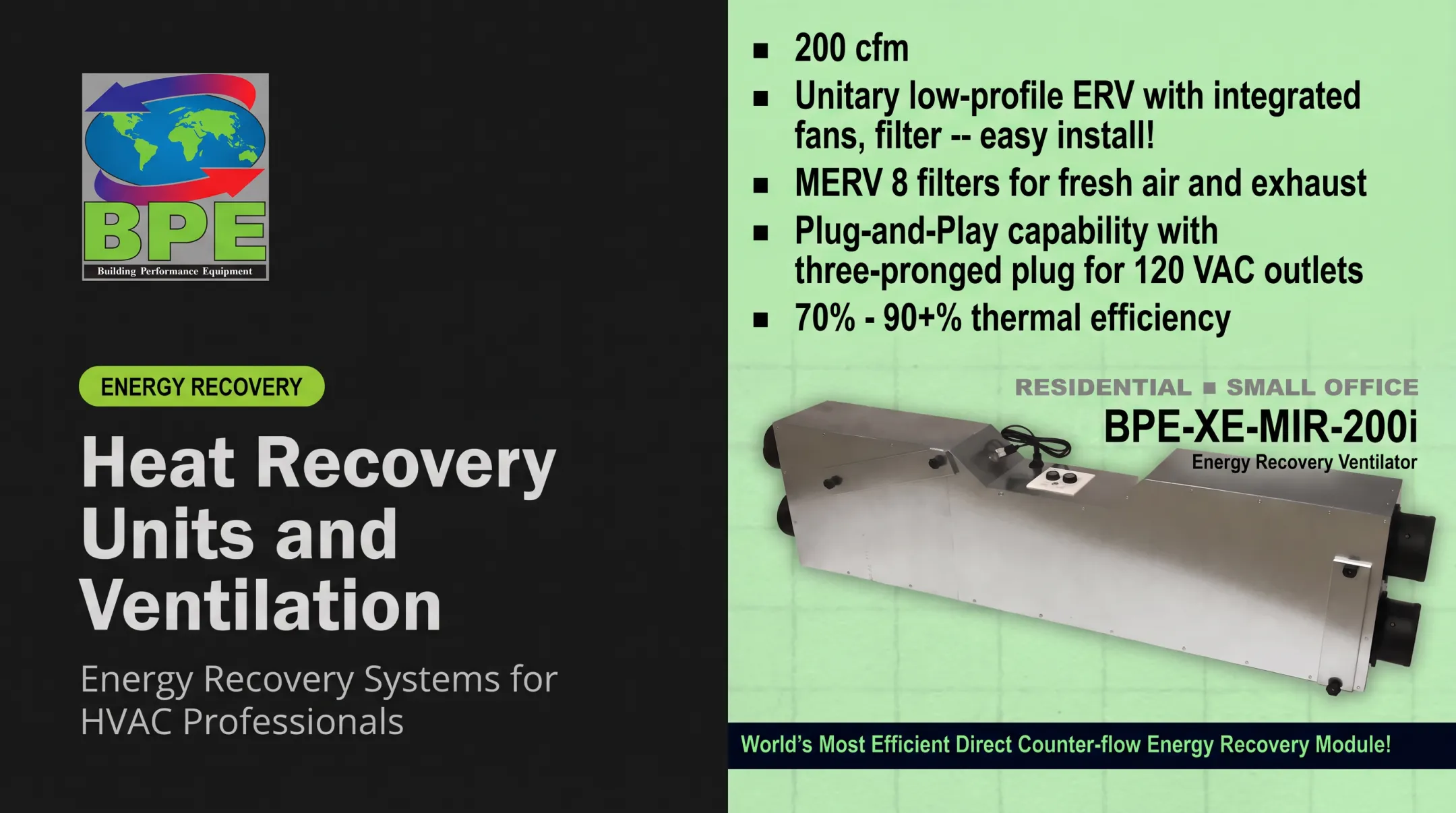
For quick field estimates, a simplified rule of 20 cfm per occupant gets you in the right ballpark before engineering analysis refines the number. A six-person conference room, for example, lands around 120 cfm, enough to size a compact unit like a BPE-XE-MIR-200i before confirming with full load calculations.

HRV or ERV? Let Climate Decide
- Cold, dry climates: ERVs help retain winter humidity indoors
- Hot, humid climates: ERVs reject incoming moisture before it hits the cooling coil
- Already-humid buildings: HRVs (or an ERV core sealed to block moisture transfer) avoid adding more
Sizing, Ductwork, and Retrofit Reality
Beyond airflow capacity, real-world performance hinges on:
- External static pressure (a 2,250 cfm unit might see static pressure climb from roughly 0.1 inches W.C. at low speed to over 1.1 inches at full capacity)
- Duct velocity kept under 500 fpm to limit noise and pressure loss
- Filtration: MERV 8 is standard, MERV 13 optional for finer particulate control
- Service clearance and available electrical capacity
Retrofits add their own wrinkles: tight mechanical rooms, existing rooftop units, and awkward duct pathways. Modular, stackable cores that two technicians can assemble without a crane solve a lot of these headaches in existing buildings.
Centralized, Decentralized, or Packaged?
| Arrangement | Best fit |
|---|---|
| Centralized ducted | Schools, offices, larger commercial spaces |
| Decentralized/packaged | Individual apartments, small offices, single rooms |
| Modular/unitary | Scalable projects from homes through industrial facilities |
Building Performance Equipment manufactures air-to-air energy recovery equipment spanning roughly 60 cfm residential units up to 20,000 cfm industrial systems, along with specification support for engineers comparing options. The right call still depends on reviewing your actual load calculations and equipment documentation, not just the efficiency number on a spec sheet.
Benefits and Building Applications
Recovering energy from exhaust air directly reduces the heating and cooling burden tied to ventilation, which can represent a large share of total HVAC load. In high-occupancy spaces like schools, ventilation alone can account for roughly 70% of heating and cooling demand.
Beyond energy savings, balanced ventilation with recovery supports:
- Dilution and removal of CO2, odors, and excess moisture
- More stable indoor temperatures across occupied hours
- Reduced condensation risk from trapped humidity
Ventilation isn't a substitute for source control, proper filtration, or specialized contaminant treatment. It works alongside those measures, not instead of them.
Where This Shows Up in Practice
- K-12 schools: Hopewell Valley School District recaptured 80% to 95% of exhausted thermal energy across 13 classrooms; Hunterdon Regional High School cut facility energy use by 26.7%
- Specialty commercial: A hair salon used roughly 900 cfm of ERV-driven exchange to clear keratin-treatment odors almost instantly
- Studio and wellness spaces: A yoga studio kept CO2 below 1,000 ppm across a 4,200-square-foot space using paired recovery units
- Industrial: A monastery running CNC stone-working equipment used five recovery units to manage humidity around sensitive machinery
Industrial and process-exhaust environments need extra scrutiny. Chemical fumes, solvent-laden air, and high-moisture processes (tanneries, fragrance manufacturing) often require corrosion-resistant materials, isolation, or filtration before energy recovery makes sense.
Design, Controls, Operation, and Maintenance
Smart controls cut unnecessary ventilation without sacrificing air quality. Demand-controlled ventilation using CO2 sensors is one of the more effective levers. Set a control point around 600 ppm and an off point near 500 ppm, and fans ramp down automatically when a room empties out.
Controls That Actually Reduce Fan Energy
- Variable-speed or electronically commutated motors adjust output to real-time demand
- BACnet-capable controllers allow scheduling and remote diagnostics
- Humidity sensors can trigger staged cooling or reheat sequences
- Fully speed-controllable fans let facility staff manually rebalance pressurization by season
Commissioning and Routine Maintenance
Every installation needs airflow measurement, supply-and-exhaust balancing, sensor calibration, and documented control verification before handoff. Skipping this step is the fastest way to end up with a system that never hits its rated performance.
On the maintenance side, keep it simple:
- Inspect and replace filters on schedule (MERV 8 standard, MERV 13 where finer filtration matters)
- Check fans, belts, and motors for wear
- Inspect duct connections and seals
- Verify control setpoints haven't drifted
- Watch for unusual noise or gradually declining airflow: early signs of a fouled core or failing fan
Units built with no moving parts in the exchange core itself simplify this list considerably, since there's no wheel or belt inside the core to service.
Running the Lifecycle Numbers
Don't evaluate recovery equipment on installed cost alone. Factor in electrical consumption, avoided heating and cooling energy, maintenance, replacement parts, and expected service life against your actual utility rates and operating hours.
The Department of Energy notes that in mild climates, fan electricity can sometimes outweigh the avoided conditioning savings, which is why a proper calculation matters more than a sales brochure.
One documented commercial retrofit posted an installed cost of roughly $298,847 against annual savings of $53,555, landing a 5.58-year simple payback and a 17.2% internal rate of return over a 20-year measure life. Your numbers will differ, but that's the kind of analysis worth running before committing to equipment.

For larger or more complex projects, an energy model or engineering calculation beats back-of-envelope math every time. If you're weighing recovery equipment against a conventional exhaust or makeup-air approach for a specific building, talking through the load profile with Building Performance Equipment's engineering team can help pressure-test the assumptions before you spec anything.
Frequently Asked Questions
How expensive is an ERV system?
Cost varies widely by airflow capacity, system type, controls, ductwork, and electrical work required. Rather than quoting a universal price, get a quote based on your building's specific load and installation complexity.
Does an ERV run all the time?
Many ERVs run continuously at low speed but modulate, boost, or cycle based on occupancy, humidity, and air-quality sensors. Your project team should configure these controls to match code requirements and actual usage patterns.
Which HVAC system is the most energy-efficient?
No single system wins for every building. Equipment efficiency, ventilation strategy, heat recovery, controls, envelope performance, and climate all interact . The best outcome comes from matching the system to the building, not chasing one spec number.
What is the difference between an HRV and an ERV?
HRVs recover sensible heat only. ERVs recover sensible heat and transfer some moisture between airstreams. Climate and indoor humidity goals typically decide which one fits your building.
How does energy recovery reduce ventilation energy use?
The recovery core preconditions incoming outdoor air using energy already present in the exhaust airstream, cutting the heating or cooling work your HVAC system has to do. Fan power and pressure drop still factor into the total energy picture, so they belong in any real comparison.