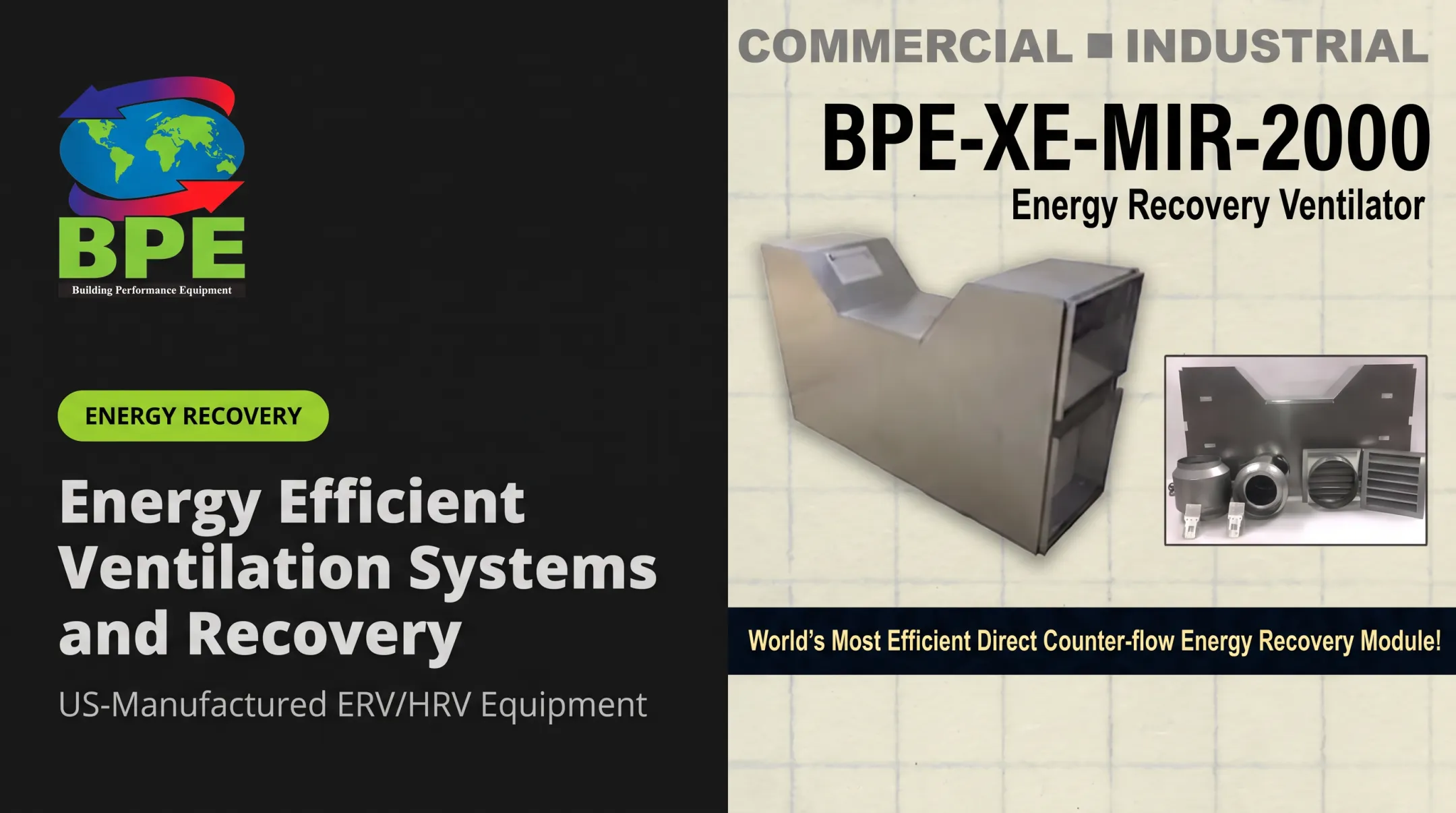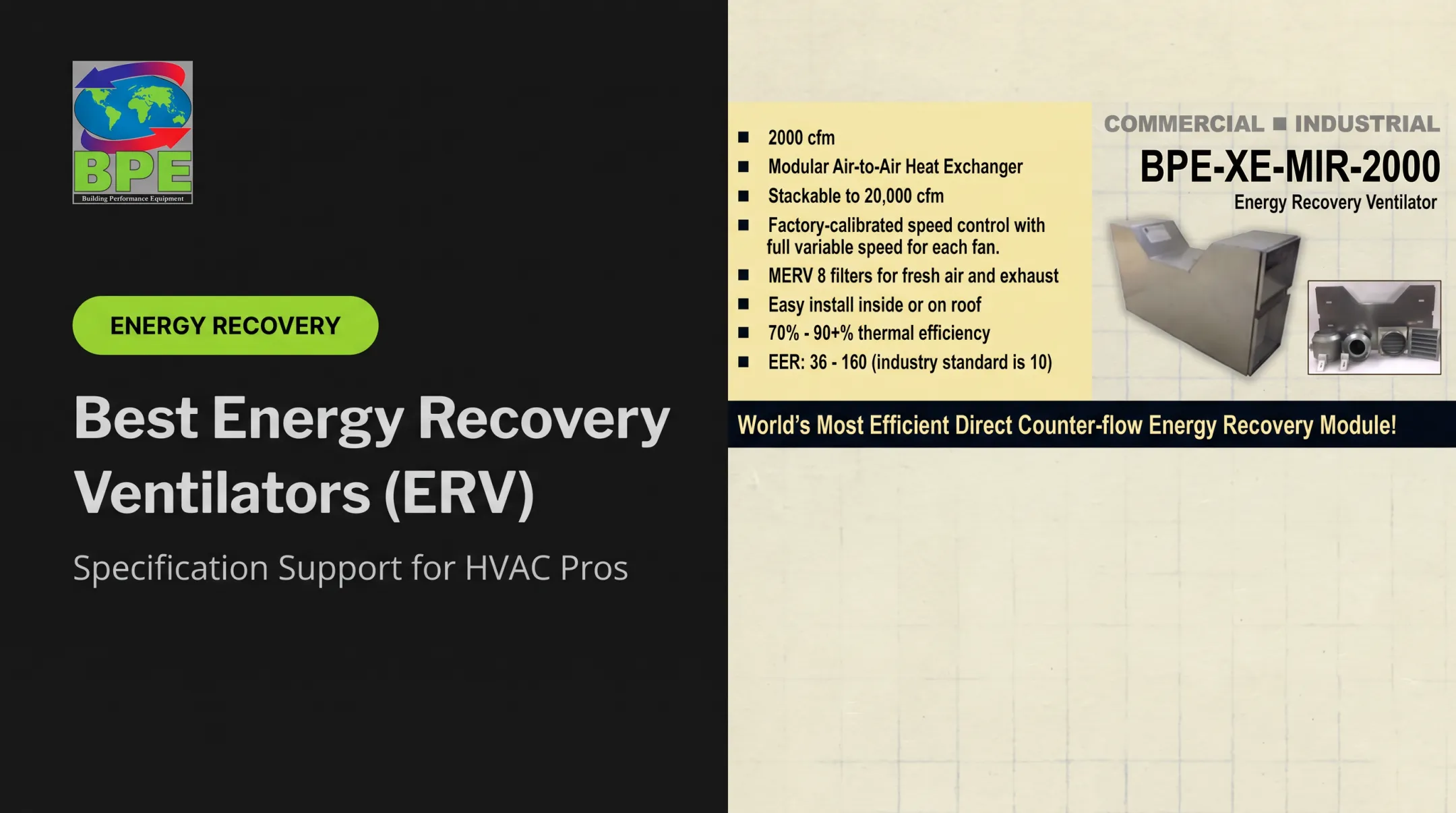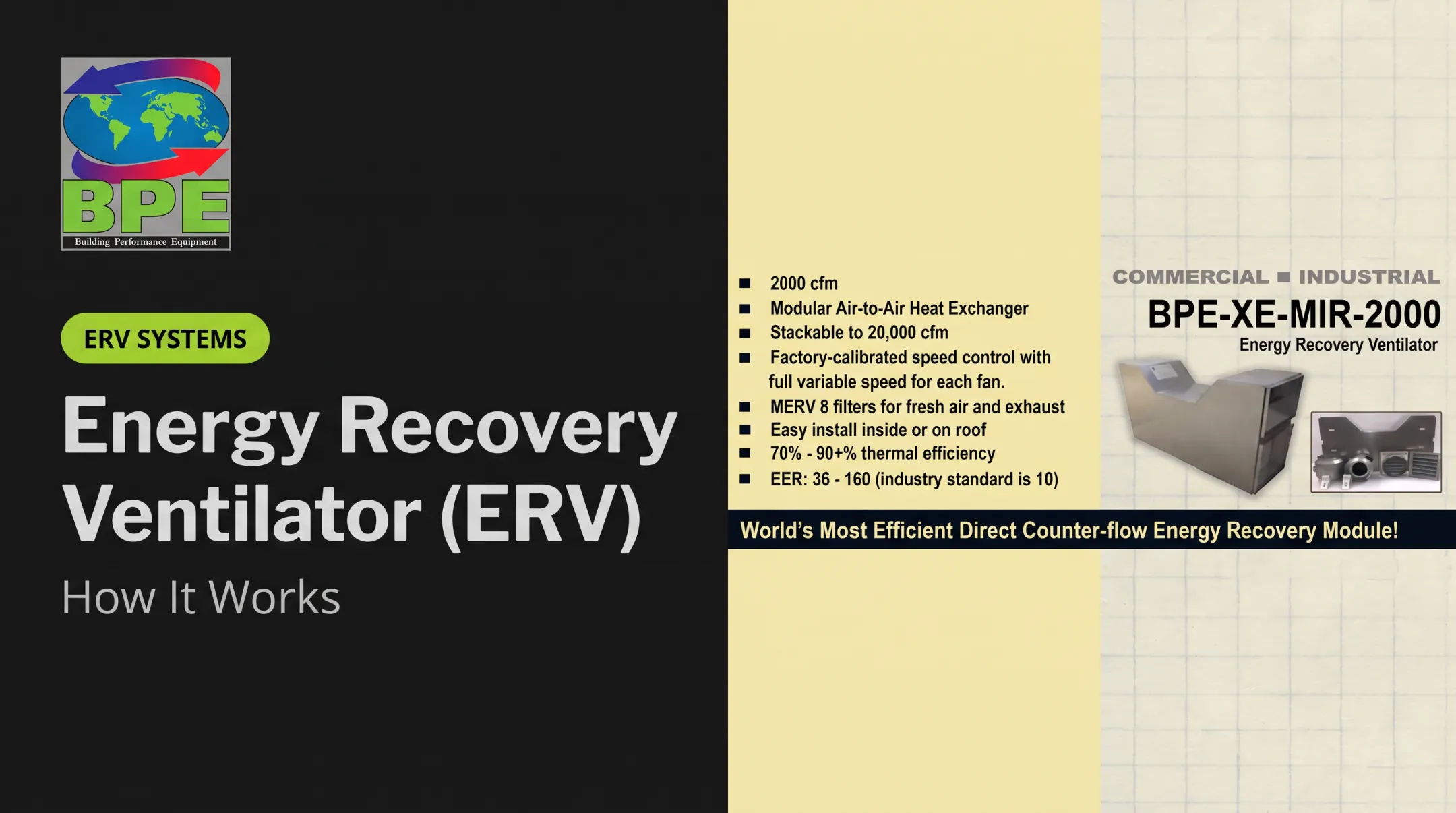

An energy recovery ventilator (ERV) solves part of that problem. It brings outdoor air in while exhausting stale indoor air, transferring heat and, in many systems, moisture between the two separate airstreams before either reaches its destination.
Here's the catch: ERV efficiency isn't one headline percentage. Recovery ratings, fan energy, airflow, pressure drop, climate, controls, installation quality, and maintenance all shape how a system actually performs once it's running in a real building. This article breaks down how energy recovery works, how to read efficiency ratings correctly, and how engineers, contractors, facility teams, and building owners can select and operate ERV systems that deliver on paper and in practice.
Key Takeaways
- ERVs cut the heating and cooling penalty of mechanical ventilation by tempering incoming air with energy pulled from exhaust air
- Sensible recovery measures heat transfer only; total or enthalpy recovery adds moisture transfer to the equation
- Certified test data, fan power, airflow balance, and duct design matter as much as the nominal recovery rating on a spec sheet
- Properly selected and commissioned equipment supports indoor air quality, occupant comfort, lower energy costs, and reduced carbon emissions
How ERVs Recover Energy
An ERV runs on two fans working in opposite directions. One pulls outdoor air into the building; the other pulls stale indoor air out. The two airstreams pass through a transfer core, exchanging energy without mixing.
A few terms worth nailing down before going further:
- Outdoor air: fresh air entering the system from outside
- Supply air: outdoor air after it passes through the core, heading into occupied spaces
- Return air: stale air pulled from inside the building toward the core
- Exhaust air: return air after it passes through the core, discharged outside
- Transfer core: the heat exchanger where supply and exhaust airstreams cross paths and swap energy
Sensible and Latent Recovery
In winter, outgoing indoor air is warmer than incoming outdoor air. As the two streams cross inside the core, heat moves from the exhaust airstream into the supply airstream, preheating it before it reaches the space or the heating equipment. In summer, the process runs in reverse: warm outdoor air gets precooled by cooler exhaust air on its way out.
That's sensible recovery. An ERV goes a step further and recovers latent energy, too, meaning moisture. A membrane or enthalpy-wheel core lets water vapor move between airstreams, which is useful in humid climates where incoming summer air carries a heavy moisture load.
A heat recovery ventilator (HRV), by contrast, recovers sensible heat only. Whether the moisture-transfer function actually matters depends on your climate, indoor humidity targets, and building use.
Building Performance Equipment's direct counter-flow cores, for example, are built to deliver sensible thermal efficiency in the 80%–98% range depending on model and airflow, with latent effectiveness added where humidity control matters.
In one Intertek-tested configuration, the core recorded 91.5% sensible effectiveness at a 57 SCFM outdoor airflow rate. That figure shows how recovery performance is tied to a specific tested airflow, not a single universal number.
The practical payoff: recovered energy reduces the load placed on furnaces, boilers, heat pumps, air conditioners, and dehumidification equipment. The exact reduction depends on the project, but the principle is simple. Exhausting conditioned air straight outside throws away energy you already paid for. Running it through a transfer core first recovers a meaningful share of that investment before it leaves the building.

How ERV Efficiency Is Measured
Efficiency claims mean little without knowing which metric, and which test conditions, produced them. The Home Ventilating Institute (HVI) defines four distinct recovery metrics, and mixing them up leads to bad comparisons.
| Metric | What it measures | Fan energy treatment |
|---|---|---|
| SRE (Sensible Recovery Efficiency) | Net sensible heat recovered | Includes electric consumption |
| TRE (Total Recovery Efficiency) | Sensible plus latent energy recovered | Includes electric consumption |
| ASRE (Adjusted SRE) | Same as SRE, fan energy excluded | Excludes electric consumption |
| ATRE (Adjusted TRE) | Same as TRE, fan energy excluded | Excludes electric consumption |
HVI recommends using ASRE and ATRE when fan or blower energy is already a separate input in your energy-modeling software. Otherwise you risk double-counting fan power.
Test Conditions Change the Number
None of these ratings are abstract. HVI certification tests run under specific conditions: a heating test at 32°F outdoor air and 72°F indoor air, and an optional cooling test at 95°F outdoor air and 75°F indoor air. A unit's reported efficiency at one airflow and pressure can look very different at another.
That's why BPE's specification sheets report sensible effectiveness across a flow range rather than a single number. The BPE-SC-UNI-2000, for instance, is documented at 95% sensible efficiency at 500 SCFM, dropping to 64% at 2,250 SCFM: the same core, two very different numbers, both true for their respective airflows.

When comparing equipment, insist on:
- Current HVI-certified ratings, not manufacturer marketing claims
- The specific airflow and pressure conditions the rating applies to
- The rating standard used (ARI/AHRI 1060 and ASHRAE 84 are the governing test methods)
A rating produced under one set of conditions is not equivalent to a rating produced under another, even if the numbers look similar on paper.
What Determines Real-World ERV Efficiency
A transfer core can post an impressive recovery number in a lab and still underperform in the field. Several variables stand between rated efficiency and delivered performance.
Fan energy is the first one engineers overlook. An ERV that recovers substantial heat but draws excessive electrical power to move air through a restrictive core can deliver less net benefit than a less "efficient" unit with a lower-pressure-drop design.
BPE's guide specifications call for an overall EER above 30, accounting for motors, fans, controls, and other parasitic loads together, not the core's recovery rating in isolation.
Static pressure and duct design come next. Undersized ducts, restrictive filters, sharp bends, and poorly selected grilles all raise fan power while cutting delivered airflow. Turning vanes placed around a sharp corner can cut static pressure losses at that point by as much as 85%, which is a meaningful difference when fan energy is already working against you.
Commissioning turns design intent into measured performance:
- Verify supply and exhaust airflow match design intent
- Balance the system so neither airstream dominates
- Confirm control sequences operate as programmed
- Check for leakage or bypass around the core
- Document actual operating points against the design
A Minnesota field study examining 402 ERVs across 134 commercial and institutional buildings found 75 distinct operational and system issues, with more than 90% correctable once identified.
One unit had auxiliary outdoor airflow bypassing the recovery core entirely, cutting effective recovery by up to half. Control sequencing errors, neglected maintenance, and installation mistakes accounted for most of the problems, not core failure.

Climate and seasonal conditions add another layer. Cold-climate units need frost or defrost strategies, since frost buildup on the core reduces recovery and typically requires added heat to manage. Hot, humid climates shift the priority toward latent load management.
None of this replaces the rest of your HVAC strategy. An ERV reduces ventilation-related loads, but it doesn't eliminate the need for heating, cooling, dehumidification, filtration, or source control.
Choosing and Specifying an Efficient ERV
Selecting equipment at its maximum advertised efficiency, rather than at the project's actual design airflow and pressure, is one of the most common specification mistakes. A core rated for 95% efficiency at 500 CFM won't deliver that number running at 2,000 CFM.
A practical specification checklist should cover:
- Required outdoor and exhaust airflow at design conditions
- Climate-specific sensible and total recovery ratings
- Fan power (watts per CFM) and external static pressure
- Filtration level, sound ratings, and controls integration
- Frost protection strategy for cold-climate applications
- Service access and available installation space
Match the Equipment to the Application
Needs vary considerably by building type:
- Residential and multifamily: compact, plug-and-play units sized for per-unit fresh air delivery
- K-12 and university facilities: stackable modules that raise classroom ventilation rates without major structural rework
- Commercial offices: balanced systems coordinated with CO2-based demand control under ASHRAE 62.1
- Industrial and process-exhaust applications: chemical fumes, solvents, or high-moisture exhaust often need specialized separation and corrosion-resistant materials rather than standard ERV cores
Building Performance Equipment manufactures high-efficiency air-to-air energy recovery equipment across this range, from the BPE-XE-MIR-200-i (60–200 CFM, designed for residential and light-commercial installs) to modular BPE-SC-UNI systems that stack to 20,000 CFM for larger commercial and industrial jobs.

Verify current model-specific ratings, certifications, pressure-drop data, and application limitations directly against the manufacturer's technical submittals before finalizing a spec.
Energy codes increasingly set a floor for this decision. The 2024 IECC code requires an enthalpy recovery ratio of at least 50% at design conditions for applicable systems. Confirm which code edition and amendments your jurisdiction has actually adopted, since adoption varies by state and municipality.
First cost matters, but so does lifecycle performance. Review projected operating conditions, controls compatibility, filter replacement costs, and commissioning requirements before comparing quotes on price alone. A core with a lower sticker price and a 4-year service life can cost more over 20 years than one with a longer-rated heat exchanger warranty.
Operating, Maintaining, and Evaluating an ERV
Most ERVs run continuously or on a schedule, but the right runtime depends on occupancy, ventilation requirements, indoor air quality goals, and outdoor conditions, not a single universal setting.
Routine maintenance generally includes:
- Inspecting and replacing filters on a schedule appropriate to the installation
- Checking the transfer core for fouling using a mirror and flashlight on hard-to-reach sections
- Confirming condensate drainage stays clear where applicable
- Verifying fans and controls respond correctly to commands
Manufacturer guidance varies by model and site conditions. BPE recommends annual filter inspection for typical school and office environments, with core cleaning as needed in dustier or greasier industrial settings.
Clean the core once performance or airflow shifts by around 10%. Treat any maintenance interval as model-specific rather than universal, and check the manufacturer's documentation for your unit.
Facility teams can track performance over time through:
- Airflow measurements and fan energy draw
- Temperature and humidity trends across seasons
- Filter pressure drop and system alarms
- Occupant feedback and utility or energy-model data
Schedule a professional inspection and rebalancing after any major duct, envelope, occupancy, or HVAC change. A system commissioned correctly on day one can drift out of balance after a renovation or a change in building use, and catching that early protects the efficiency you specified in the first place.
Frequently Asked Questions
Should you run your ERV (air exchanger) all the time?
Continuous operation is often appropriate for balanced ventilation systems, but the correct runtime depends on the design, code requirements, occupancy patterns, and outdoor conditions. Follow manufacturer guidance and any demand-control settings, such as CO2-based cycling, rather than assuming one schedule fits every building.
What are the three types of ventilation?
The three broad approaches are natural ventilation (intentional openings driven by wind or pressure differences), mechanical ventilation (fan-driven airflow), and hybrid or mixed-mode systems combining both. Within mechanical ventilation, balanced systems like ERVs differ from supply-only or exhaust-only setups, which can pressurize or depressurize a building.
What is a good efficiency rating for an ERV?
"Good" depends on your climate, design airflow, pressure conditions, and project goals: there's no single universal cutoff. Compare verified, certified ratings at your intended operating point rather than relying on a manufacturer's maximum advertised number.
Is an ERV more efficient than an HRV?
ERVs transfer both heat and moisture; HRVs transfer sensible heat only. Neither is universally "more efficient"; the better choice depends on your climate, indoor humidity loads, and ventilation strategy.
How does fan power affect ERV energy recovery?
Fan electricity cuts into the net energy benefit of recovery, so pressure drop, airflow balance, motor efficiency, and controls need evaluation alongside the core's recovery rating. A high recovery percentage paired with excessive fan power can still deliver a poor system-level outcome.
How can I improve the energy efficiency of an ERV system?
Focus on correct sizing, balanced airflow, low-pressure-drop ductwork, clean filters, and controls tuned to actual needs, plus regular commissioning after building changes. ASHRAE's ventilation handbook notes recovery typically cuts 60%-80% of ventilation conditioning energy when systems operate as designed.