
Commercial projects already feel this tension directly. The 2022 revision to the model energy code tightened the whole-building leakage threshold to 0.35 cfm/ft2 at 75 Pa, according to ASHRAE's 90.1 addendum. Tighter envelopes mean mechanical ventilation can no longer be an afterthought.
That's where energy recovery ventilators (ERVs) come in — they introduce outdoor air without handing the full heating or cooling load to your HVAC system. This review compares ERVs by application rather than picking one universal winner, because airflow needs, climate, ductwork, controls, and service access all shift what "best" actually means. We'll cover small-space, mid-size, large-capacity, ductless, and engineered high-efficiency options.
Key Takeaways
- ERVs swap stale indoor air for filtered outdoor air while transferring heat and moisture between the two streams
- Judge units by certified airflow, recovery performance, static pressure, controls, sound, and service access, not a single efficiency number
- Capacity and configuration should match the building's occupancy, duct layout, climate, and governing ventilation standard
- Building Performance Equipment suits engineered, modular, retrofit, institutional, commercial, and cold-climate projects
- Verify project-specific performance data directly with each manufacturer before specifying or purchasing
Overview of ERVs in the U.S. Ventilation Market
An energy recovery ventilator is a balanced mechanical ventilation system. It exhausts stale indoor air and supplies filtered outdoor air at matched rates, transferring sensible heat (and, depending on the core, moisture) between the two airstreams as they pass each other.
That moisture-transfer capability is what separates an ERV from its cousin, the heat recovery ventilator (HRV). HRVs primarily move heat; ERVs move heat and moisture. The right choice depends on your climate and indoor humidity goals, not a blanket regional rule.
ERVs matter most in:
- Airtight single-family and multifamily homes where natural infiltration no longer supplies enough fresh air
- Schools and university buildings with high occupancy density and strict ventilation-rate requirements
- Offices and industrial facilities managing process exhaust alongside occupant comfort
ASHRAE's 2024 Handbook notes that enthalpy (energy/moisture) cores suit moderate-to-high outdoor humidity conditions, while sensible-only recovery can work better where indoor humidity is already high. The models below represent different capacity ranges and use cases. Always verify current specifications, certifications, and availability directly from the manufacturer before purchase or specification.

Top ERV Systems for U.S. Applications in 2026
The ranking below prioritizes application fit, documented performance, airflow range, control sophistication, installation practicality, maintenance burden, and manufacturer support, not just a headline efficiency percentage.
Building Performance Equipment ERV Systems
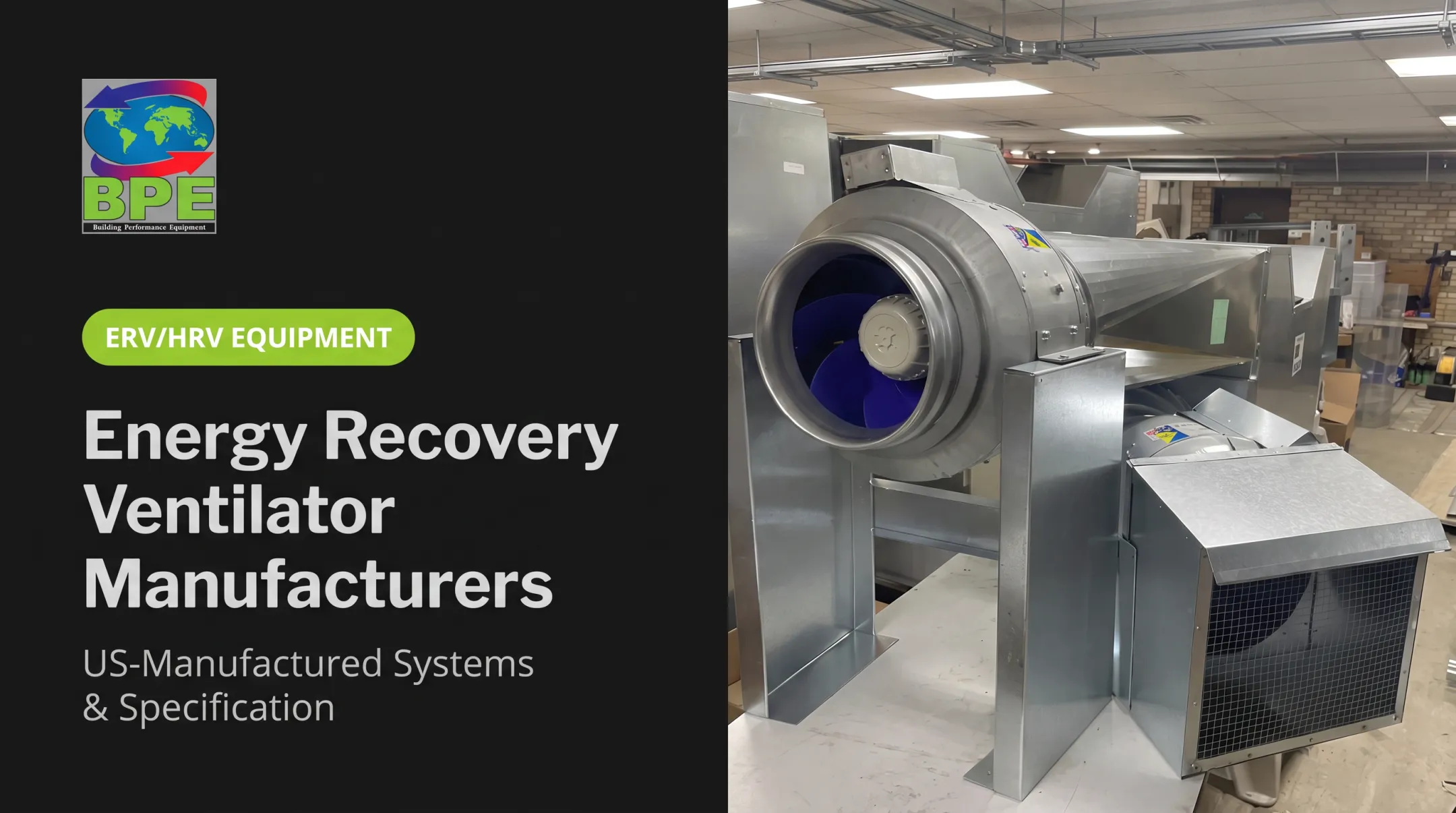
Building Performance Equipment (BPE) has engineered air-to-air energy recovery equipment since 1997, built around CEO Klas Haglid's patents in energy-recovery devices and controls. The company manufactures in the U.S. and positions its equipment around indoor air quality, comfort, energy use, and carbon performance rather than as a single off-the-shelf appliance.
BPE's lineup spans a wide capacity range:
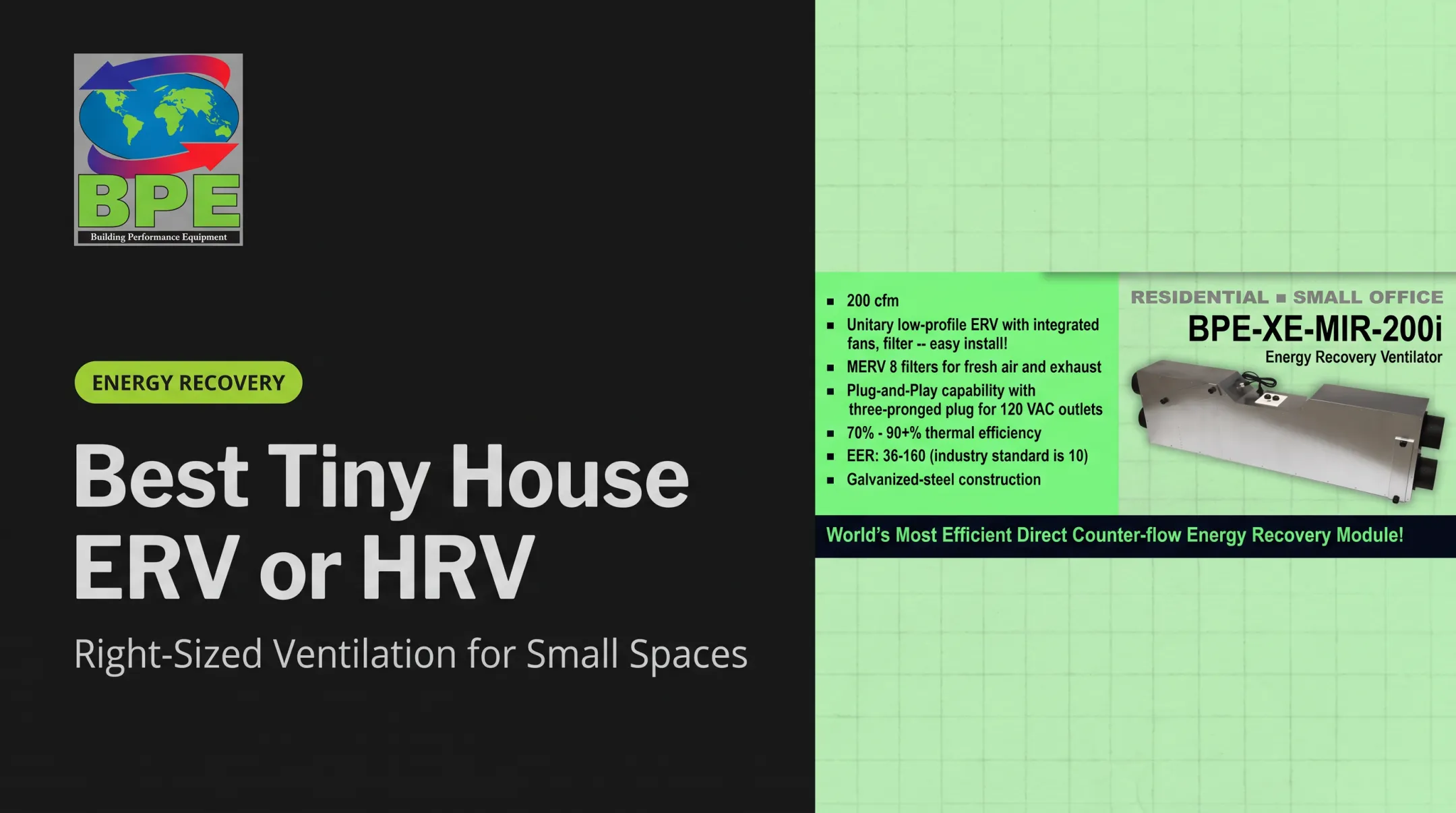
- BPE-XE-MIR-200i: 60–200 CFM, plug-and-play 120 VAC operation for small offices or homes
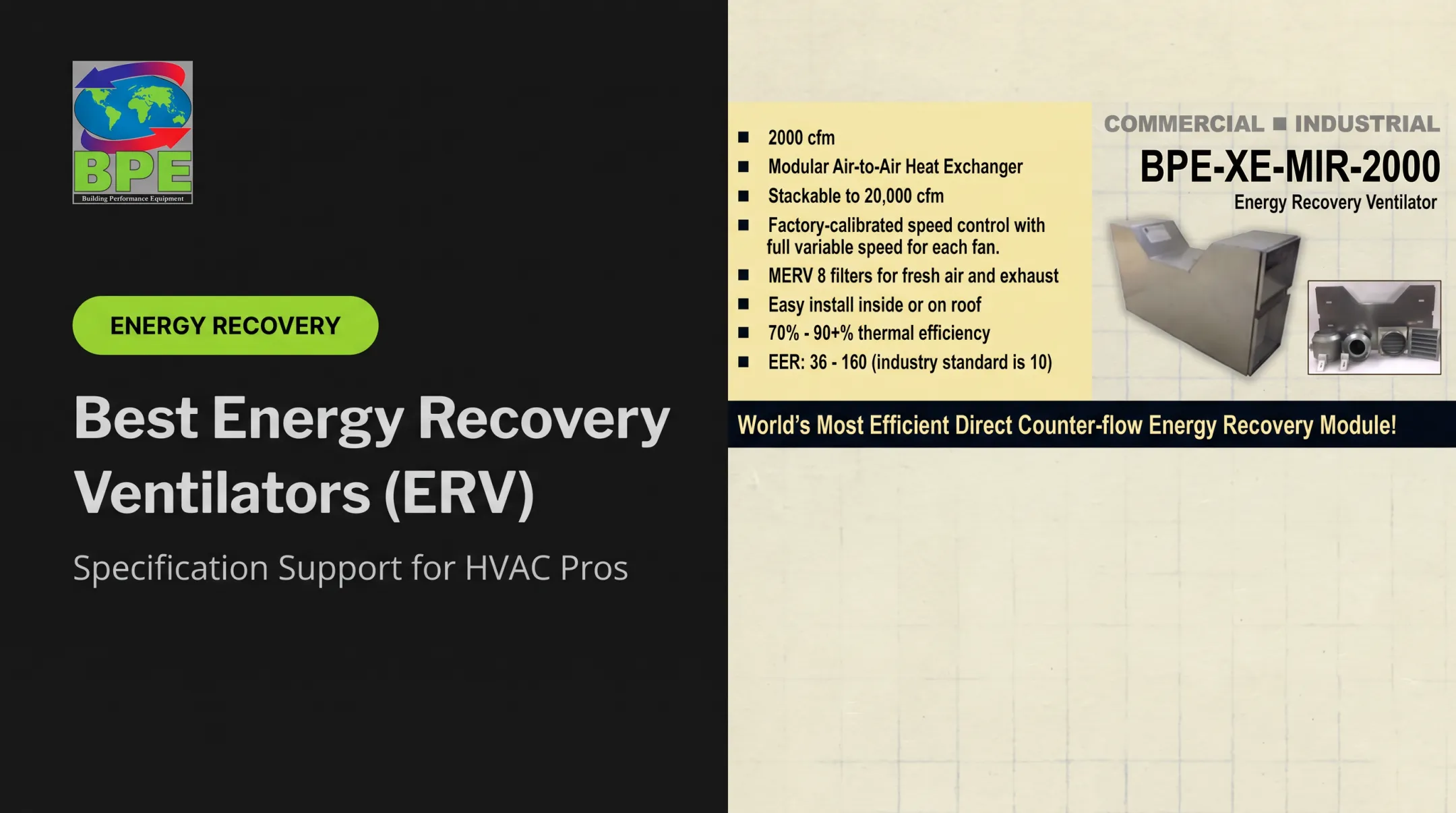
- BPE-XE-MIR-2000: 500–2,250 CFM per unit, stackable to 20,000 CFM across up to 10 modules
- BPE-SC-UNI-UNI: 500–20,000 CFM depending on configuration, factory-wired and field-tested, sized to fit through a standard 36-inch door
Reported thermal efficiency runs 70% to 90%+, with Regenerative Condensate Return technology adding up to 34% latent efficiency in humid conditions. At Hunterdon school district, ten 2,000-CFM BPE modules serving 34 classrooms were projected to cut energy consumption by roughly 26.7%.
Best for: MEP-engineered projects, school and campus retrofits, multifamily buildings, and commercial or industrial facilities with specialized exhaust needs — such as tanneries, perfume manufacturing, or server farms. Confirm model-specific performance data against current BPE documentation; one configuration doesn't fit every application.
Broan ONE BLP150E75 Energy Recovery Ventilator
This compact ducted unit targets small homes, apartments, and condos. The manufacturer's spec sheet lists an operating range of 32–146 CFM at 0.4 in. w.g., with recovery that drops as airflow climbs:
| Net Airflow | Winter SRE (32°F) | Summer TRE (95°F) |
|---|---|---|
| 36 CFM | 84% | 82% |
| 64 CFM | 78% | 74% |
| 110 CFM | 70% | 65% |
A cold-weather test shows 36% SRE at -13°F and 68 CFM, but that figure is tested to CSA C439-18 and explicitly isn't HVI-certified at that condition, so don't present it as one.
The unit uses VIRTUO auto-balancing with an LCD display offering 1-CFM selection increments, runs on 120V/170W, and measures roughly 10 inches high by 33 inches long.
Best for: compact homes and apartments where duct space is tight. It's undersized for larger multifamily buildings or commercial floor plans — check occupancy-based airflow requirements before specifying.
Aprilaire V22BEC Healthy Air System
Aprilaire's V22BEC fits mid-size residential or light multifamily projects. Its February 2026 spec sheet rates it at 118 CFM at 0.30 in. w.c. external static pressure, with capacity falling to 100 CFM at 1.00 in. w.c., a reminder that duct resistance matters more than the headline number.
Recovery is published as SRE 72%, ASRE 74%; a latent recovery figure wasn't included in the current sheet, so verify that separately if humidity control is a priority.
Installation flexibility is a strength:
- Mounts on ceiling, wall, or floor
- Two washable foam filters (no recurring filter purchases)
- Runs continuously with push-button speed control, or integrates with an 8120X control or compatible AprilAire thermostat
- Accepts a 24-VAC dry-contact signal for third-party controls
Best for: moderate-size homes needing retrofit-friendly mounting and thermostat integration. Compare certified performance at your project's actual external static pressure, not the maximum published airflow.
Broan B210E75R AI Series Energy Recovery Ventilator
For larger homes and demanding floor plans, Broan's AI Series ERV covers 65–206 CFM at 0.4 in. w.g., dropping to 199 CFM at 0.6 in. w.g. Recovery data is airflow- and temperature-specific:
- 81% SRE at 32°F and 64 CFM
- 78% SRE at 32°F and 81 CFM
- 65% SRE at -13°F and 83 CFM
VIRTUO controls provide automatic airflow balancing and real-time diagnostics through the integrated LCD, which simplifies commissioning compared to manual balancing dampers. Two configurations exist: RT (suspended, chain-mounted) and RS (wall-mounted, side ports), both residential-indoor-only with six-inch duct connections.
Best for: larger single-family homes with genuine higher-airflow requirements. Oversizing this unit for a modest-size home creates unnecessary noise, energy use, and balancing headaches. Size to calculated demand, not maximum capacity.
Pioneer ECOasis 150 Ductless Energy Recovery Ventilator
Don't let the model name fool you: the Pioneer ECOasis 150 (model ERV150AHRPM25L) delivers 88 CFM, not 150. It's built for room additions, single offices, and retrofit spaces where running full supply-and-exhaust ductwork isn't practical.
Installation requires just two 4-inch wall penetrations, sloped slightly toward the outdoors, rather than a duct network. The manufacturer suggests coverage of 200–500 square feet per unit — useful guidance, but not a substitute for an actual ventilation-rate calculation.
Controls include a touchscreen, handheld remote, and smartphone app (2.4-GHz Wi-Fi required), with Auto, Manual, Timer, Sleep, and PURE modes. Published sound ratings vary between documents (36 dB(A) in the manual versus a 23–37.9 dB(A) range on the manufacturer's website), so confirm measurement conditions before comparing to other units.
Best for: single-zone retrofits and additions. It's explicitly marketed as a single-room solution, so don't treat it as whole-building ventilation for a larger home or commercial space.
Zehnder ComfoAir Q600 ERV
The Q600 targets high-performance homes and technically managed projects prioritizing distribution design and monitoring over simplicity. Zehnder America's system reference guide lists base-unit performance of 353 CFM at both 100 Pa and 200 Pa static pressure, drawing 243W and 287W respectively, with sound power ratings of 60–61 dB(A).
This is a complete-system installation, not a plug-and-play appliance:
- Distribution through 8-inch galvanized ductwork and manifolds with 4, 6, 8, 10, or 12 connections
- ComfoControl smartphone/tablet operation requiring a ComfoConnect LAN C accessory
- Built-in CO2 and relative-humidity sensing
Zehnder America publishes an HVI certificate resource for the Q600, but specific numerical SRE/TRE ratings and U.S. electrical requirements weren't confirmed in current documentation, so verify both directly before specifying.
Best for: larger high-performance homes where occupants and designers want granular control. Factor in total installed cost, local installer availability, and replacement-part access alongside equipment efficiency. This isn't a unit most homeowners install themselves.

How We Chose the Best ERV Systems
We compared current manufacturer documentation and independent certification records where available, normalized performance by airflow and static pressure, and distinguished verified facts from marketing claims.
Sizing comes first. HVI's net airflow guidance specifies using actual delivered outdoor air, not maximum rated CFM, to size equipment against your governing ventilation standard. Calculate required airflow from occupancy and floor area before comparing units.
Climate and moisture performance need context, too. Frost-control thresholds vary by device type and aren't the same as minimum operating temperatures. ASHRAE's 2024 Handbook notes that actual frost risk depends on exhaust-air temperature, humidity, and core design, not a single universal cutoff. Ask each manufacturer:
- What defrost or bypass strategy does the unit use, and at what temperature does it activate?
- How does recovery efficiency change between summer and winter test conditions?
- Is the humid-climate or cold-dry-climate performance data from the same test standard?
The installed system matters more than the nameplate. We weighed:
- External static pressure at realistic duct lengths, not just rated maximum airflow
- Control integration with existing thermostats, BACnet systems, or demand-control sensors
- Filter type, core-cleaning frequency, and service clearance around the unit
- Warranty terms, replacement-part availability, and local installer support
Certification claims were checked model-by-model. HVI, AHRI, CSA, and UL all test different things. A UL 1812 compliance statement is not a recovery-efficiency rating, and an HVI listing doesn't automatically cover every operating point a manufacturer publishes. We didn't assign a certification to any model unless the current listing confirmed it.

Common buyer mistakes worth flagging:
- Oversizing on maximum CFM alone
- Comparing SRE against TRE as if they're interchangeable
- Ignoring duct resistance
- Placing units where filters can't be reached
- Assuming an ERV replaces dedicated humidification or dehumidification equipment
Conclusion
The best ERV for 2026 depends on your building's airflow requirement, climate, moisture goals, duct layout, and maintenance plan. A compact plug-and-play unit that's perfect for a condo would be badly undersized for a school gym, and an engineered modular system built for a tannery exhaust problem is overkill for a single bedroom addition.
Before finalizing a purchase or specification, compare certified performance data at your actual operating conditions, total installed-system requirements, lifecycle costs, and whether local service support exists for the model you're considering.
For commercial, institutional, industrial, cold-climate, multifamily, or other engineered applications, Building Performance Equipment can help evaluate project-specific airflow, static pressure, and control requirements. Reach the team at 201-722-1414 or info@bpequip.com. Equipment recommendations should always follow a review of your specific application, not a generic product pick.
Frequently Asked Questions
What is an ERV review?
An ERV review evaluates a system's certified airflow, sensible and total recovery performance, controls, installation requirements, sound levels, maintenance needs, and documented reliability for a specific building or climate — not just a single efficiency claim.
Is an ERV system worth it?
It's worth it when controlled ventilation, humidity management, comfort, and reduced HVAC ventilation load justify the equipment and installation cost. Value depends on your climate, building airtightness, occupancy, energy prices, and installation quality.
What is the difference between an ERV and an HRV?
An ERV transfers both heat and moisture between incoming and outgoing air; an HRV primarily transfers heat only. The right choice depends on your climate and indoor humidity targets.
How do I choose the right size ERV?
Start with required outdoor airflow based on occupancy, floor area, and your applicable ventilation standard, then check performance at your actual external static pressure and duct design — not the maximum published CFM.
What should I compare when reviewing ERV systems?
Compare airflow, sensible and total recovery at matching test conditions, static pressure, sound levels, filter type, frost control, control options, service access, certifications, warranty, and installer support.
How often does an ERV need maintenance?
Filters, cores, grilles, ducts, drains, and controls need periodic inspection and cleaning per the manufacturer's schedule. Dusty, smoky, high-occupancy, or industrial environments typically need more frequent attention.