
Buildings need continuous ventilation to remove moisture, odors, pollutants, and carbon dioxide. But opening windows or running exhaust fans non-stop lets conditioned air escape and pulls in unconditioned air to replace it. Energy-efficient homes and commercial spaces require mechanical ventilation precisely because natural infiltration alone doesn't maintain indoor air quality, according to the Department of Energy.
This article walks through the air paths, the heat-exchange core, the fans, the controls, the system types, and where these systems actually get used.
Key Takeaways
- Two separate fans exhaust stale air and supply outdoor air at the same time.
- A heat-exchange core transfers thermal energy between the two streams without mixing them.
- HRVs recover sensible heat only; ERVs recover heat and some moisture.
- Centralized units use ductwork; decentralized units mount room-by-room.
- Performance depends on correct sizing, balancing, and ongoing maintenance, not the core alone.
What Is a Heat Exchange Ventilation System?
A heat exchange ventilation system is mechanical equipment that replaces stale or contaminated indoor air with filtered outdoor air while recovering a portion of the thermal energy from the outgoing air stream.
Relying on window-opening, envelope leakage, or exhaust-only fans still gives you ventilation, but it also creates drafts, uncontrolled airflow, pressure imbalances, and avoidable heating or cooling losses. A heat exchange system closes that gap.
This equipment is not a furnace, air conditioner, or heat pump, and it will not independently heat or cool a space. Installing one also does not eliminate the need for proper filtration, humidity control, or contaminant-specific exhaust treatment where those are required.
Core components include:
- Outdoor-air intake and exhaust-air outlet
- Supply and exhaust fans
- Filters on both airstreams
- A heat-exchange core
- Ductwork and dampers
- Sensors and controls
- Condensate or frost-management provisions in cold climates
HRVs vs. ERVs
The two main equipment categories handle moisture differently:
| Type | What it transfers | Best suited for |
|---|---|---|
| HRV (Heat Recovery Ventilator) | Sensible heat only | Buildings where winter indoor humidity already runs high |
| ERV (Energy Recovery Ventilator) | Sensible heat plus some moisture/latent energy | Buildings needing year-round humidity moderation |
Centralized vs. Decentralized Systems
Centralized systems use one main unit tied into a duct network, serving a whole building or large zone. Decentralized systems use multiple room-level or wall-mounted units instead. The choice affects installation cost, airflow distribution, maintenance access, and how practical a retrofit is when an existing building has little room for new ductwork.

Suitability depends on:
- Climate and indoor humidity targets
- Building airtightness and occupancy patterns
- Exhaust contaminants and available mechanical space
- Applicable US design and code requirements
How Does a Heat Exchange Ventilation System Work?
Operation is a continuous, or demand-controlled, sequence: exhaust stale air, bring in outdoor air, transfer energy across the core, distribute the conditioned air, and adjust as conditions shift.
Initiation
The system starts or ramps up based on several triggers:
- Continuous scheduling
- Occupancy signals
- Humidity or CO₂ sensors
- Pressure controls
- Manual boost settings
- Integration with a building automation system
Two air paths run at once. Indoor exhaust air travels from moisture- or pollutant-producing areas (bathrooms, kitchens, high-occupancy rooms) toward the unit. Outdoor air simultaneously enters through a dedicated intake and passes through filtration before reaching the core.
For this to work as designed, the system needs correctly sized airflow, suitable intake and exhaust locations, adequate electrical power, accessible filters, and protection from rain, snow, debris, and nearby contaminated outdoor-air sources.
Core Operation
The central mechanism is straightforward. Outgoing exhaust air passes along one side of an engineered exchange surface while incoming outdoor air passes along the other side. Thermal energy moves across that surface. The two airstreams never intentionally combine.
In winter, warmer indoor exhaust preconditions colder outdoor air before it reaches occupied spaces. BPE's counter-flow configuration, for example, is documented to reach effectiveness levels of up to 99%, compared with roughly 75% for cross-flow designs and 50% for parallel-flow arrangements, according to BPE's installation guidance.

In summer, the same exchanger can reduce the thermal impact of hot outdoor air, though it is still not a substitute for active air conditioning.
Sensible vs. latent transfer matters here:
- Sensible transfer moves temperature only (HRVs)
- Latent transfer moves moisture too (ERVs, when conditions and core design support it)
Performance hinges on airflow rate, temperature difference, core effectiveness, fan energy, filter loading, duct leakage, static pressure, and whether supply and exhaust air are properly balanced. The ASHRAE Handbook notes that rated effectiveness applies at stated flow conditions, not automatically to every installed scenario—always check manufacturer documentation.
One important warning: in industrial settings, if exhaust contains chemicals, fumes, pathogens, grease, or other hazardous contaminants, a designer must verify whether energy recovery is even appropriate. Some contaminant classes should never be transferred or recirculated, and equipment or isolation measures must prevent unsafe cross-contamination.
Regulation / Control
Controls keep the ventilation rate and air balance where they're supposed to be. They do this by adjusting:
- Fan speed
- Dampers and bypass dampers
- Operating schedules
- Boost modes
- Demand-control inputs (CO₂ or occupancy sensors)
Cold-weather protection matters too. Frost can form on the core and reduce effectiveness, so cold-climate installations often include preheating, insulation, condensate management, or defrost cycling, following the manufacturer's installation requirements.
Commissioning is where good design either proves itself or doesn't. Installers should verify:
- Supply and exhaust airflow
- Pressure relationships and recovery performance
- Control responses and noise levels
- Filter access and discharge locations
Blocked filters, poor balancing, excessive duct resistance, bad intake placement, or disabled controls can all degrade delivered airflow and energy performance, even with an efficient core.
Output / Result
The end result: stale, moisture-laden, or pollutant-containing air leaves the building, while filtered outdoor air enters at a far more comfortable temperature than it would without recovery. That translates into better indoor air quality, reduced ventilation-related heating or cooling load, improved occupant comfort, and often lower operating emissions.
Actual savings still vary by climate, occupancy, envelope performance, system design, and maintenance condition. The NIST net-zero study found continuous HRV operation delivered a 7% annual reduction in conditioning-system electricity in one Maryland test house.
Additional HRV fan energy partly offset that gain, and results split sharply by season: a 36% heating-month saving against a 5% cooling-month increase. Recovered-energy percentage and net annual savings are not the same number.
Where Are Heat Exchange Ventilation Systems Used?
Residential and multifamily: Whole-house ventilation, apartments, affordable housing, high-performance homes, and retrofits all use this equipment. Centralized systems need room for ductwork and a main unit; decentralized units make more sense where running a full duct network isn't practical.
Institutional and commercial: K-12 schools, universities, offices, and retail buildings need dependable outdoor-air delivery. Occupancy schedules, room density, acoustics, filtration needs, and building automation all shape which system fits. Schools in central New Jersey, for instance, have deployed hundreds of Building Performance Equipment (BPE) units for classroom-level displacement ventilation.
Industrial and specialized applications bring their own demands:
- Manufacturing and process facilities need makeup air and contaminant control
- Tanneries manage high humidity and chemical exposure
- Fragrance manufacturers exhaust solvent-laden air continuously
- Server facilities need continuous, precise environmental control
Before specifying or installing a system, evaluate:
- Required outdoor-air volume and climate zone
- Heating and cooling loads
- Indoor humidity targets and building airtightness
- Available service space and duct routes
- Electrical requirements and controls
- Maintenance access and code compliance
- Documented equipment performance
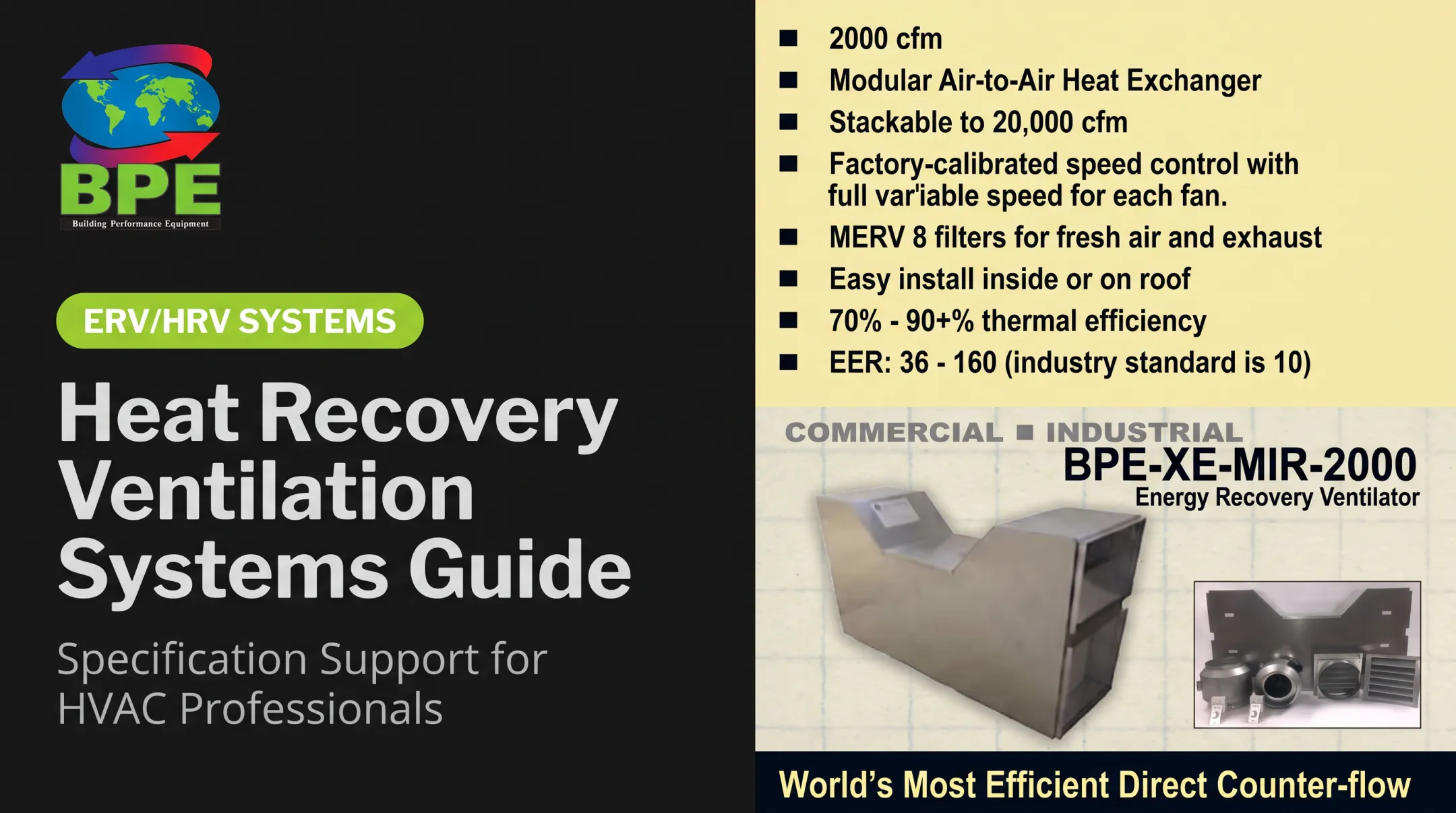
Building Performance Equipment manufactures air-to-air energy recovery equipment ranging from 60-CFM residential modules to 20,000-CFM industrial systems. Solutions pair energy recovery devices with matched controls, which can simplify specification for engineers.

No single product line fits every building, and performance claims should always trace back to documented testing.
Conclusion
Strip away the marketing language, and the working logic is simple: two fans move two separate air streams, an exchange core transfers heat (and in some systems moisture) between them, and controls keep the ventilation rate and pressure balance where they need to be.
Understanding that logic helps with real decisions: HRV versus ERV, centralized versus decentralized layout, correct equipment sizing, contaminant handling in industrial exhaust, and commissioning after install. System performance ultimately comes down to the complete design and installation, not the exchanger sitting inside the box.
Frequently Asked Questions
What are the types of heat exchange ventilation systems?
The main categories are HRVs and ERVs, each available in centralized or decentralized configurations. The right type depends on your climate, humidity goals, building layout, and ventilation requirements.
What is a whole-house heat recovery ventilation system?
A whole-house HRV continuously exhausts stale indoor air and supplies filtered outdoor air through a heat-exchange core. It typically uses a central unit connected to ductwork serving the entire home.
How does a heat exchange ventilation system work?
Exhaust air and incoming outdoor air travel through the unit on separate paths. They exchange heat (and sometimes moisture) across a core without physically mixing, then the preconditioned outdoor air is distributed to occupied spaces.
What is the difference between an HRV and an ERV?
An HRV transfers sensible heat only. An ERV transfers heat plus some moisture. Selection should match your building's climate and indoor humidity conditions rather than defaulting to one type.
Does a heat exchange ventilation system mix indoor and outdoor air?
Properly designed systems keep supply and exhaust streams separate while transferring energy across the core. Equipment condition, core design, and installation quality all affect how well that separation actually holds up.
What maintenance does a heat exchange ventilation system require?
Expect regular filter inspection and replacement, periodic core and fan cleaning, condensate or frost-protection checks, and duct or damper inspection. Airflow and control settings should also be verified on an ongoing basis.