
Introduction
Tiny houses trap a lot of life in very little air. A shower, a pot of soup, and a good night's sleep for two people can push humidity and CO2 higher than in a conventional home — simply because there's less air to absorb it.
Tight building envelopes make this worse. Without planned airflow, moisture, cooking odors, and off-gassing from finishes build up fast. DOE's 2014 ventilation profile confirms that as homes get tighter, deliberate mechanical ventilation becomes necessary, not optional.
ERVs and HRVs solve this by swapping stale air for fresh air while recovering some of the energy you'd otherwise lose. This guide compares compact US-available options and walks through how to pick between ducted and ductless, ERV and HRV, based on your layout, climate, and tolerance for noise and maintenance.
Key Takeaways
- An ERV recovers heat and moisture; an HRV recovers heat only — neither wins in every climate
- Size the unit to your home's actual airflow need, not its physical footprint or recovery percentage
- Ducted systems distribute air more precisely; ductless units solve tight retrofit spaces
- Noise, filtration, frost handling, and service access matter as much as price
- Always confirm current specs and US availability before buying
Overview of ERVs and HRVs for Tiny Houses in the US
An energy recovery ventilator (ERV) uses two in-line fans: one pulls fresh outdoor air in, the other pushes stale indoor air out. A heat exchanger core sits between the two airstreams, transferring both heat and moisture before the air mixes with your living space.
A heat recovery ventilator (HRV) does the same job but only transfers heat, not moisture. That distinction matters more than it sounds: in a humid climate, an ERV helps keep summer moisture out, while an HRV in a dry winter climate avoids trapping excess humidity indoors.
Why does a 200-square-foot home need this at all? Because tight construction (R-40 walls, R-60 roofs) eliminates the random air leakage that used to ventilate older homes by accident. Building codes now require mechanical ventilation to compensate, following standards like ANSI/ASHRAE 62.1.

Four broad approaches exist:
- Exhaust-only: removes air but relies on uncontrolled leaks for makeup air
- Supply-only: pushes air in without controlled exhaust
- Balanced ducted: one unit, matched supply and exhaust, distributed through ductwork
- Balanced ductless (through-wall): paired units mounted directly in exterior walls, no ducts required
For a space this small, balanced systems (ducted or ductless) are almost always worth the extra planning. They're the only approaches that guarantee you're not just pulling conditioned air out without a controlled way to replace it.
Top Tiny House ERV or HRV Options
We selected these options by verifying airflow range, physical footprint, recovery method, documented US availability, and installation requirements against current manufacturer sources, not brand name alone.
Building Performance Equipment Compact Residential ERV Line
Building Performance Equipment, a New Jersey-based manufacturer that's built energy recovery equipment since 1997, offers a plug-and-play residential line sized for exactly this kind of low-airflow application.
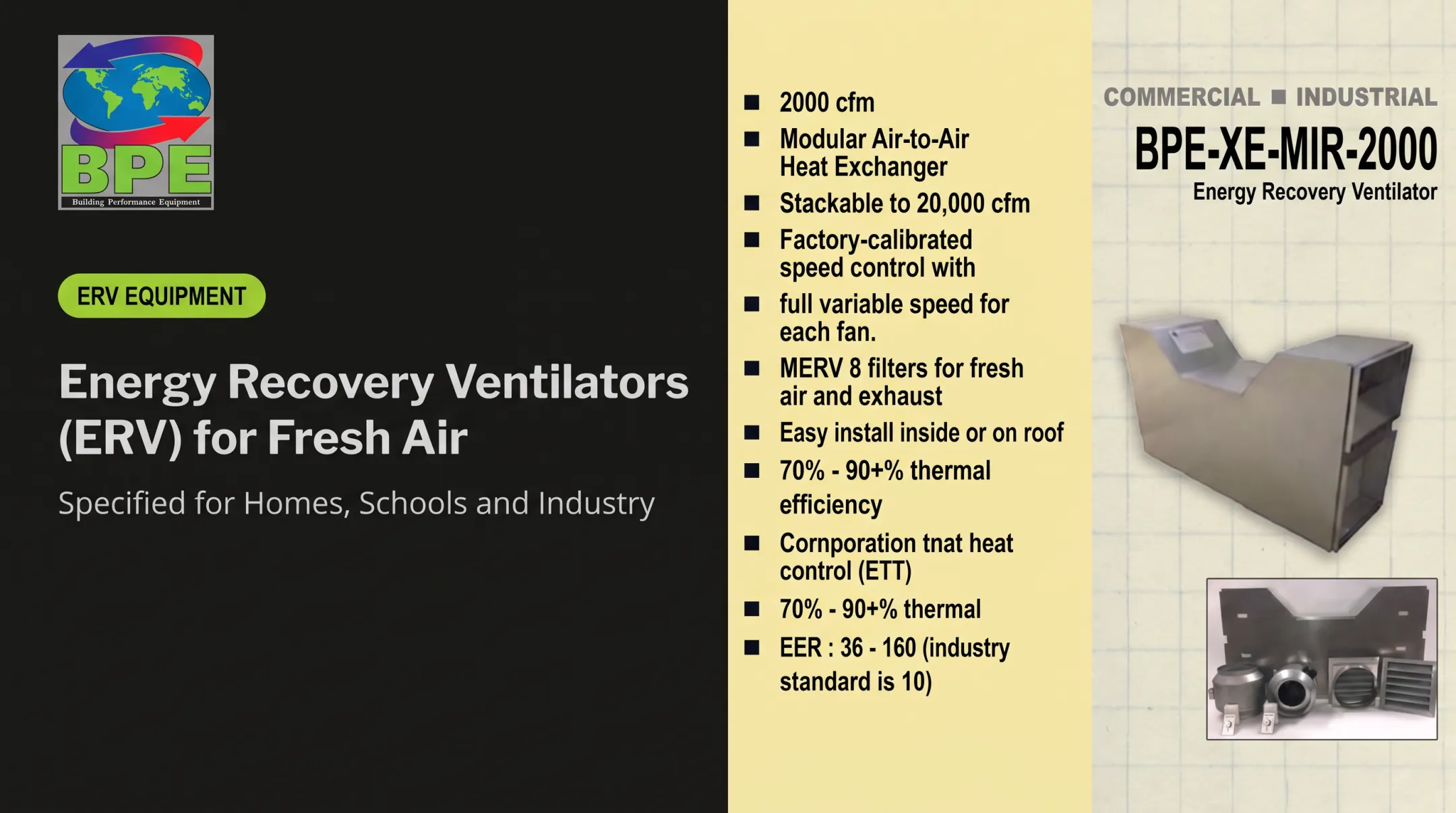
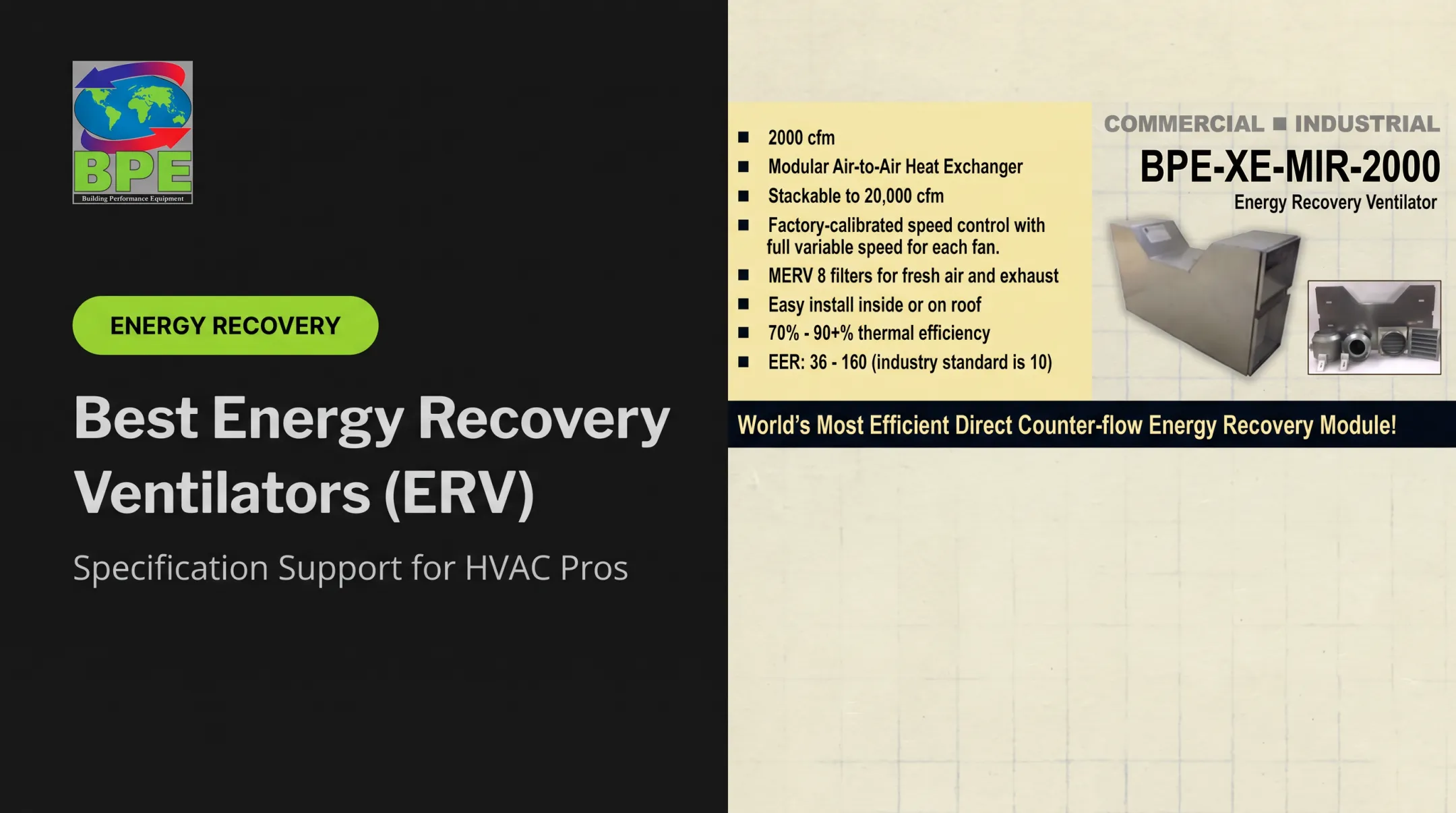
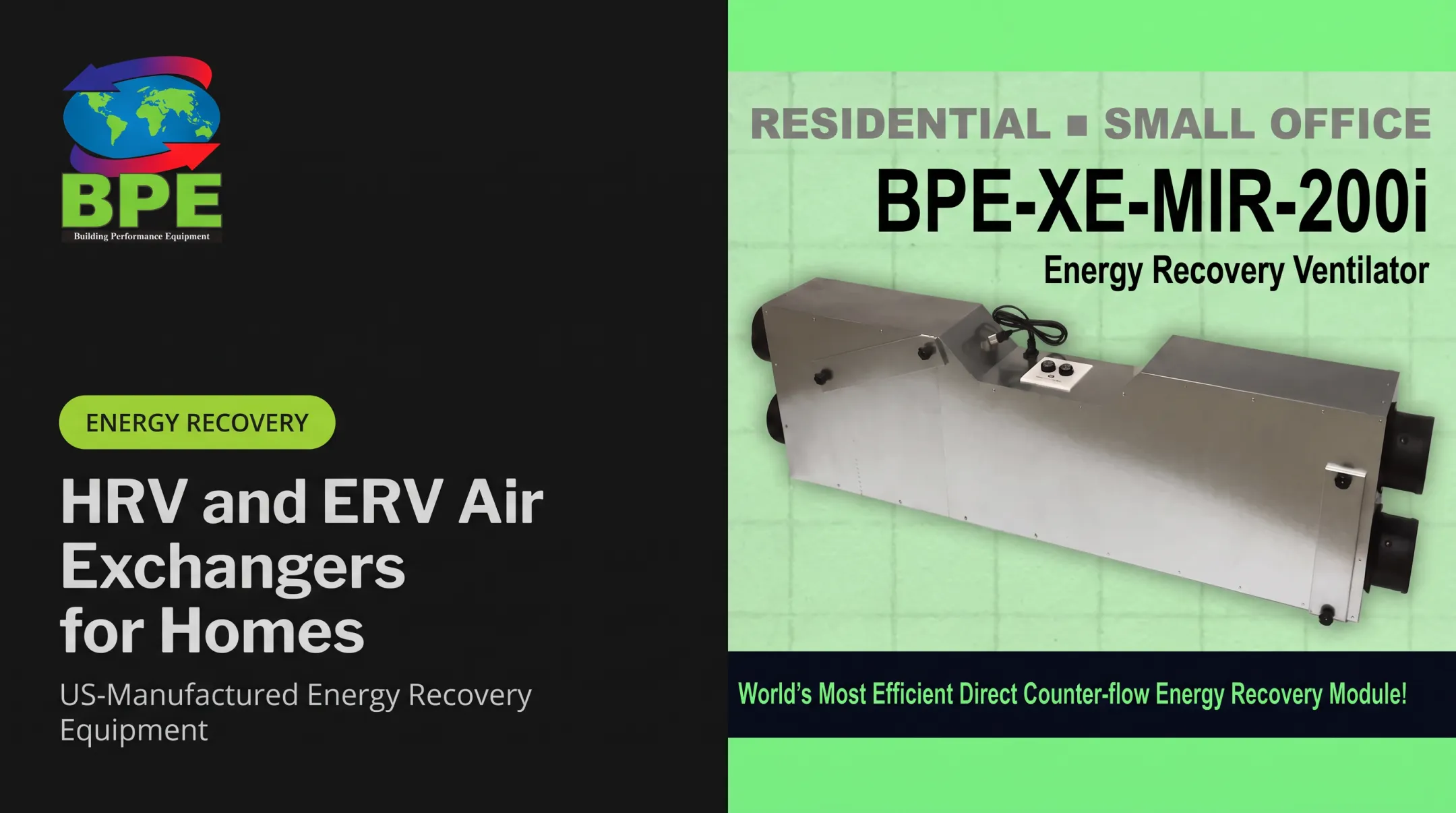
The BPE-XE-MIR-200i (horizontal) and BPE-CE-MIR-200i (vertical) deliver 60–200 CFM, which comfortably covers a tiny house using BPE's own sizing rule of roughly 20 CFM per occupant.
Both configurations plug straight into a 120 VAC outlet and tie into new or existing ductwork — no electrician required for the unit itself. The vertical version occupies about 1.09 square feet of floor space, which matters when every square foot in a tiny home is spoken for.
What sets this line apart:
- Polymer fixed-plate core recovers both heat and moisture
- Rated 86% sensible and 7% latent effectiveness at 200 SCFM
- Factory-wired, tested, and shipped ready to install
- Can be fully sealed on request to run as a pure HRV instead
| Spec | BPE-XE-MIR-200i / BPE-CE-MIR-200i |
|---|---|
| Airflow | 60–200 CFM |
| Dimensions | Horizontal: 64"L × 8"W × 18.5"H; Vertical: 8"W × 20"D footprint |
| Recovery type | Polymer fixed-plate, heat + moisture |
| Test standard | ARI 1060 (EER 31.53 summer / 75.67 winter) |
| Electrical | 115V, single-phase, 60Hz, 60W per fan at 226 CFM |
| Filters | MERV 8 standard (MERV 13 optional) |
| Frost strategy | Below -10°F / 40% RH: contact manufacturer for application guidance |
| Install type | Plug-in, ducted |
| Warranty | 18 months parts; 10-year heat exchanger (guide spec) |
LUNOS e² Series Through-Wall System
If your tiny house has zero mechanical room space, a through-wall system skips ductwork entirely. LUNOS's e² line uses paired fans that alternate direction every 70 seconds, each one storing heat in a regenerative core during exhaust and releasing it during supply.
This "no ducts" approach suits tight builds, but it comes with trade-offs: minimum wall depth runs 8 to 12 inches depending on the fan version, and because the two fans swap roles, you lose some of the clean separation between supply and exhaust air that a true ducted ERV provides.
| Spec | LUNOS e²60 (US kit) |
|---|---|
| Airflow settings | 5 / 10 / 15 / 20 / 25 / 35 CFM |
| Recovery type | Reversing regenerative core (ceramic or polymer, confirm variant) |
| Wall depth | 8" (short) to 11–12" (standard) |
| Sound | From 18 dB(A); confirm pressure vs. power rating |
| Power draw | 0.4–3.3W |
| Controls | Groups of 2 or 4 fans per controller |
| Recovery rating | 89% (DIBT/DIN V 4701, ~15 CFM) |
| US support | 475 High Performance Building Supply |
Panasonic WhisperComfort Compact Ducted ERV
Panasonic's FV-06VE1 WhisperComfort60 launched in the US in February 2024 and fits a 14-inch joist bay, making it one of the more straightforward compact ducted options if your tiny house already has (or can accommodate) short duct runs.
Its capillary core transfers both heat and moisture, and the unit steps through continuous speeds of 20, 30, 40, or 50 CFM with a 60 CFM boost setting. Per Panasonic's spec sheet, sensible recovery hits 70% at 32°F, dropping to 60% total recovery at 95°F.
One catch for cold climates: outdoor temperatures between 23°F and 14°F trigger a defrost cycle, and below 14°F, the unit shifts to exhaust-only operation, temporarily cutting supply air.
| Spec | Panasonic WhisperComfort60 (FV-06VE1) |
|---|---|
| Airflow | 20/30/40/50 CFM continuous; 60 CFM boost |
| Duct connections | 4" or 5" |
| Recovery type | Capillary core, heat + moisture |
| Efficiency | 70% SRE at 32°F; 60% TRE at 95°F |
| Electrical | 120V, 60Hz, 39W at 60 CFM |
| Filters | MERV 13 supply filter; reusable return filter |
| Sound | 0.9–2.5 sones depending on CFM setting |
| Frost strategy | Defrost cycle 23–14°F; exhaust-only below 14°F |
| Warranty | 6 years motor; 3 years parts |
Holtop Compact or Ductless ERV
Holtop's Eco-Pair Plus (model AV-TTW5-W) looks appealing on paper, with claimed recovery efficiency up to 97% and a Wi-Fi app for controls. The catalog, however, lists Chinese contact details, and current documentation doesn't establish US-specific certification, authorized stock, or service support.
Treat this one as a candidate to investigate further rather than a confirmed US-ready purchase:
- Airflow with F7 filter: 11.8/23.5/29.4 CFM, 35.3 CFM boost
- Dimensions: 239.6 × 258 × 499.7mm, with wall duct extending 280–600mm
- Filtration: two prefilters plus F7 (labeled MERV 11, equivalence unverified)
- Power: 100-240V AC, 50-60Hz, 6-7.8W
- Sound: 32.7 dBA (test distance/speed not stated)
Verify US import, warranty, and service channels directly with Holtop before committing.
AccuraSEE MINI or Fantech FIT80E
AccuraSEE's MINI is Canadian-manufactured, priced in CAD, and sold through Canadian dealers. US availability and support aren't established in current documentation, so we're substituting a better-verified alternative: Fantech's FIT80E, which carries current US specification sheets and support contacts.
The FIT80E uses a washable, moisture-permeable crossflow membrane and is CSA C439 tested and HVI certified. Those third-party numbers matter more than manufacturer claims alone.
| Spec | Fantech FIT80E |
|---|---|
| Airflow | 78 CFM at 0.4" w.g.; 100 CFM net supply at 0.1" w.g. |
| Dimensions | 20⅝" × 21⅝" × 9¼" |
| Mounting | Wall or ceiling bracket |
| Duct connections | 4" |
| Recovery type | Washable crossflow polymer membrane |
| Efficiency | 70% SRE at 32°F/42 CFM; 50% TRE at 95°F/42 CFM |
| Test standard | CSA C439, HVI certified |
| Electrical | 120V, single-phase, 58W rated |
| Frost strategy | Below 14°F: supply shuts down, exhaust runs high, then resumes |
| Warranty | 7 years motor; 5 years parts and core |
Its minimum airflow setting isn't independently verified for low-demand tiny house use, so confirm turndown capability before ordering.

How We Chose the Best Tiny House ERV or HRV
"Best" here means reliable, correctly-sized airflow within your home's physical, electrical, and acoustic limits, not the biggest brand name or the single highest efficiency number on a spec sheet.
Airflow and distribution. Start with required ventilation airflow based on floor area and occupancy, then check whether one unit can distribute that air effectively or whether you need paired units or a small duct run to reach wet rooms like the bathroom.
ERV versus HRV and climate. An ERV's moisture transfer helps in humid summers and dry winters alike; an HRV may suit climates where you specifically want to shed indoor moisture rather than retain it. Check HVI's buying guide for climate-specific selection guidance before deciding.
Installation and design. Consider:
- Duct length and static pressure if going ducted
- Wall depth and fan pairing if going through-wall
- Condensate handling and electrical access
- Protection from wind-driven rain at exterior terminals
Comfort, IAQ, and maintenance. Sound ratings aren't reported consistently across manufacturers. Some use sound pressure, others sound power, so don't compare numbers at face value. Filtration level, ease of core cleaning, and service access all affect long-term indoor air quality more than the headline recovery percentage.
Cost and verification. Compare purchase price, installation labor, ductwork or wall penetrations, electrical hookup, filter replacement frequency, and warranty terms together. Always identify which test standard (ARI 1060, HVI/CSA C439, or a manufacturer's internal DIN rating) backs any efficiency claim before you compare two products side by side.

Conclusion
A tiny house still needs properly sized, balanced ventilation. The small square footage doesn't make that need disappear, it just changes the constraints you're working within. The right choice comes down to your required airflow, your climate, your layout, and how much mechanical space and maintenance access you actually have.
Don't shop by footprint or the highest advertised recovery rating alone. Compare lifecycle performance, confirmed test standards, and installation quality, and verify current specifications against your local ventilation requirements before you buy.
If you're sizing a system for a specific tiny-house project, Building Performance Equipment can help you match airflow, recovery type, and installation approach to your actual design. Reach out at info@bpequip.com or 201.722.1414.
Frequently Asked Questions
How much does a heat recovery ventilation system cost?
Compact single-room units can run a few hundred dollars; ducted whole-home ERVs typically cost more once you add ductwork, wall penetrations, and electrical work. Get itemized quotes for equipment and installation separately.
Should I run my air exchanger all the time?
Most balanced ventilation systems are designed for continuous low-speed operation to manage odors and humidity steadily. Check your manufacturer's controls: occupancy, humidity, and outdoor conditions may call for schedule adjustments.
How do I clean a heat recovery ventilator?
Clean or replace filters per the manufacturer's interval, inspect the core for buildup, and clean fan blades and grilles. Always isolate power first, and follow your specific unit's maintenance manual.
Is an HRV worth the money?
It depends on your climate and airtightness. HRVs pay off fastest in extreme winter or summer climates with high energy prices; mild climates may see smaller returns on the added equipment and fan electricity cost.
What's the smallest ERV available?
"Smallest" depends on your airflow need and installation type: a through-wall unit like LUNOS's e²60 starts around 5 CFM, while compact ducted units like BPE's 200i start at 60 CFM. Compare verified specs for your specific airflow target.
What is an HVAC ventilator?
It's equipment that exchanges indoor and outdoor air. Exhaust-only fans simply remove air, while balanced HRVs and ERVs recover heat (and in an ERV's case, moisture) from the outgoing airstream before venting it.