
The challenge is that bringing in outdoor air isn't free. Every cubic foot of fresh air has to be heated, cooled, humidified, or dehumidified to match indoor conditions. Skip that step and you get comfort complaints and wasted energy. Skip ventilation altogether and indoor air quality suffers.
An energy recovery ventilator solves this by transferring energy between outgoing and incoming air streams rather than just mixing them together. This guide walks through what an ERV is, how it operates stage by stage, and where it makes sense to install one.
Key Takeaways
- Balanced ERVs exhaust indoor air and supply outdoor air on separate paths
- The core preconditions outdoor air by transferring sensible heat and often moisture
- Fans, filters, controls, and airflow balance set real-world performance
- Homes, schools, and industrial buildings gain better IAQ, comfort, and HVAC efficiency
- Climate, airflow needs, contaminants, and local codes drive correct selection
What Is an Energy Recovery Ventilator?
An energy recovery ventilator (ERV) is a mechanical, balanced ventilation device. It pulls filtered outdoor air into a building while simultaneously exhausting stale or contaminated indoor air. The two air streams never mix directly. Instead, they pass by each other across an energy-transfer core, where heat and (depending on the core design) moisture move from one stream to the other.
That design solves a specific problem: tightly sealed or heavily occupied buildings need reliable fresh air, but conditioning large volumes of outdoor air from scratch can spike heating and cooling costs. An ERV preconditions that air before it ever reaches the furnace, heat pump, or air handler.
What an ERV Is Not
- Not a bathroom or kitchen exhaust fan. Those remove air without recovering any of its energy.
- Not a standalone air purifier or dehumidifier. An ERV may include filtration and can reduce moisture load, but it isn't a substitute for dedicated humidity or air-cleaning equipment.
- Not one fixed size or layout. Units range from compact residential models to modular commercial systems and specialized industrial installations.
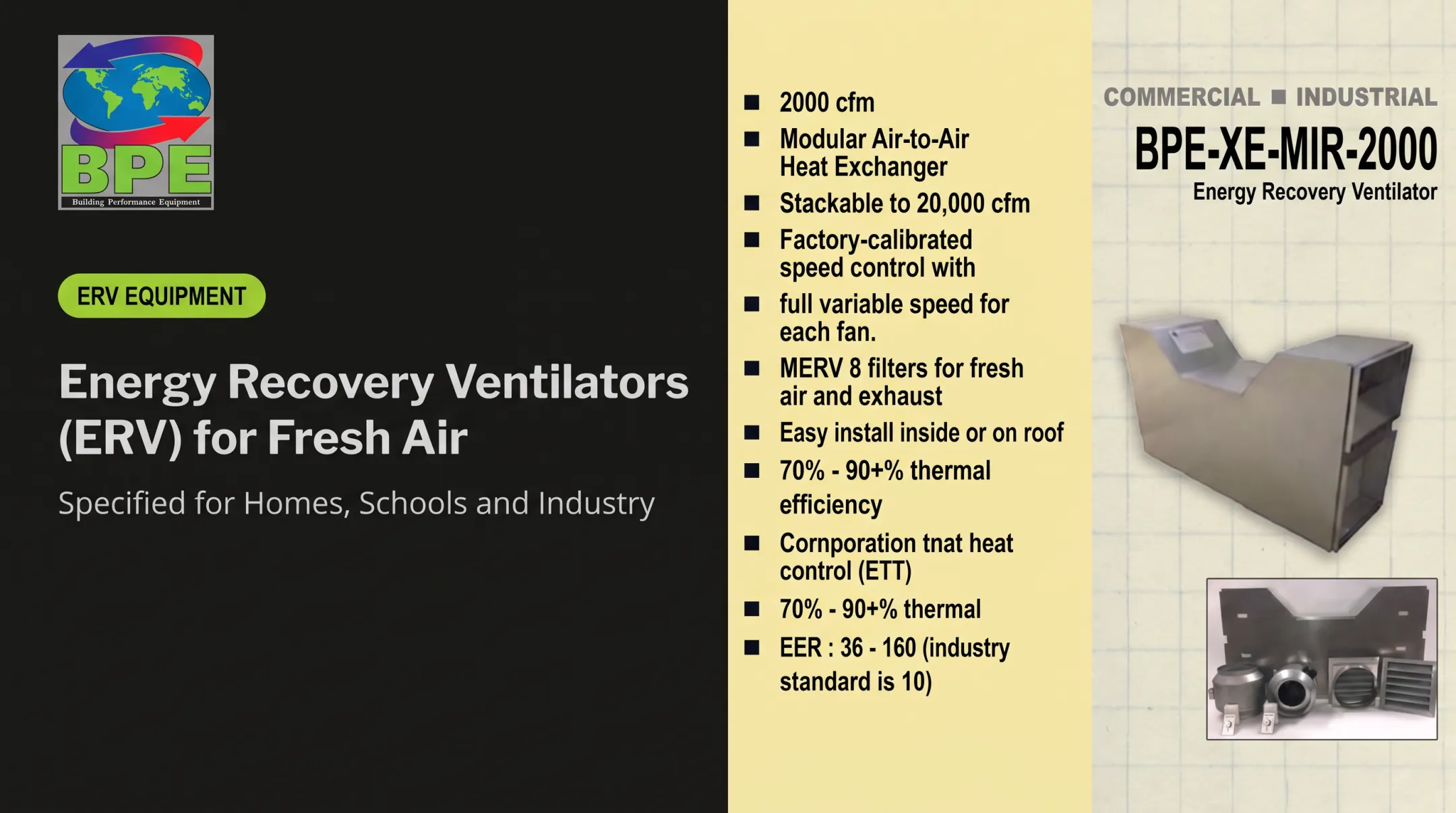
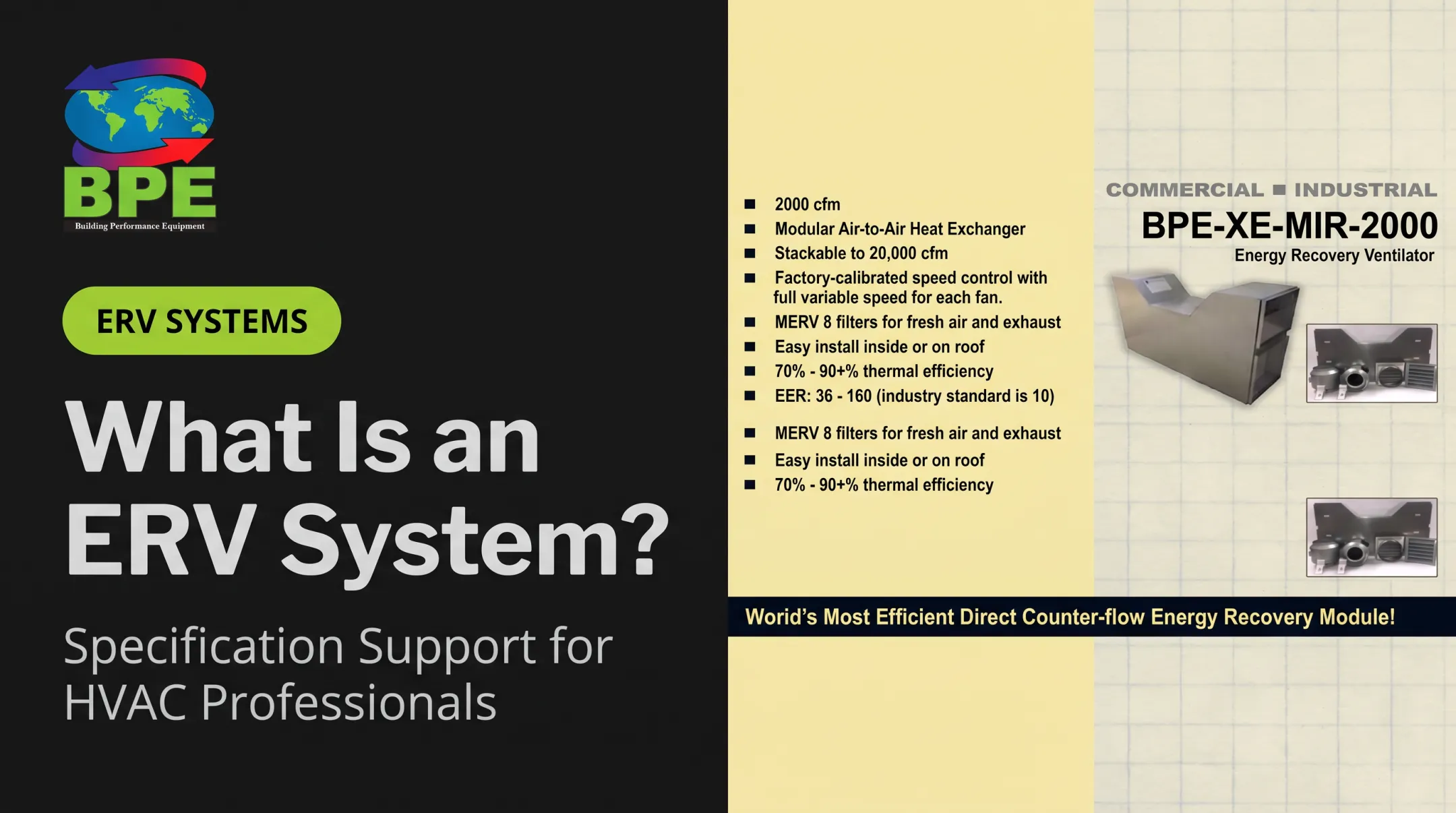
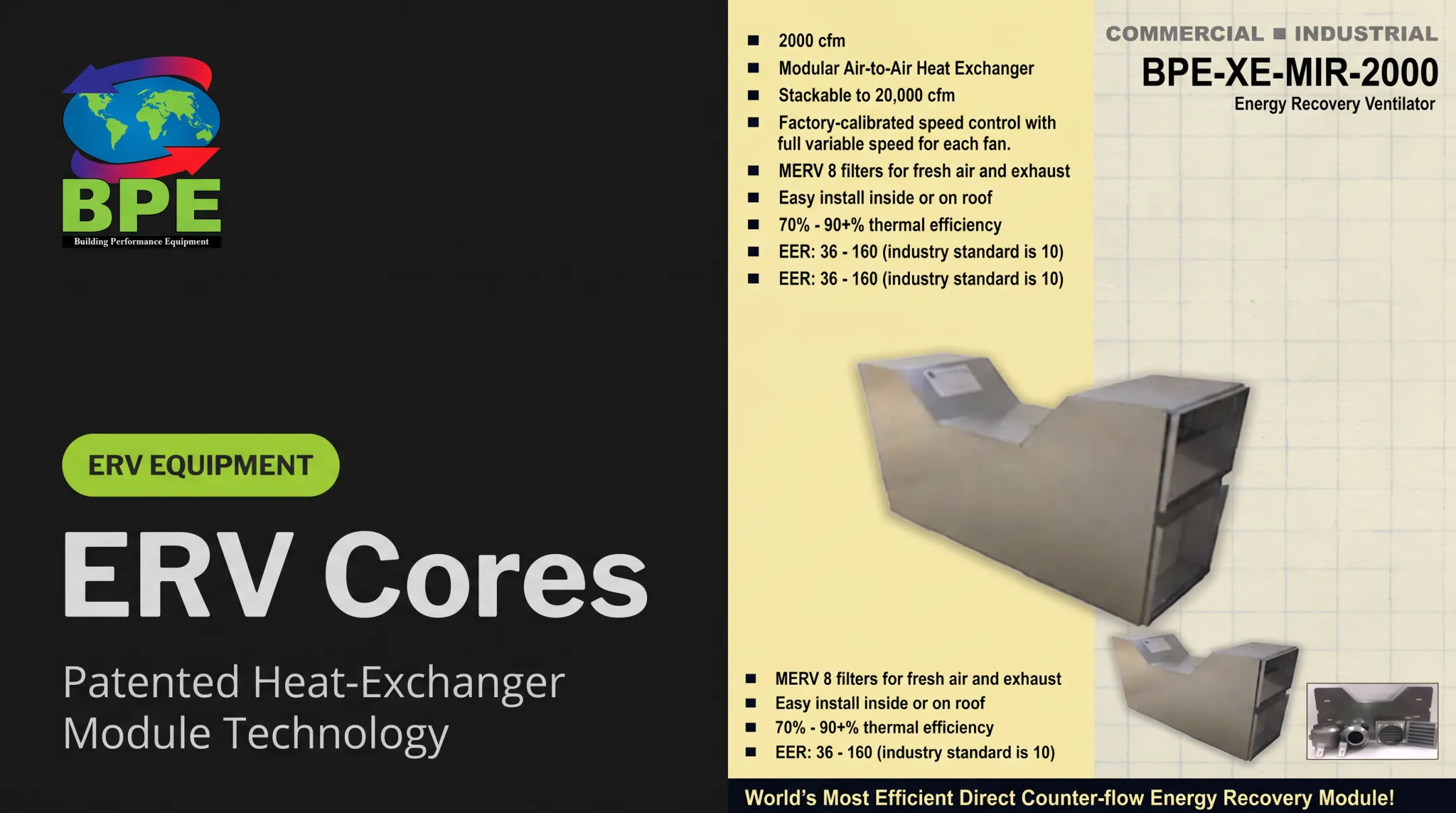
Building Performance Equipment's product range illustrates that span. Residential ERVs range from 60-200 CFM for a single-family home or small office, while stackable modular units scale from 500 CFM up to 20,000 CFM for schools, offices, and industrial plants.

Core Components
Regardless of size, most ERVs share the same basic parts:
- Outdoor-air intake and exhaust outlet
- Supply and exhaust fans
- Filters on both air streams
- An energy-transfer core
- Duct connections, dampers, and sensors
- A control interface or building automation tie-in
Those components exist to deliver outdoor air at the rates codes increasingly require. U.S. building codes reference ventilation standards like ASHRAE 62.1 and 62.2, which set outdoor-air rates for commercial buildings and dwelling units. The ASHRAE standards bookstore lists these as the governing references.
Meeting those rates does not automatically require an ERV. Energy recovery is a more efficient way to supply the outdoor air the standards call for—not a mandate on its own.
How Does an ERV Work?
An ERV runs as a continuous or scheduled process. Two fans move separate air streams through the unit at the same time, so ventilation and energy transfer happen together rather than in sequence.
Initiation
The system starts based on how it's controlled:
- A wall control or occupancy sensor
- A building automation system schedule
- An indoor air quality or humidity sensor
- A simple continuous-run timer
Operation can be continuous, demand-controlled, or staged according to occupancy and outdoor conditions. Building Performance Equipment's guide specifications, for example, support optional CO2 demand-side ventilation controls under ANSI/ASHRAE Standard 62.1-2016, which reduce outdoor-air intake during low-occupancy periods.
Commissioning still comes first: adequate power, open dampers, clear intake and exhaust hoods, correctly sized ductwork, and a balanced airflow. Skip it and the unit may run without delivering its rated airflow.
Core Operation
Outdoor air follows one path: it enters through an intake, passes through filtration, crosses the energy-transfer core, and gets supplied to occupied spaces or connected HVAC equipment.
Stale indoor air follows the opposite path. It's drawn from designated spaces, carrying odors, carbon dioxide, and excess humidity, then pushed through a separate channel and exhausted outdoors.
The core is where the real work happens:
- In winter, warmer exhaust air transfers heat to colder incoming air. Depending on the core, moisture transfer can also help retain indoor humidity.
- In summer, cooler exhaust air transfers cooling energy to warmer incoming air, while moisture transfer can reduce the latent load from humid outdoor air.
This is where sensible recovery (temperature transfer) and latent recovery (moisture transfer) diverge. Not every ERV handles both equally.
Building Performance Equipment's guide specifications call for sensible effectiveness above 80% and latent effectiveness above 30% under ARI 1060 testing, with outdoor air preconditioned to within 10°F of room temperature in a single pass. Always check manufacturer or AHRI-certified data rather than assuming one ERV performs like another.
The result: incoming air arrives filtered and preconditioned, while exhaust air carries pollutants and unwanted heat or moisture outside. Recovered energy reduces, but doesn't eliminate, the work left for a furnace, air conditioner, or heat pump.

Regulation and Control
Supply and exhaust fans, variable-speed drives, dampers, and sensors keep airflow balanced as conditions change. Excessive imbalance affects building pressure, infiltration, door operation, and how much outdoor air actually gets delivered.
Performance also depends on:
- Airflow rate and fan power
- Static pressure and filter loading
- Core effectiveness and duct leakage
- Outdoor temperature and humidity
Cold-climate installations often need frost-control or defrost strategies, since frost buildup can restrict airflow and raise pressure resistance. Building Performance Equipment flags conditions below -10°F or 40% relative humidity as situations warranting extra application review on some of its models. Hot, humid climates need coordination with air-conditioning and dehumidification systems instead.
Industrial applications add another layer. Exhaust air containing chemicals, solvents, grease, or infectious materials needs careful review before it touches a recovery core, both to protect the equipment and to prevent cross-contamination.
Output and Result
The output is a measured supply of filtered outdoor air and a matching exhaust flow, delivered with less energy penalty than unconditioned ventilation.
Measurable quality markers include:
- Outdoor-air delivery rate
- Sensible and latent recovery effectiveness
- Fan energy and pressure drop
- Resulting HVAC load reduction
Source these figures from certified equipment data, not marketing claims. The U.S. Department of Energy notes that many energy-recovery systems recover roughly 70% to 80% of the energy in exiting air, though that's a general range, not a guaranteed figure for any specific unit.
From there, the ERV connects downstream to dedicated ventilation ducts, an air handler, a rooftop unit, or a building automation system.
In practice, a 2,000 CFM unit drawing 70°F exhaust air in winter can precondition 10°F outdoor air close to room temperature before it reaches the heating coil. In summer, the same core reverses the process, tempering hot, humid intake air against cooler exhaust.
Building Performance Equipment manufactures air-to-air energy recovery equipment across this range, including modular systems that stack without crane access, plus controllers for monitoring and scheduling. Efficiency and static pressure vary by model, so review current specifications for the unit under consideration.
Where Are ERVs Used?
ERVs fit best where a building needs controlled outdoor-air ventilation, carries significant heating or cooling demand, and can't rely on open windows or uncontrolled infiltration to manage air quality.
Residential and High-Performance Buildings
Tightly constructed homes, multifamily and affordable housing, and Passive House or net-zero projects all depend on consistent fresh-air delivery. Building Performance Equipment's compact residential units, built for homes up to six occupants or small offices up to ten people, are designed for this kind of retrofit or new-construction installation.
Institutional and Commercial Buildings
K-12 schools, universities, offices, and hospitality facilities all need ventilation rates coordinated with occupancy schedules. One documented case: Hopewell Valley Regional School District reduced energy consumption by over 32% across five years while improving thermal comfort and indoor air quality. The district used Building Performance Equipment's systems across its classrooms.

Industrial and Specialized Applications
Manufacturing plants, tanneries, and fragrance production facilities often need energy recovery on makeup air or process exhaust. These environments require extra scrutiny:
- Engineered source control for hazardous fumes
- Material compatibility review for the exchanger core
- Cross-contamination analysis before connecting any contaminated exhaust stream
What Influences Suitability
A few variables determine whether (and which) ERV fits a given building:
| Factor | Key Consideration |
|---|---|
| Climate | Humid climates benefit more from latent recovery; dry climates less so |
| Building use | Occupancy, operating hours, and pollutant sources drive airflow needs |
| Installation | Roof penetrations, mechanical room space, and duct routes affect feasibility |
| Equipment | Airflow capacity, pressure drop, filtration, and certified performance data |
In some cases, an ERV needs to work alongside other systems, such as dedicated dehumidifiers, kitchen exhaust, or laboratory fume controls. A qualified HVAC or mechanical design professional should verify ventilation requirements, applicable codes, and safe exhaust handling before you specify any equipment.
Conclusion
An ERV's job comes down to simple logic: exhaust stale air, supply outdoor air, and transfer heat and moisture across a core while keeping the two airstreams separate.
Frost control in a cold climate, demand-based controls in an office, and exhaust filtration in an industrial plant all build on that same mechanism.
Getting the details right determines whether a building sees the comfort and efficiency gains an ERV promises on paper:
- Climate suitability
- Airflow sizing
- Controls and ductwork
- Filtration
Before specifying or installing a system, compare certified equipment data and consult an experienced energy-recovery or mechanical-systems professional. Building Performance Equipment's engineering team works directly with homeowners, HVAC contractors, and facility managers on project-specific selection and specification support.
Frequently Asked Questions
How does an ERV system work?
Two fans move separate supply and exhaust air streams through the unit at the same time. Both pass through an energy-transfer core, where heat and, depending on the core, moisture transfer between the streams without mixing them.
How big of an ERV do I need for my house?
Sizing depends on required outdoor airflow, floor area, occupancy, climate, and building tightness, not floor area alone. A professional load and ventilation calculation gives a more reliable answer than a rule of thumb.
Should an ERV run constantly?
Many residential systems are designed for continuous low-speed operation. Demand-controlled or scheduled settings can also work well, depending on occupancy and the building's ventilation strategy.
Should you run an ERV in summer?
Yes, in most cases. Summer operation delivers needed outdoor-air exchange while transferring some heat and moisture to the exhaust stream, though it should be coordinated with air-conditioning and dehumidification equipment.
Is an ERV system worth it?
For most tightly built or heavily occupied buildings, the ventilation, comfort, and energy-recovery benefits outweigh the equipment and installation cost. Actual payback still depends on climate, building use, and project specifics.
Which is better, an ERV or HRV?
Both provide balanced ventilation, but an ERV transfers heat and moisture while an HRV primarily transfers sensible heat. Climate and indoor humidity levels usually decide which makes more sense for a given building.