
Introduction
Modern homes and commercial buildings are built tighter than ever. Better insulation and air sealing cut energy waste, but they also trap stale air, moisture, and pollutants indoors.
The EPA warns that tightening a building without adding deliberate ventilation lets combustion gases and volatile organic compounds build up instead of leaking out naturally, as EPA guidance on energy weatherization and indoor air quality explains.
Cooking, showering, and laundry add moisture that, without proper airflow, feeds mold and dust mites. CO2 levels climb in occupied rooms, too, signaling that ventilation hasn't kept pace with occupancy.
This is where an energy recovery ventilator comes in. An ERV exchanges stale indoor air for fresh outdoor air while transferring heat and moisture between the two separate air streams. You get fresh air without paying full price to heat or cool it from scratch.
This guide covers how ERVs work, their benefits and limits, how they compare to HRVs, where they fit best, and what to look for when selecting and maintaining one.
Key Takeaways
- ERVs supply fresh outdoor air and exhaust stale indoor air in balanced, matched volumes
- The energy recovery core transfers heat and moisture between air streams without mixing them
- Delivers better indoor air quality, humidity moderation, comfort, and lower HVAC loads
- An ERV is not a substitute for dedicated filtration or humidity control
- Climate, airflow requirements, building use, and certified performance data should drive selection
What Is an ERV System?
ERV stands for energy recovery ventilator, the physical equipment. "Energy recovery ventilation" describes the broader design strategy that uses that equipment.
ASHRAE classifies an ERV as an air-to-air device that transfers both heat and moisture between two air streams, which sets it apart from units that recover heat alone. Its 2024 ASHRAE Handbook chapter on air-to-air energy recovery equipment covers the distinction in detail.
An ERV's job is straightforward: continuously remove stale indoor air while bringing in outdoor air, in balanced, controlled volumes. That's a meaningful step up from just venting air out and hoping it gets replaced.
As the two air streams pass near each other inside the unit, the system recovers:
- Sensible energy - temperature, or heat
- Latent energy - moisture, or humidity
This preconditions incoming outdoor air before it reaches occupied space.
Main Components
Every ERV, regardless of size, shares a few core parts:
- Separate intake and exhaust ducts. Outdoor air in and stale air out on isolated paths, with no cross-connection
- Supply and exhaust fans. Two in-line fans move each air stream independently
- Energy recovery core. A fixed-plate or wheel-based exchanger, where the heat and moisture transfer actually happens
- Filters, dampers, sensors, and controls. These manage airflow and air quality, and can include features like CO₂ demand-controlled ventilation
What an ERV Is Not
An ERV handles ventilation air; your HVAC system still handles space conditioning. It is not:
- A replacement for your furnace, air conditioner, or heat pump
- A substitute for a dedicated air purifier aimed at fine particulates or smoke
- A hazardous-fume source-capture system like a lab hood
A basic exhaust fan or cracked window moves air, but neither recovers energy from outgoing air, and neither guarantees balanced airflow. That balance, plus energy recovery, is why ERVs show up in tightly sealed, high-performance buildings.
Where ERVs Are Used
Common ERV applications include:
- Single-family and high-performance homes
- Multifamily apartment buildings
- Schools and university facilities
- Commercial offices and retail spaces
- Select industrial facilities, including tanneries, server farms, and manufacturers managing chemical or solvent fumes
How Does an ERV System Work?
An ERV runs two air paths at once:
- Supply path: Pulls outdoor air through an intake and filter, then through the recovery core, into the building
- Exhaust path: Pulls stale indoor air, carrying heat, moisture, odors, and pollutants, through a separate duct and the same core on its way outside
Inside the core, the two streams flow through separate channels, close enough to exchange energy but never physically combining. Counter-flow designs, which run the streams in opposite directions, can reach effectiveness around 99%, compared with roughly 75% for cross-flow and about 50% for parallel-flow arrangements.

Why Direction Flips With the Seasons
- Winter: Warm, moist indoor exhaust air gives up heat and some moisture to the cold, dry incoming outdoor air
- Summer: Hot, humid outdoor air gives up heat and moisture to the cooler, drier exhaust air leaving the building
That benefit scales with the temperature and humidity difference between the two streams.
Sensible, Latent, and Total Recovery
Three figures describe how well a unit recovers energy:
- Sensible recovery - how much heat transfers between streams
- Latent recovery - how much moisture transfers
- Total energy recovery - combined heat and moisture transfer
Don't rely on a single generic efficiency number from marketing copy. Look for AHRI Standard 1060 test data, which measures sensible and latent effectiveness, airflow, and pressure drop under defined conditions, not one blended figure.
Fixed-Plate vs. Rotating Wheel
Two core designs dominate the market:
- Fixed-plate cores: No moving parts; a water-vapor-permeable plate transfers moisture and heat, simplifying maintenance and limiting cross-stream leakage
- Rotating-wheel cores: A slowly turning media wheel absorbs and releases heat and moisture through both streams; high effectiveness, with a moving part and small carryover risk
Real-world performance also hinges on fan speed and airflow balance, duct layout, building pressure differences, and how the controls are configured.
Important: If an ERV will handle chemical fumes, process exhaust, or other hazardous contaminants, bring in a professional engineer for the design review. Energy recovery must never compromise source control, occupant safety, or code compliance.
What Are the Benefits and Limitations of an ERV?
An ERV improves indoor air quality and trims ventilation-related heating and cooling load, but it is not a standalone humidity fix and it adds equipment, ductwork, and upkeep. Here is what holds up—and what to weigh—before you specify one.
Cleaner, Fresher Air and Better Comfort
Balanced ventilation dilutes indoor pollutants, CO2, odors, and VOCs, while supply-side filters catch incoming dust and pollen. Because incoming air is preconditioned through the recovery core, occupants also feel fewer drafts and temperature swings than they would with an untreated fresh-air vent.
How ERVs Save Energy
Preconditioned outdoor air reduces the ventilation-related heating and cooling load your HVAC system has to cover. Actual savings depend on climate, airflow rates, runtime, duct design, and the equipment's rated performance. There's no universal savings percentage that applies to every building or climate.
Humidity: Moderation, Not a Cure-All
- In humid climates, moisture transfer in the core reduces the latent load on cooling and dehumidification equipment
- In cold, dry climates, moisture recovery can help limit uncomfortably dry indoor air in winter
- An ERV isn't a replacement for a dedicated humidifier or dehumidifier when moisture loads run unusually high or low
ERV vs. HRV
Both recover heat. The difference is moisture: an ERV transfers heat and moisture between air streams, while an HRV (heat recovery ventilator) transfers heat only. Climate, indoor moisture generation, and design goals drive the choice. Humid climates and high-moisture spaces—pools, kitchens, locker rooms—typically favor ERVs.

Where ERVs Shine
- Tightly sealed, high-performance, or net-zero buildings
- High-occupancy spaces like gyms, studios, and auditoriums
- Schools and classrooms with variable occupancy
- Multifamily housing needing per-unit fresh air
- Facilities requiring continuous outdoor-air ventilation, such as data centers
Trade-Offs to Weigh
- Upfront equipment and installation costs
- Ductwork and wall or roof penetrations
- Fan electricity use
- Routine filter and core maintenance
- Possible noise, often addressable with silencers
- Pressure drop across the core
- The need for proper balancing and commissioning at startup
Choosing, Installing, and Maintaining an ERV System
Start With Required Airflow
Size an ERV around the building's required outdoor airflow, floor area, occupancy, and climate. ASHRAE Standards 62.1 and 62.2 set minimum ventilation rates for commercial buildings and dwelling units, respectively.
Use the applicable standard, and any stricter local code, to set target airflow before you compare equipment. Full details are on ASHRAE's 62.1 and 62.2 standards page.
Residential and Multifamily Considerations
For homes and apartment units, weigh:
- Room-by-room or per-unit distribution of fresh air
- Available ductwork and installation space
- Sound levels near bedrooms
- Controls that occupants will actually use
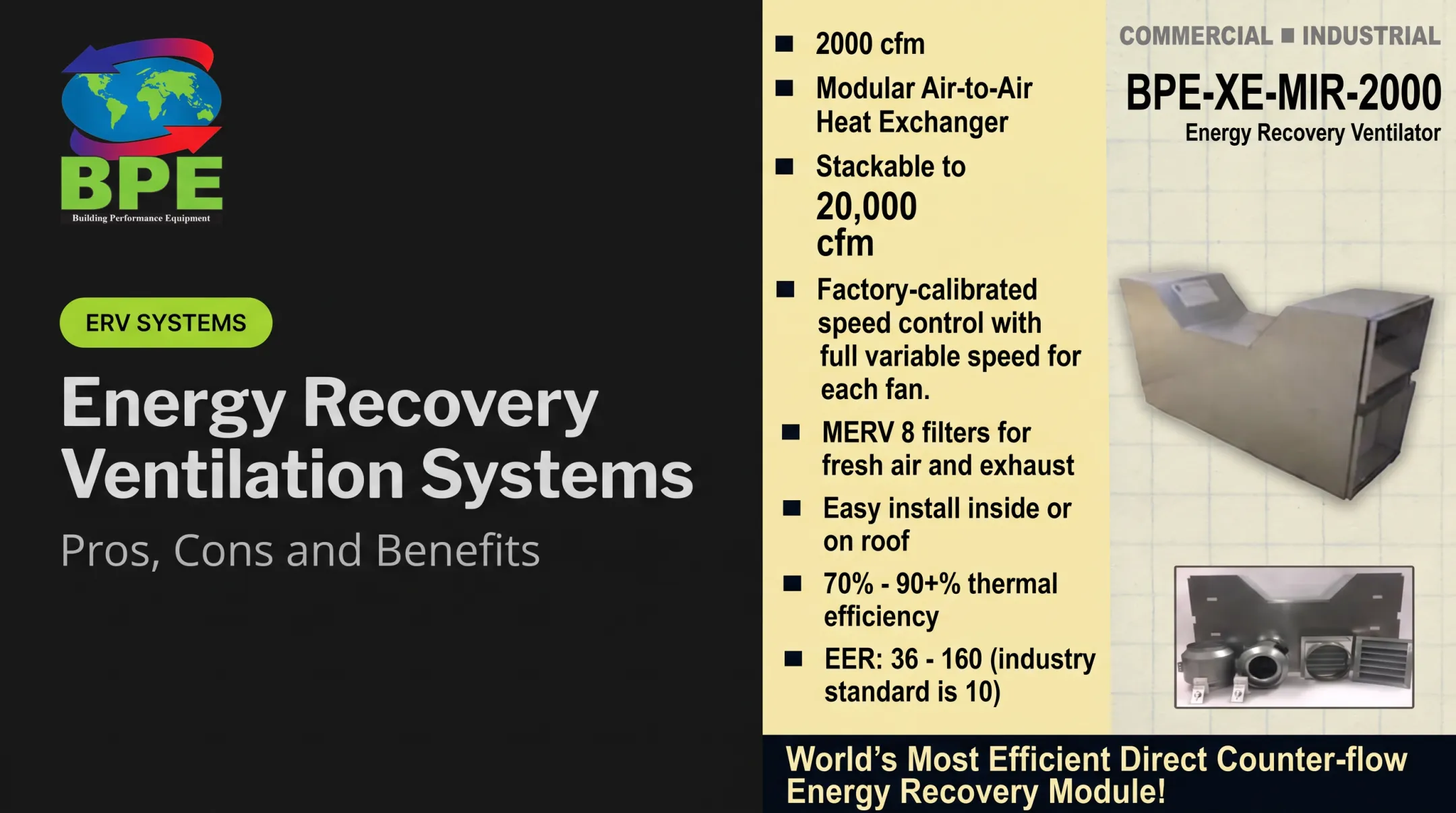
Plug-and-play residential units in the 60-2,000 cfm range fit many in-suite multifamily jobs, and some models support DIY setup.
Commercial and Industrial Considerations
Larger facilities carry additional requirements:
- Occupancy schedules and variable airflow needs
- Exhaust contaminants and required pressure relationships
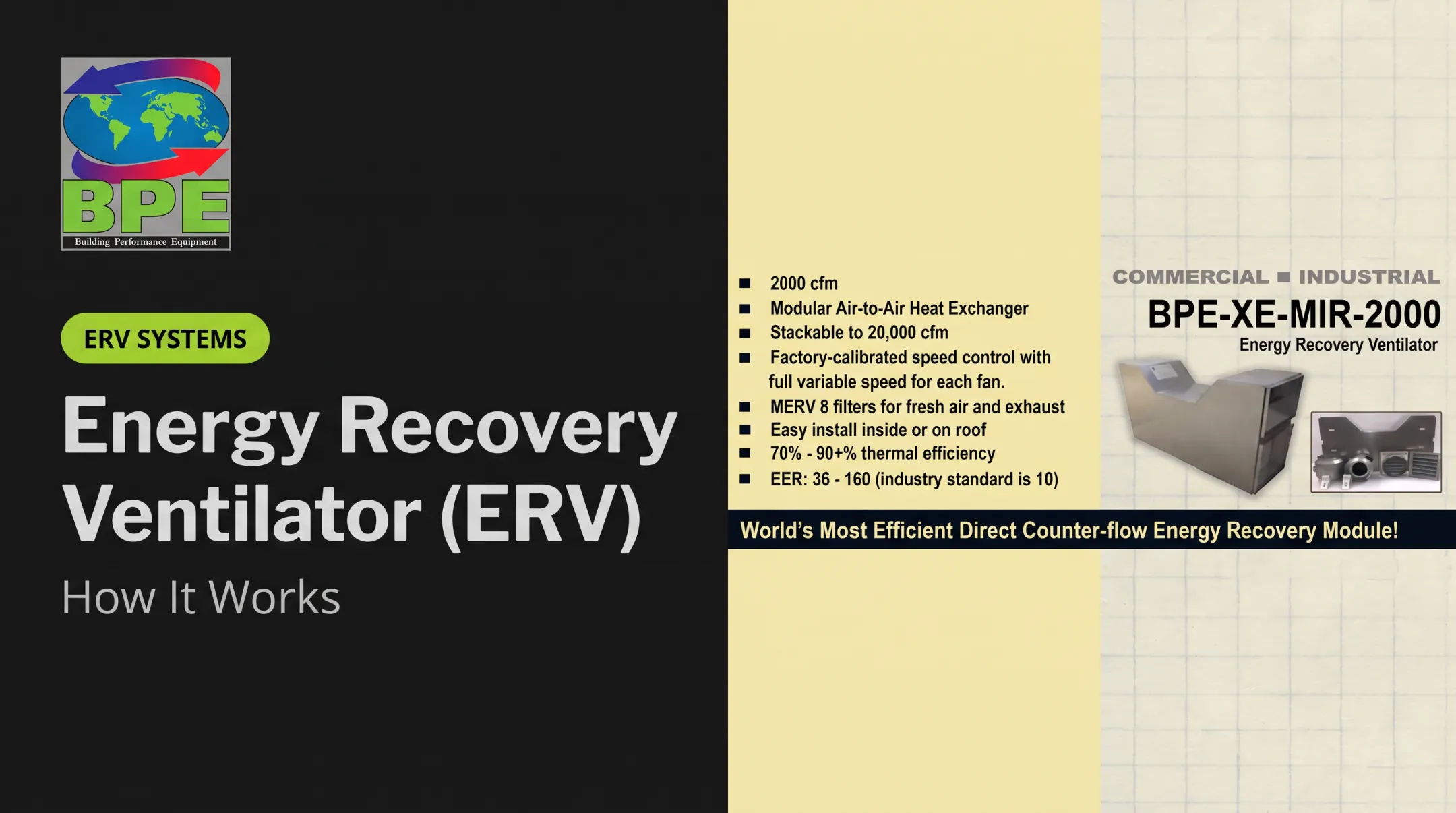
- Filtration levels, with MERV 8 common on commercial units
- Redundancy for critical facilities
- Controls integration and demand-based ventilation
- Commissioning to confirm rated performance in the field
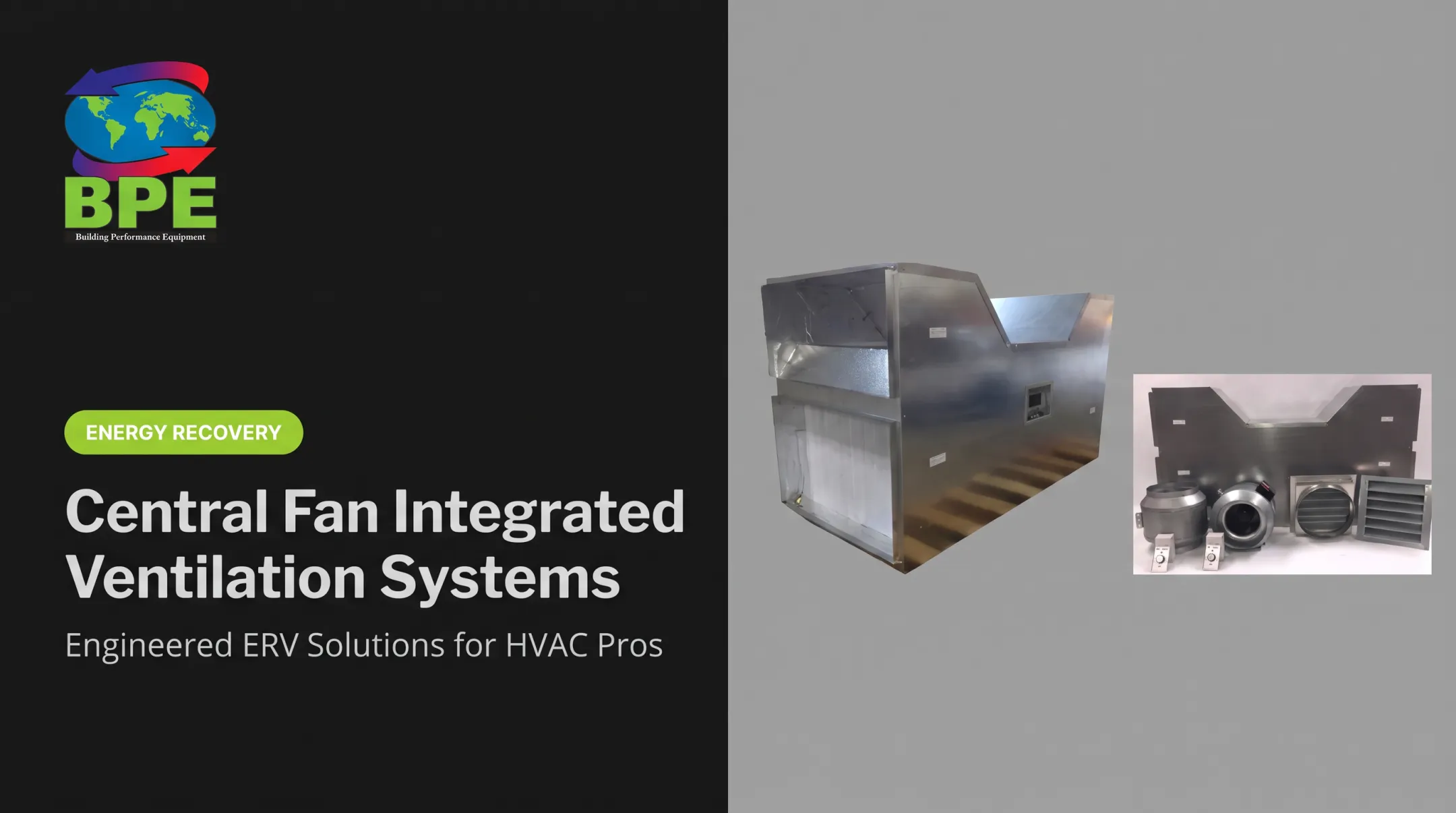
Stackable commercial and industrial modules that scale from roughly 500 to 20,000 cfm let schools and facility managers raise ventilation rates without replacing an entire rooftop structure.

Look Beyond the Headline Number
Request complete performance data, not one efficiency figure:
- Rated airflow, both supply and exhaust
- Sensible and latent effectiveness
- Total energy recovery
- Pressure drop and fan power
- Exhaust-air transfer ratio
- Conditions under which the data was measured
Installation and Maintenance Basics
Professional design should confirm these items before startup:
- Intake and exhaust separation
- Weather protection
- Correct duct sizing
- Condensate drainage
- Electrical capacity
- Airflow balancing
- Code compliance
Once running, a simple routine keeps performance on track:
- Inspect or replace filters on a regular schedule
- Keep intake and exhaust hoods clear of debris
- Inspect the recovery core for buildup or damage
- Verify fans and controls operate as designed
- Re-check airflow balance if performance seems to drift
Building Performance Equipment manufactures air-to-air energy recovery equipment, from plug-and-play residential units to stackable commercial and industrial systems, along with controls and filter boxes for integrated building-performance projects.
Engineers, contractors, facility managers, and building owners should review BPE's equipment documentation for model-specific performance data before specifying a unit. For cold-climate ventilation, high-efficiency retrofits, or projects that pair energy recovery with air quality goals, compare the patented counter-flow core design and condensate-return technology against current technical documentation.
Frequently Asked Questions
What does ERV stand for?
ERV stands for energy recovery ventilator. It's equipment that exchanges stale indoor air for fresh outdoor air while recovering heat and moisture between the two air streams.
What is an ERV system and what does it do?
An ERV provides balanced ventilation: it exhausts stale indoor air and supplies filtered outdoor air in matched volumes. An energy recovery core sits between the two streams, transferring heat and moisture without mixing the air itself.
What are the benefits of an ERV system?
ERVs improve ventilation and indoor air quality, moderate humidity, boost comfort, and reduce the ventilation-related load on your HVAC system. Results vary based on climate, design, and how the system is operated.
Should an ERV run continuously?
Many ERVs are designed for continuous, low-speed operation to maintain steady fresh-air delivery. Schedules should still reflect the building's ventilation design, occupancy patterns, outdoor conditions, and a professional's recommendation.
Is an ERV expensive to run?
Most running cost is fan electricity, which is often modest and partly offset by lower heating and cooling loads from preconditioned air. Total cost depends on fan power, airflow, runtime, climate, and maintenance.