
Introduction
Most HVAC systems do one thing really well: they move the same air around your building, over and over. Heat it, cool it, filter it, repeat. What they don't do automatically is bring in a controlled supply of outdoor air.
In fact, EPA's indoor air guide notes that most home heating and cooling systems don't mechanically introduce fresh air at all. That gap matters more now than it used to.
Tighter building envelopes trap moisture, carbon dioxide, odors, and indoor pollutants that used to leak out through gaps and cracks. Without an intentional ventilation strategy, that stale air just stays put.
This guide covers how fresh air intakes actually work, how to weigh a basic intake against an energy-recovering system like an ERV or HRV, and what to verify before anyone installs one.
Key Takeaways
- A fresh air intake brings measured outdoor air into a system; it is not the same as return-air recirculation
- Required outdoor-air volume depends on occupancy, floor area, climate, exhaust rates, and applicable codes
- ERVs, HRVs, and DOAS units precondition outdoor air, cutting the energy penalty of ventilation
- Intake placement, filtration, controls, and commissioning matter as much as the ductwork itself
What Is an HVAC Fresh Air Intake and Why Does It Matter?
A fresh air intake is the controlled opening, hood, louver, duct, damper, and related equipment that brings outdoor air into a building or HVAC system. It's a deliberate pathway, not a byproduct of leaky construction.
A typical setup follows this path:
- Outdoor hood or louver – the exterior opening, usually shielded from wind-driven rain
- Bird and insect screen – blocks pests and debris from entering the ductwork
- Damper – controls or shuts off airflow
- Filter – commonly MERV 13 in modern designs, removing particulates before conditioning
- Fan or air handler – moves the air into the system
- Conditioning section – heats, cools, or dehumidifies the incoming air
- Supply distribution – delivers the conditioned air to occupied spaces
Outdoor Air vs. Return Air vs. Combustion Air
These three terms get confused constantly, and the distinction matters for design:
| Term | What it actually is |
|---|---|
| Outdoor air | Air from outside that hasn't yet circulated through the system |
| Return air | Air removed from a space to be recirculated or exhausted — not automatically the same as recirculated air |
| Combustion air | Air specifically required for fuel-burning equipment to combust completely |
Done well, outdoor air dilutes indoor-generated pollutants, replaces exhausted air, and helps manage humidity. Done poorly, it raises heating and cooling loads, creates drafts, or drags in outdoor pollutants.
The goal is always measured, conditioned, balanced air, not just an open hole in the wall.
Call in a professional when you notice:
- Persistent odors or complaints about stale air
- Condensation on windows
- High occupancy in a tight building envelope
- Strong exhaust systems pulling out more air than anything is replacing
Fresh Air Ventilation System Types
Not every building needs the same approach. Here's how the main options differ.
Basic AHU-integrated intake: An outdoor opening ducted straight into the return plenum or air handler. Simple, inexpensive, but the incoming air gets whatever conditioning the main system already provides, with no dedicated treatment.
Dedicated Outdoor Air System (DOAS): Conditions and distributes ventilation air separately from the rest of the HVAC system, often with its own dehumidification and recovery equipment. Common in schools, offices, and multifamily buildings where zone-by-zone control matters.
Exhaust makeup-air systems: Replace air removed by bathroom fans, kitchen hoods, lab exhaust, or manufacturing processes. Makeup air isn't automatically outdoor air; it can blend outdoor, recirculated, and transfer air, but it usually still needs heating, cooling, or filtration before it enters occupied space.
HRV and ERV: Where Recovery Comes In
A plain intake duct just moves air. An HRV or ERV recovers energy from the air leaving the building before it's exhausted, using it to precondition incoming air.
- HRV transfers heat only, between outgoing and incoming airstreams
- ERV transfers heat and a measurable amount of moisture, which helps in humid climates and during dry winters
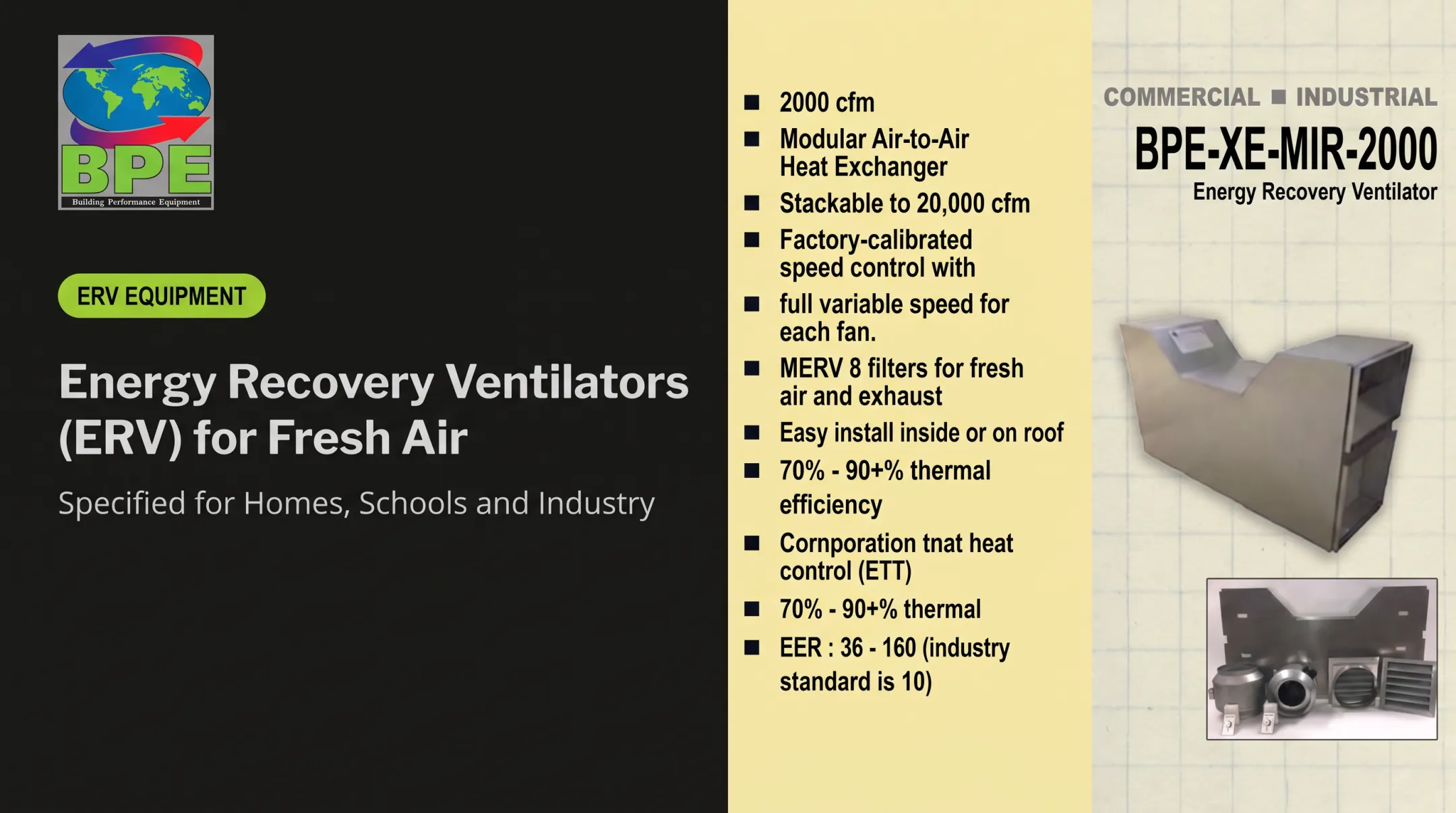
Building Performance Equipment's counter-flow ERV modules, for example, are rated at 70–90%+ thermal efficiency, with some models reaching up to 34% latent effectiveness in high-humidity conditions.
At a machine-shop installation, two BPE-XE-MIR-3000 units displaced chemical odors with outdoor air while still recovering a meaningful share of exhaust heat. Schools across central New Jersey have used hundreds of these units paired with displacement ventilation, drawing fresh air in on one side of a classroom while pulling contaminated air out the other.

Verify current capacities, efficiency ratings, pressure drop, controls, and certifications in manufacturer documentation before specifying any unit. Ratings vary by model and test conditions.
One caution worth repeating: chemical or process exhaust is not interchangeable with comfort-ventilation exhaust. Energy recovery equipment should only be paired with process exhaust after an engineer evaluates contaminant type, cross-leakage risk, and material compatibility.
Design and Sizing Considerations
Sizing a fresh air intake isn't just picking a duct diameter and calling it done. Several inputs drive the actual number:
- Occupancy count and floor area
- Space use and operating schedule
- Exhaust quantities already in the building
- Climate and indoor air-quality goals
- Applicable ASHRAE standards and local code requirements
ASHRAE's current standards (62.1 for commercial buildings and 62.2 for residences) use a people-plus-area approach, combining an outdoor-air rate per occupant with a rate per square foot.
As an illustration only, a preliminary rule of thumb for a small conference room might land around 20 cfm per occupant. That's a starting point for conversation, not a number to design around. Always pull current standard tables and local code requirements for an actual design value.
Placement and Component Details
Duct diameter alone doesn't determine performance. Airflow velocity, fittings, filters, dampers, and static pressure all factor in. A sharp bend without turning vanes can create as much resistance as an inline filter. Vanes can cut that corner's static pressure by up to 85%.
Intake placement is its own discipline. Current design details call for:
- Separation distances from contaminant sources per code tables (combustion exhaust, loading areas, cooling towers, waste storage)
- Intake velocity near 300 fpm below 7,000 cfm and 400 fpm above it, to limit rain entrainment
- Corrosion-resistant screens that block a 0.5-inch probe and discourage bird nesting
- Ductwork pitched toward drains for condensate management
Even with correct separation distances, ASHRAE's Handbook Chapter 46 notes that wind patterns and local airflow disturbances can still pull contaminated air back into an intake. Distance tables are a minimum, not a guarantee.
Commissioning closes the loop: measure actual outdoor-airflow volume, verify supply/exhaust balance, test dampers and sensors, and document final settings before calling the job done.

Installation, Operation, and Maintenance
Installing a fresh air intake follows a predictable sequence:
- Survey the existing HVAC equipment
- Confirm structural and electrical capacity
- Choose the intake route
- Install weatherproof exterior components
- Wire the controls
- Balance the finished system
Retrofits add complications that new construction doesn't face:
- Limited roof or wall space for the hood and ductwork
- Existing fans that lack capacity for the added static pressure
- Condensate drainage that wasn't planned for
- Noise from added airflow
- Fire or smoke barrier penetrations that require code-compliant dampers under NFPA 90A
Some manufacturers address space constraints with modular equipment. BPE's stackable ERV modules, for instance, are designed so a 20,000 cfm system can be assembled on a rooftop using only elevator or stair access, without crane work. Confirm installation time and labor needs for your specific project before locking them into the schedule.
A Simple Maintenance Checklist
- Inspect the exterior hood and screen for debris, leaves, snow, or nests
- Replace filters based on pressure drop or manufacturer guidance, not a fixed calendar date
- Check damper and sensor operation
- Inspect drain pans and coils for buildup
- Confirm nothing is blocking airflow at the intake
Revisit ventilation performance whenever conditions change:
- Occupancy shifts
- Renovations
- Envelope tightening
- HVAC control reprogramming
- New exhaust equipment
Any of those can throw off a balance that was correct on day one.
How to Choose the Right Fresh Air Approach
The right approach depends on a handful of variables working together:
- Building type and required airflow
- Available mechanical room or ceiling space
- Local climate
- Exhaust characteristics already in place
- Indoor air-quality goals
- Whether it's new construction or a retrofit
A simple intake works when outdoor air can be filtered, conditioned, and balanced without creating unacceptable energy, comfort, or moisture problems. For buildings with continuous ventilation needs and real heating or cooling costs on the line, an ERV or HRV is worth evaluating.
DOE's energy saver guide notes that most recovery systems can recover roughly 70–80% of the energy in exiting air. In mild climates, the added fan electricity can sometimes offset those savings, so the math depends on your climate zone.
Schools, multifamily buildings, and commercial facilities need more than a residential rule of thumb. Occupancy schedules, zone-by-zone control, maintenance access, and code documentation all factor into the right design.
Industrial, tannery, and perfume-manufacturing environments are a different category entirely. These need contaminant assessment, source control at the exhaust point, and specialist engineering review before anyone considers energy recovery equipment.
At Chanel's fine-fragrance facility in Piscataway, New Jersey, energy recovery ventilation cut natural gas consumption by 23% compared to the prior year, with a payback period under one year. That result followed a full engineering evaluation of the process exhaust first.

Building Performance Equipment works as an engineering-focused resource for U.S. projects needing high-efficiency ventilation and energy recovery. If you're weighing options for a specific building, reach the team at 201.722.1414 or info@bpequip.com.
Frequently Asked Questions
Can I add a fresh air intake to my existing HVAC system?
Often, yes, but an HVAC professional needs to verify your equipment's capacity, duct resistance, controls, filtration, and intake location first. Adding airflow without checking these can overload an undersized fan or throw off system balance.
Do I need a fresh air intake for my HVAC system?
It depends on your building's tightness, occupancy, exhaust fans, combustion appliances, and any indoor air-quality concerns. Recirculating air isn't the same as ventilating with outdoor air, so if your system only recirculates, the answer is often yes.
What is a fresh air intake in an HVAC system?
It's the exterior hood or louver, duct, damper, and filtration that connects to an air handler or dedicated ventilation unit to bring outdoor air indoors in a controlled way.
Where is the fresh air intake vent located and what does it look like?
Most are mounted on an exterior wall or roof as a louvered hood or screened opening. Placement has to keep it away from exhaust outlets, vehicle areas, and other contamination sources.
What is the difference between a fresh air intake and an ERV or HRV?
A basic fresh air intake simply brings outdoor air in. An ERV or HRV exchanges indoor and outdoor air while recovering heat, and an ERV also transfers some moisture, which an HRV does not.