
An energy recovery ventilator (ERV) can help. It brings in filtered outdoor air and exhausts stale basement air continuously, while recovering some of the energy used to heat or cool that air. But an ERV works best as one piece of a broader strategy — not a standalone fix for every basement problem.
This guide covers how ERVs work, when they help a basement, how they compare with HRVs and dehumidifiers, what they can (and can't) do about radon, and what to check before installation.
Key Takeaways
- An ERV supplies filtered outdoor air and exhausts stale basement air while transferring heat and moisture between streams.
- Improves air quality and comfort—but won’t fix foundation leaks, replace all dehumidification, or replace radon testing.
- Balanced airflow, filtration, controls, and hood placement matter more than square-footage sizing alone.
- Assess basement moisture, occupancy, and code needs before you buy equipment.
What Is an Energy Recovery Ventilator and How Does It Work?
An ERV is a balanced mechanical ventilation system. It supplies outdoor air and exhausts indoor air through two separate paths at the same time, so the basement always has fresh air coming in and stale air going out.
At the center of the unit sits a heat- and moisture-transfer core. As the two airstreams pass through it without mixing, outgoing air transfers heat (and, in an ERV, some moisture) to the incoming air. In winter, warm exhaust air preconditions cold outdoor air before it enters the space. In summer, cooler exhaust air strips heat and moisture from the hot outdoor intake before that air reaches the basement.

Core Components
- Supply and exhaust fans that maintain continuous two-way airflow
- Energy-recovery core that preconditions incoming air using energy from outgoing air
- Outdoor-air and exhaust connections, including hoods, dampers, and mesh screens
- Filters on both the intake and exhaust sides
- Sensors and controls that manage fan speed and operating cycles
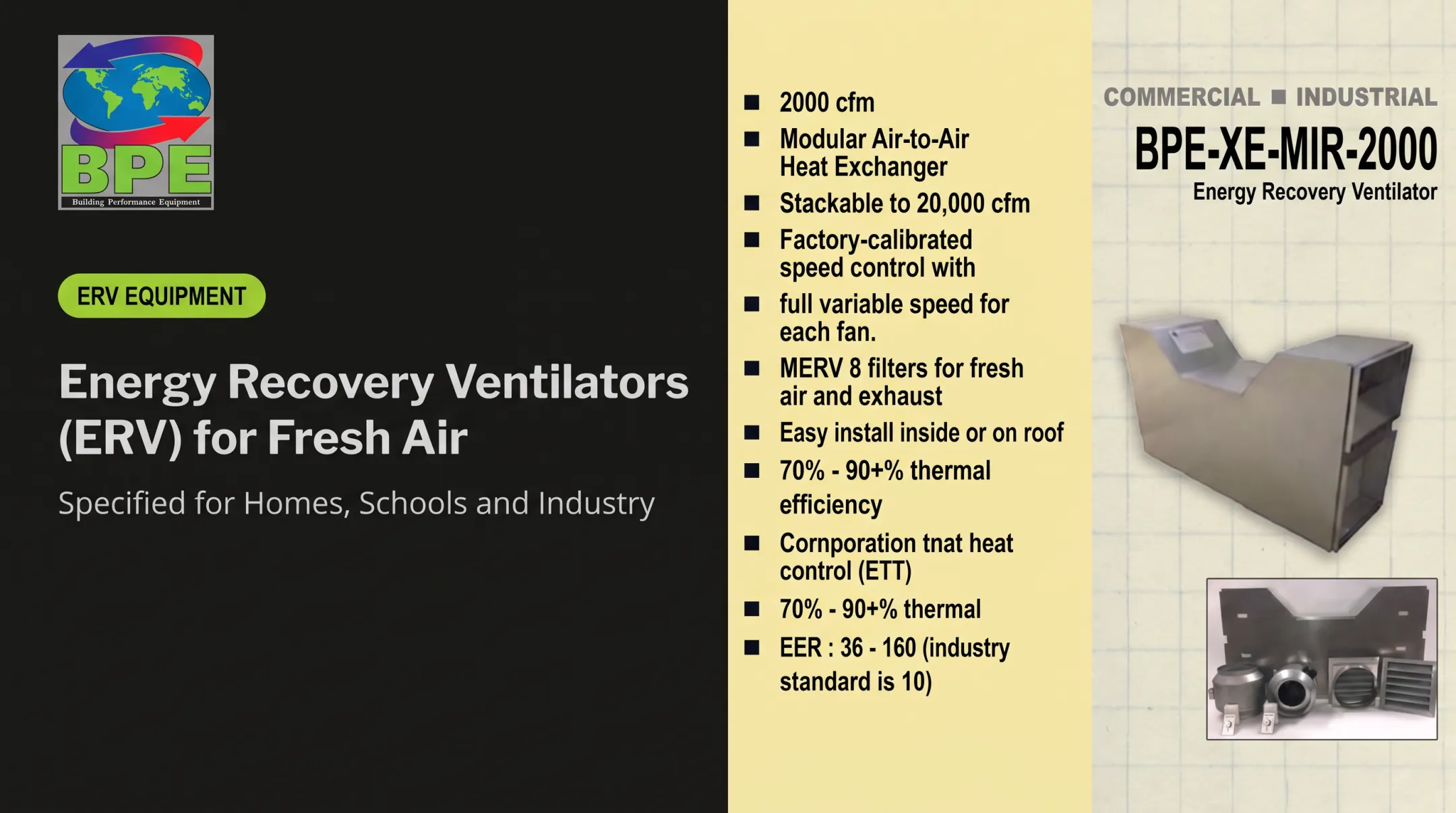
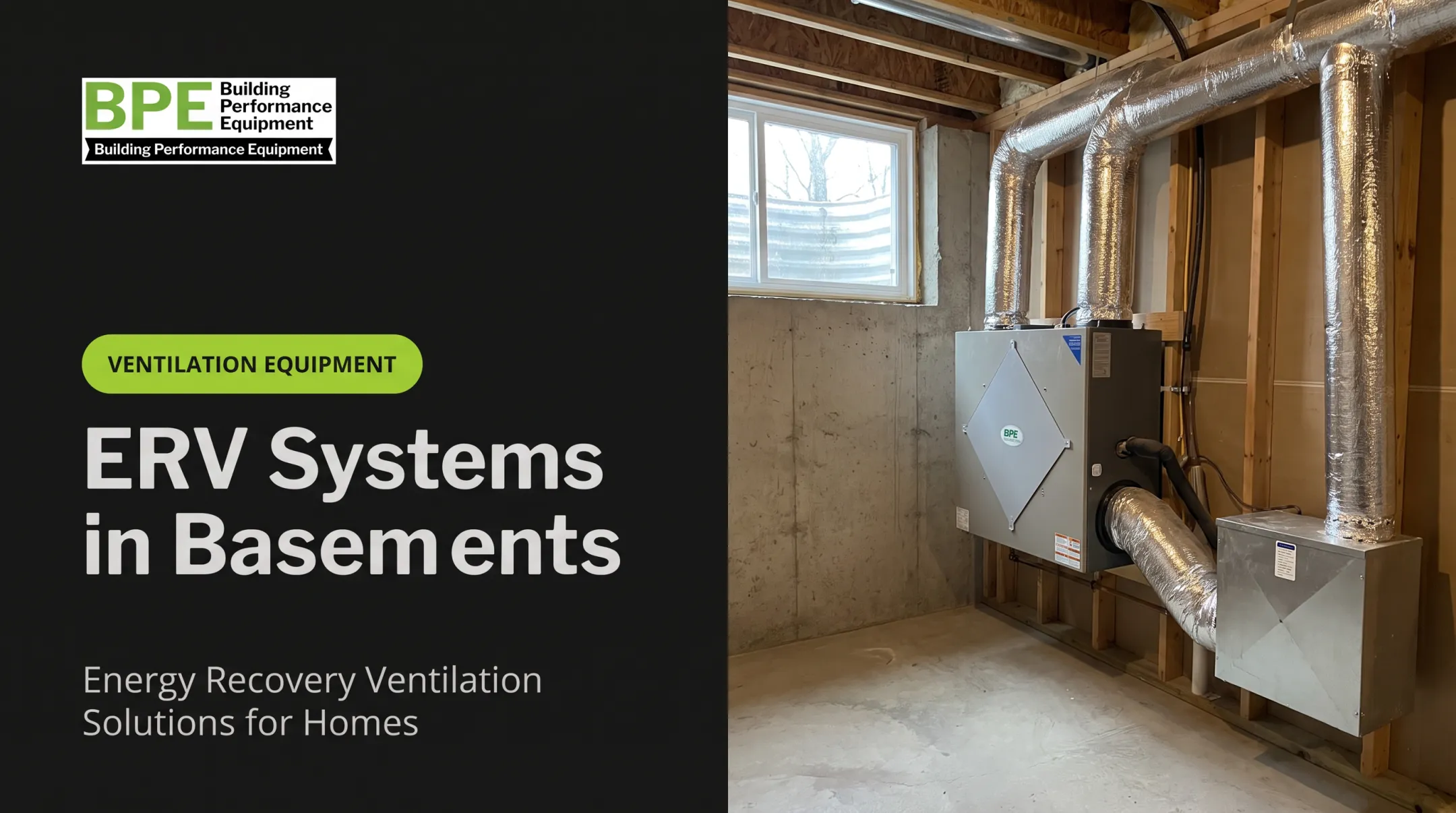
Building Performance Equipment's residential units, like the BPE-XE-MIR-200i, use two variable-speed 200 CFM fans paired with MERV 8 filtration on both airstreams. That pairing is a clear example of how the supply and exhaust sides work together.
Why Balanced Beats Exhaust-Only in a Basement
A simple exhaust fan removes air but doesn't supply anything back. That creates negative pressure, and replacement air gets pulled in through whatever path is easiest: cracks in the foundation, gaps around utility penetrations, or soil-facing assemblies.
The U.S. Department of Energy notes that balanced systems supply and exhaust approximately equal air volumes, while exhaust-only ventilation depressurizes the house and can draw in radon or mold-related pollutants from below. In a basement, that distinction matters more than almost anywhere else in the home.
That basement advantage only holds if the unit actually delivers balanced airflow at the conditions you need. Published efficiency, airflow, and sound numbers vary by test condition, so compare manufacturer data at the same static pressure and airflow rate rather than marketing claims from different test setups.
Why Basements Need a Purpose-Designed Ventilation Strategy
Basements accumulate problems that upper floors rarely see at the same intensity:
- Musty odors
- Elevated humidity
- Condensation on cool surfaces
- VOCs off-gassing from stored paint or solvents
- Uneven temperatures
Below-grade construction and stack-effect air movement mean these conditions don't stay put. They can migrate into living spaces above.
Ventilation vs. Water Management
Ventilation and bulk-water problems are not the same issue, and treating them as interchangeable leads to disappointment.
| What ventilation can do | What ventilation can't do |
|---|---|
| Remove stale, humid air continuously | Repair foundation cracks or failed drainage |
| Dilute odors and VOCs | Stop active plumbing leaks |
| Moderate ordinary moisture loads | Fix flooding or persistent bulk-water intrusion |
If water is actively entering the basement, fix grading, drainage, or the foundation first, then install ventilation equipment.
ERV or Dehumidifier?
An ERV moderates moisture transfer between airstreams and keeps air moving. A dehumidifier directly pulls water out of the indoor air.
The EPA recommends keeping indoor relative humidity below 60%, ideally between 30% and 50%. Whether a basement needs one device, the other, or both depends on measured humidity and climate, not a blanket rule.
Radon: Proceed Carefully
An ERV may dilute indoor contaminants somewhat and influence pressure relationships, but it is not a radon-control method. The EPA recommends testing the lowest lived-in level of a home (including a basement) and fixing levels at or above 4 pCi/L, typically through active subslab suction. Test first. Install ventilation based on air-quality needs, not as a radon workaround.

How to Choose and Design a Basement ERV System
Skip the shortcut of sizing equipment by square footage alone. Start with a site assessment instead.
What to Evaluate First
- Basement volume, occupancy, and intended use (finished living space vs. utility area)
- Airtightness and current moisture readings
- Local climate and outdoor air quality
- Existing HVAC configuration and duct access
- Applicable mechanical and ventilation code requirements for the dwelling
Required airflow should follow applicable residential ventilation standards and local mechanical code, factoring in floor area, bedroom count, and basement use. Final sizing should be confirmed by a qualified designer or installer, not estimated from a rule of thumb.
Comparing Your Options
| Equipment | What it does | Limitation |
|---|---|---|
| ERV | Balanced outdoor-air exchange with heat and moisture transfer | Doesn't actively dry an already damp space |
| HRV | Balanced outdoor-air exchange with heat transfer only | No moisture exchange, which some climates need |
| Exhaust fan | Removes stale air | Creates pressure imbalance; no energy recovery |
| Dehumidifier | Removes moisture directly | No continuous outdoor-air exchange |
Often the right answer is coordinating two devices: an ERV for continuous fresh air, plus a dehumidifier if measured humidity stays high despite ventilation.
ERV or HRV for This Basement?
Neither is universally better. The choice depends on regional climate, indoor moisture production, and condensation risk. Humid climates often favor an ERV's moisture transfer; cold, dry climates sometimes favor an HRV.
Building Performance Equipment's ERVs can be sealed on request to operate as HRVs when winter humidity control is the priority.
Beyond Nominal Capacity
Look past the headline CFM number. Equipment selection should also weigh:
- Sensible and latent recovery performance at actual operating conditions
- Airflow at the system's actual external static pressure, not just rated airflow
- Filtration level, fan efficiency, and sound output
- Condensate or frost management in cold climates
- Service access for filters and the recovery core
Use documented recovery performance under real test conditions as your benchmark. Building Performance Equipment specifications call for over 80% sensible effectiveness and over 30% latent effectiveness under AHRI 1060 testing in humid conditions. The company works with engineers, contractors, and building owners on airflow, controls, and equipment integration for basement and whole-building projects.
Layout Matters
For finished basements, register placement affects whether ventilation actually reaches occupied rooms. General guidance:
- Place fresh-air supply registers in large, open areas on the lowest level.
- Keep supply and stale-air exhaust registers as far apart as practical.
- Separate exterior intake and exhaust hoods by roughly 10 to 15 feet to prevent short-circuiting.
- Avoid creating dead zones in bedrooms, offices, or bathrooms where airflow doesn't reach.
Installation, Controls, and Maintenance
Installation involves more than mounting a box. Plan for:
- Equipment location and electrical power
- Outdoor intake and exhaust penetrations
- Ductwork with sealed penetrations throughout
- Condensate provisions where needed
When to Call a Professional
Some residential units are designed for straightforward DIY installation. But professional design becomes important when the ERV:
- Ties into existing HVAC ductwork or equipment
- Serves multiple rooms or a finished basement layout
- Operates near combustion appliances
- Must satisfy local code and ventilation requirements
Controls
Most basement ERVs use a timer, humidity sensor, boost switch, or HVAC interlock. Run low-speed continuous ventilation for background air exchange, and boost when humidity rises or the space is occupied.
Commissioning Checklist
Before calling the installation complete, verify:
- Supply and exhaust airflow at actual operating conditions
- Balanced operation — no net pressurization or depressurization
- Exterior hood placement and screen protection
- Filtration is correctly seated on both airstreams
- Controls and sensors respond as expected
- Operating settings documented for future reference
Ongoing Maintenance
- Replace or clean filters per manufacturer instructions, typically every one to three months
- Inspect the recovery core and fans for buildup
- Keep exterior hoods clear of debris, leaves, or snow
- Check condensate drains and dampers periodically
- Reassess airflow if the basement layout or use changes
After installation, monitor results. Track humidity readings, note occupant feedback on odors or comfort, and test for radon if you haven't already. Those checks show whether you still need supplemental dehumidification, filtration, sealing, or radon mitigation.

Conclusion: Is an ERV a Good Choice for a Basement?
For a basement that needs continuous, balanced fresh-air exchange without throwing away all the energy spent conditioning that air, an ERV is often a strong option. It addresses the air-quality half of the basement equation effectively.
It still has clear limits:
- Address water intrusion before you size ventilation
- Treat dehumidification as its own decision, based on measured humidity rather than assumptions
- Keep radon testing and mitigation separate from the ERV choice
Before buying equipment, have the basement assessed for:
- Airflow needs
- Humidity levels
- Pressure relationships
- Duct or penetration requirements
- Code compliance
For application-focused technical guidance on basement ventilation, contact Building Performance Equipment at 201.722.1414 or info@bpequip.com.
Frequently Asked Questions
What is the best ventilation for a basement?
A balanced ERV works well for many basements because it provides continuous fresh air without depressurizing the space. The right choice still depends on moisture conditions, occupancy, climate, and radon test results.
Is an ERV better than an HRV?
Neither is universally superior. ERVs transfer moisture along with heat, which suits humid climates. HRVs transfer heat only, which some cold, dry climates prefer for humidity control.
Do I need a dehumidifier if I have an ERV?
Possibly. An ERV ventilates; a dehumidifier removes moisture directly. Basements with persistent high humidity often need both, especially in humid regions.
Does an ERV reduce radon levels?
An ERV may dilute contaminants somewhat, but it's not a substitute for radon testing. The EPA recommends active subslab suction as the standard mitigation method for elevated readings.
How does an ERV work in a basement?
Two fans move air simultaneously: one brings filtered outdoor air in, the other exhausts stale indoor air. A core in between transfers heat and some moisture between the two streams.
Can an ERV be installed in a finished basement?
Yes, if you have space for the unit, power access, outdoor intake and exhaust routes, and duct or dedicated ventilation paths. You also need clear access for filter and core maintenance.