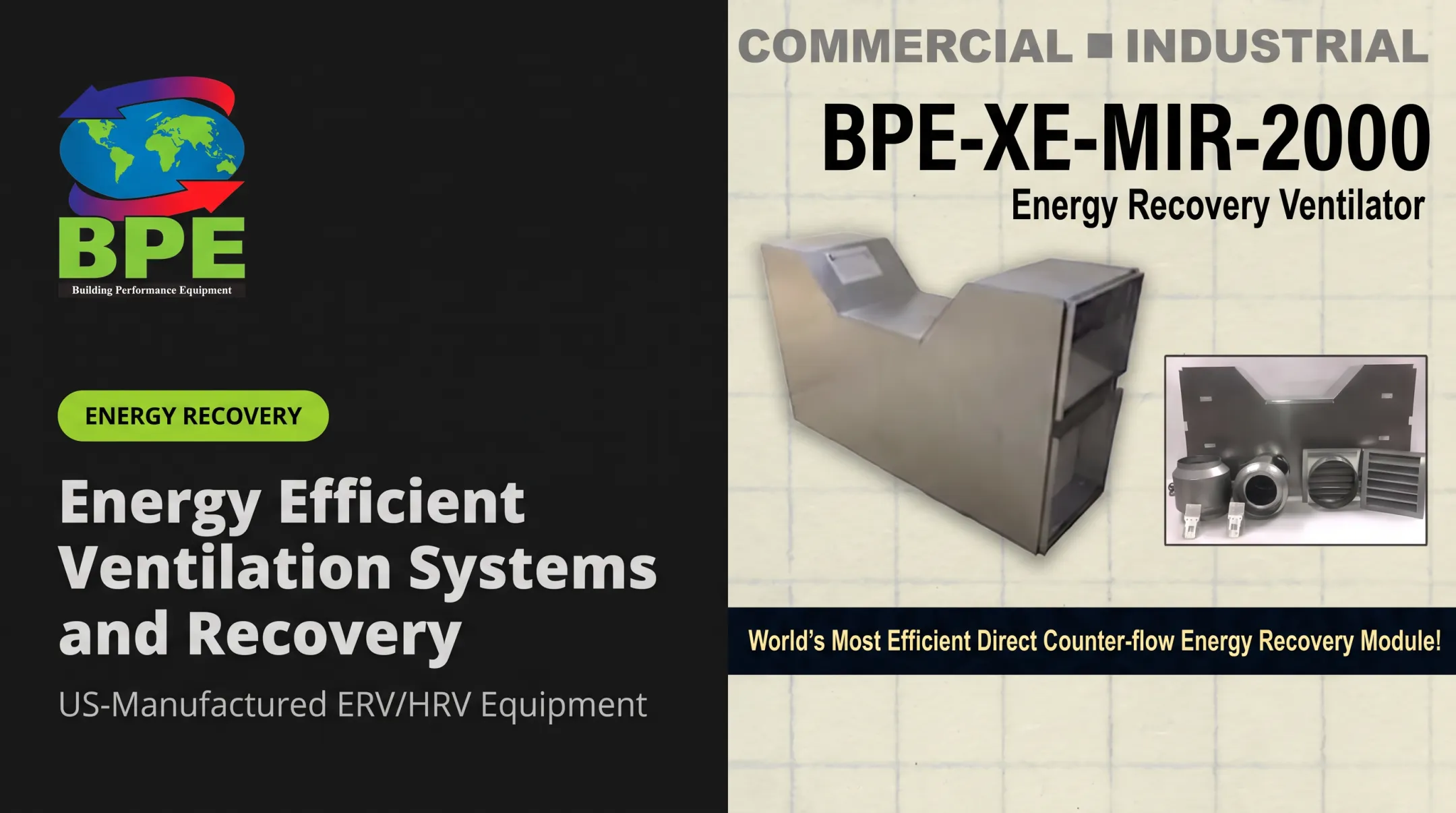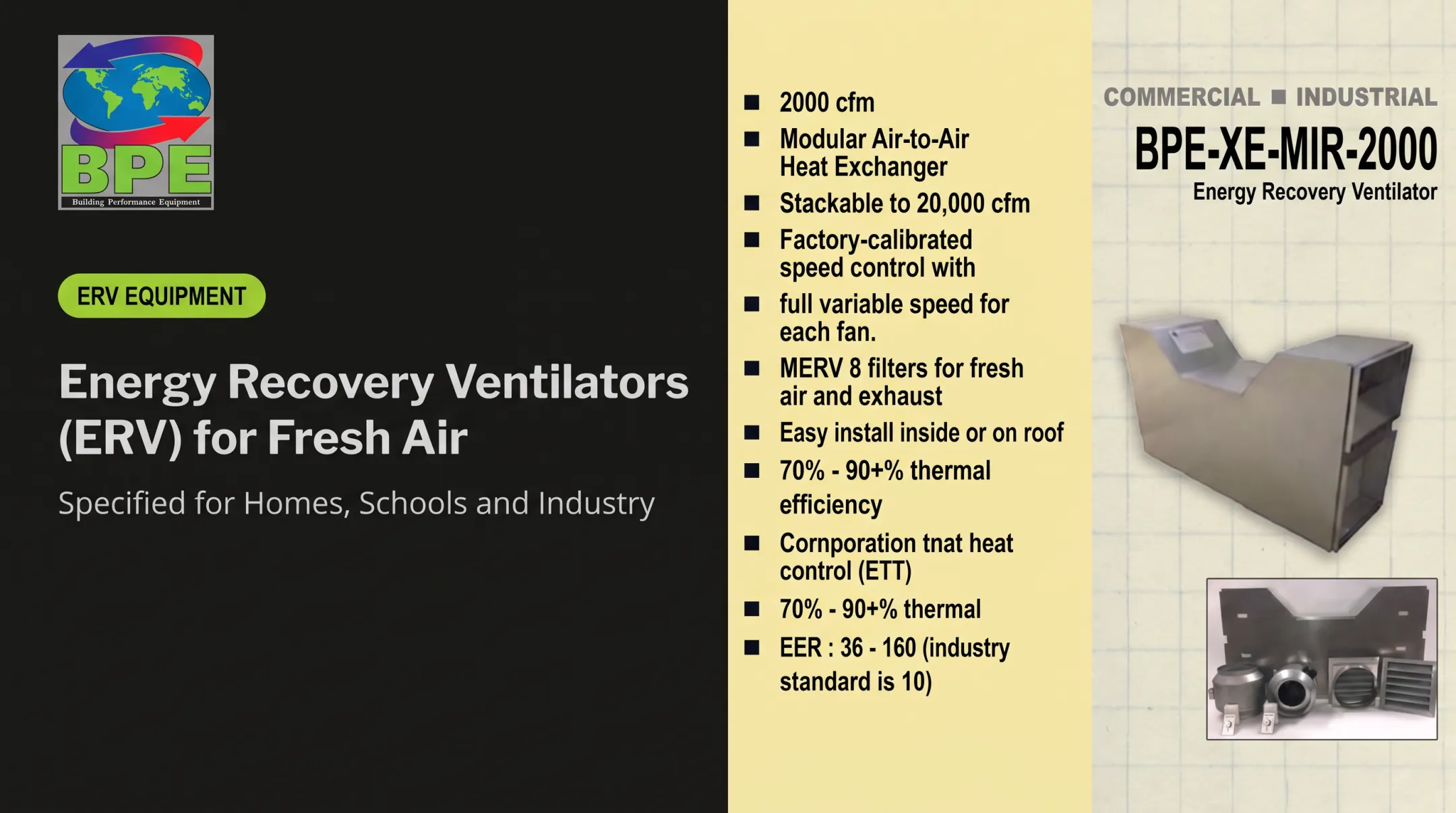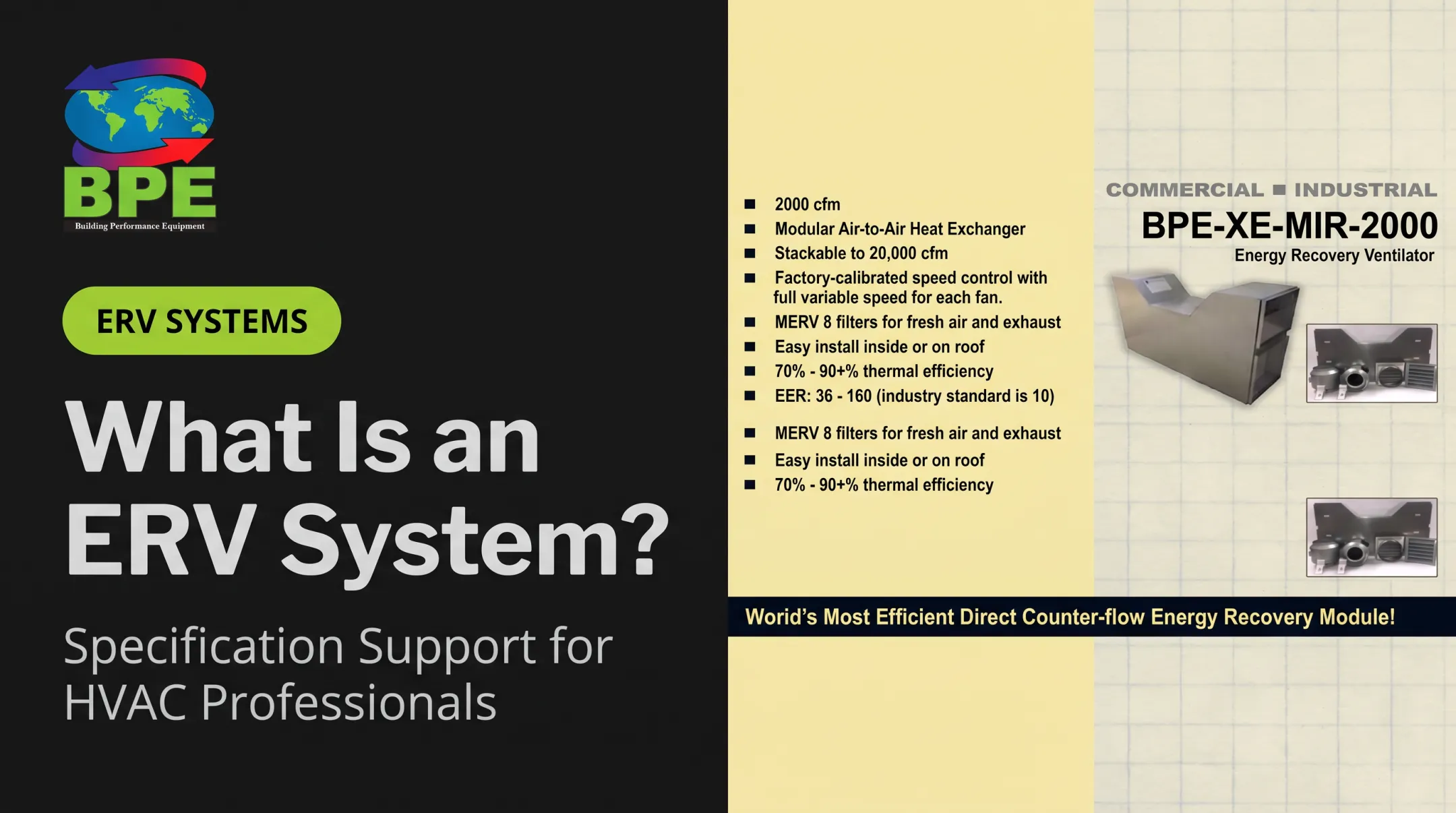

An energy recovery ventilation system, or ERV, addresses both problems at once. It swaps stale indoor air for fresh outdoor air while transferring the heat (and often the moisture) from the outgoing airstream into the incoming one. This guide walks through how ERVs work, their real benefits and limitations, how they differ from HRVs, and what to check before specifying one for your building.
Key Takeaways
- ERVs improve ventilation and temper energy and humidity loads when sized, designed, and commissioned correctly.
- Strong fit for homes, schools, offices, multifamily buildings, and select industrial facilities.
- Trade-offs: upfront cost, space and duct needs, maintenance, and limits with contaminated exhaust.
- Treat an ERV as one piece of a broader HVAC and building-performance strategy, not a standalone fix.
What Is an Energy Recovery Ventilation System and How Does It Work?
An energy recovery ventilation (ERV) system is a balanced mechanical ventilation setup. It uses two separate airstreams—supply and exhaust—that pass through a shared recovery core, wheel, or plate without physically mixing.
One fan pulls outdoor air into the building; a second fan pushes stale indoor air out. As the airstreams cross inside the core, energy moves from the warmer or more humid stream to the cooler or drier one.
Sensible and Latent Energy Transfer
In winter, outgoing warm indoor air preheats the cold incoming outdoor air before it ever reaches the space or the HVAC equipment. In summer, the reverse happens: cool, dehumidified exhaust air tempers the hot outdoor air coming in. This is sensible energy recovery: the transfer of heat.
Many ERV cores also transfer latent energy, meaning moisture. Building Performance Equipment's heat exchangers, for example, use a polymer fixed-plate core for both heat and humidity transfer, with documented thermal efficiencies from 70% to over 90% depending on airflow.
An ERV is not a dehumidifier or humidifier. It moderates incoming moisture; it does not replace dedicated humidity-control equipment when a building needs precise control.
How an ERV Differs from Basic Exhaust Fans
A bathroom exhaust fan or a simple make-up air damper isn't an ERV. Those systems either dump conditioned air outside without recovering anything, or they let outdoor air in unconditioned. An ERV is deliberately balanced: equal (or proportionally designed) supply and exhaust airflow, with energy recovery built into the exchange.

Performance depends on several design variables:
- Airflow rate — recovery effectiveness at the design cfm
- Fan power — static pressure drop across the core
- Core or wheel type — flat-plate, counter-flow, or enthalpy wheel
- Frost protection — strategy for cold climates
- Filtration and controls — integration with the broader HVAC system
According to ASHRAE's ventilation standards, energy recovery tempers the air a building already needs to bring in — it doesn't eliminate the outdoor-air requirement itself. Size the ventilation rate first, then select recovery equipment to match.
Pros and Benefits of Energy Recovery Ventilation Systems
Better Air, Lower Energy Penalty
Continuously or regularly replacing stale air dilutes carbon dioxide, odors, and many indoor-generated pollutants. An ERV isn't an air purifier. It doesn't scrub hazardous contaminants from the air it moves — it simply makes outdoor-air ventilation less expensive to run.
That cost reduction is the real selling point. A Department of Energy–supported study modeled a membrane ERV serving a constant-air-volume packaged system in a Miami office zone. With the ERV and a bypass mode added, annual equipment energy dropped from 14,634 kWh to 13,576 kWh, a 7.2% reduction for that specific system boundary (DOE, 2006). That figure is modeled for one configuration, not a universal savings rate, but it shows how the mechanism works.
Real-World Numbers from the Field
BPE's own case studies tell a similar story at different scales:
- Hunterdon Regional High School cut facility energy consumption by 26.7% after adding energy recovery equipment.
- Hopewell Valley School District retrofitted 13 classrooms and recaptured 80% to 95% of thermal energy that would otherwise have been exhausted.
- At the Redbank YMCA natatorium, two heat exchangers supplied 10,000 cfm of make-up air, warming incoming winter air from 20–35°F up to 75°F.
- A strip-mall retrofit delivered 100% outdoor air at under 0.75 watts per cfm, with sensible heat recovery exceeding 86%.
Comfort and Odor Control
High-load spaces show the comfort gains clearly:
- A hot-yoga studio using a BPE-XE-MIR-2000 kept air exchange moving through a 300-square-foot room (3,200 cu ft) where heat and exertion drive CO2 higher than usual
- A salon with keratin-treatment odors saw the smell clear almost instantly once a 900-cfm unit went online
Facility managers notice these results on the floor, not only in lab reports.
The common thread across offices, gyms, classrooms, and multifamily buildings: ERVs let a building bring in the outdoor air it needs without throwing away all the energy already spent conditioning the air leaving. Actual load reduction on rooftop units or air handlers still depends on project-specific design calculations, not a blanket percentage.
Cons and Limitations of Energy Recovery Ventilation Systems
Upfront Cost Adds Up
ERV projects involve more than the unit price. One documented office-area installation broke down as:
- Equipment: $232,846.93
- Soft costs: $23,284.69
- Management and commissioning: $23,284.69
- Total: roughly $279,417
Compare lifecycle cost, not sticker price. A cheaper unit with a 4-year core life can cost more over 20 years than a pricier unit built to last.
Space, Access, and Retrofit Headaches
Even compact units need planning:
- Filter and core access for servicing
- Duct-routing paths that don't conflict with existing HVAC
- Roof curb height (commercial units typically need at least 24 inches)
- Condensate drainage in humid climates, with sloped ductwork and proper drain pans
Some unitary systems are built to fit through a standard 36-inch door, which helps retrofits, but routing supply and exhaust ducts through an occupied building is almost never simple.
Maintenance Isn't Optional
| Task | Typical Interval |
|---|---|
| Filter inspection | About once a year |
| Core/wheel cleaning | When flow or effectiveness shifts by 10% |
| Insect screen/HEPA vacuum | Roughly every 5 years, condition-dependent |
| Airflow rebalancing | After any major service |
In typical schools or offices, filter changes may be the only recurring task. Grease, lint, or process fumes shorten that interval considerably.
Not Every Exhaust Stream Qualifies
This is the limitation design teams can't skip. Leakage through an energy-recovery core counts as recirculation, and ASHRAE's interpretation of Standard 62.1 prohibits transferring Class 4 exhaust air into supply air (ASHRAE, 2011).
Kitchen range hoods, chemical fume streams, and infectious-material exhaust need dedicated treatment, not a shared recovery core. At one welding shop, a separate wall-mounted exhaust filter caught heavier fumes before the remaining air ever reached the ERV core.

A qualified engineer should classify exhaust air before an energy recovery arrangement is chosen.
ERV vs. HRV: Which Recovery Ventilation System Is Better?
Both systems move stale air out and fresh air in through a shared core. The difference is what crosses that core.
| Factor | HRV | ERV |
|---|---|---|
| Recovers | Sensible heat only | Sensible heat plus moisture (latent energy) |
| Best suited for | Drier climates, moisture-sensitive spaces | Humid climates, buildings wanting moderated incoming humidity |
| Winter effect | Warms incoming air | Warms and slightly humidifies incoming air |
| Summer effect | Cools incoming air | Cools and slightly dehumidifies incoming air |
| Humidity control | None | Partial; not a substitute for dedicated equipment |
Neither system is universally better. If a building already has excess winter humidity, an ERV that transfers moisture back indoors works against humidity-control goals.
Some manufacturers, including Building Performance Equipment (BPE), can reconfigure an ERV core as an HRV for buildings that run too humid in winter.
Choose an HRV when:
- The climate is dry and moisture transfer is not desired
- The design goal is purely sensible heat recovery
- Indoor humidity is already high in winter
Choose an ERV when:
- The building needs balanced ventilation with some moisture moderation
- Humid-climate makeup air needs partial pre-dehumidification before it reaches the space
- Tight or high-performance buildings benefit from moderated incoming humidity
Either way, confirm actual performance against manufacturer data tested to AHRI 1060. Effectiveness varies by model, airflow, and operating conditions.
Is an ERV System Right for Your Building?
Signs Worth Investigating
- Persistent stale air, odors, or complaints despite existing ventilation
- Window condensation in winter
- High outdoor-air conditioning costs relative to building size
- Plans to increase ventilation rates for code compliance or occupant health
- A tightly sealed envelope with no dedicated fresh-air path
Where ERVs Tend to Make Sense
ERVs show up repeatedly in real installations across these building types:
- Schools retrofitting classrooms without structural changes
- Commercial offices sharing a rooftop unit
- Multifamily buildings needing per-unit fresh air
- High-performance homes chasing tight envelope targets
- Industrial facilities with continuous ventilation demand
Examples range from a strip-mall office retrofit to a tennis-facility HVAC upgrade pulling 6,000 cfm.
What to Verify Before Specifying
- Required airflow by room, not just building total
- Pressure relationships between supply and exhaust
- Recovery effectiveness at your actual design conditions, not just peak-rated numbers
- Fan power and static pressure budget
- Frost strategy if winter design temperatures drop below 0°F
- Exhaust contaminant classification and applicable code sections
- Service access for filters and core cleaning
Total-Cost Checklist
- Equipment and ductwork
- Electrical and controls integration
- Installation labor and commissioning
- Expected energy impact (modeled, not assumed)
- Available utility or state incentives, verified for your specific program and timing
- Maintenance labor over the equipment's service life
Building Performance Equipment, a New Jersey–based manufacturer operating since 1997, builds high-efficiency air-to-air energy recovery equipment ranging from 60-cfm residential units to 20,000-cfm commercial systems, alongside controls and project-specification support.
Its founder, Klas Haglid, a professional engineer and former ASHRAE technical committee chair, built the company's approach around pairing recovery cores with integrated controls rather than treating ventilation as an afterthought. That mix of engineering, IAQ focus, and carbon-reduction goals is one option to weigh during evaluation.

Installation, Controls, and Maintenance Considerations
Get the Right People Involved
ERV selection isn't a plug-and-play decision for most commercial projects. A qualified HVAC or mechanical engineer should calculate ventilation demand, size fans and ductwork, and balance supply and exhaust airflow.
They also confirm compatibility with existing rooftop or air-handling equipment. Commissioning every installation for proper airflow isn't optional; it's standard practice.
Controls That Actually Matter
Control strategies that pay off in real buildings include:
- Demand-based ventilation using CO2 setpoints (600 ppm on / 500 ppm off is one common approach)
- Fan interlocks tied to occupancy schedules
- Frost protection logic for cold-climate operation
- BACnet integration so the ERV sequence talks to the building management system, not around it
A Realistic Maintenance Routine
- Inspect filters roughly once a year; replace as needed
- Clean the recovery core when flow or effectiveness shifts by about 10%
- Check fans, motors, and drain pans each service visit
- Verify sensors and dampers against commissioning data
- Document every service measurement for comparison over time
Building Performance Equipment's engineering work includes patented designs that combine recovery devices with integrated controls. Ventilation equipment performs best when it is coordinated with the building envelope, lighting, and HVAC operation from the start.
Frequently Asked Questions
Which is better, an ERV or HRV?
Neither is universally better. Choose based on climate, indoor humidity goals, and building needs—humid or mixed climates and tight homes often favor ERVs, while colder, drier climates may suit HRVs.
Is an ERV system worth it?
It depends on your building's ventilation load, climate, and current indoor air quality (IAQ) or energy problems. Energy recovery, comfort gains, and lower outdoor-air conditioning costs often justify the cost when a project-specific review confirms payback.
Should I run my ERV all the time?
Many systems are designed for continuous or scheduled operation, but the right setting depends on occupancy, outdoor conditions, and manufacturer guidance. Check your equipment's operating instructions before changing default schedules.
What is the difference between an ERV and an HRV?
An HRV recovers sensible heat only. An ERV recovers sensible heat plus some moisture. Actual performance numbers vary by manufacturer and climate, so compare certified data for your specific model.
How much maintenance does an ERV require?
Typical maintenance includes annual filter checks, core cleaning when performance drops by about 10%, and periodic fan and sensor inspection. Intervals shift based on the equipment manual and how dirty or humid the operating environment is.
Can an ERV be added to an existing HVAC system?
Often, yes. Feasibility depends on available space, ductwork routing, electrical capacity, and whether existing exhaust systems can be reused or need separate treatment. A mechanical engineer should confirm compatibility before specifying equipment.