
The EPA warns that tightening a building's envelope without adequate ventilation can increase exposure to indoor pollutants that would otherwise escape through natural leakage, per its guidance on energy, weatherization, and indoor air quality. That's the problem heat recovery ventilation solves.
A heat recovery ventilator, or HRV, exchanges stale indoor air for fresh outdoor air while transferring heat between the two separate streams. It doesn't mix them. It just moves the energy.
This guide covers what HRVs and ventilators actually mean, how the heat exchanger works, how HRVs differ from ERVs, where each fits, and what it takes to select, install, and maintain one correctly.
Key Takeaways
- HRVs exchange stale indoor air for fresh outdoor air while recovering sensible heat
- The core transfers energy between airstreams while keeping those streams separate
- Cold or mixed climates usually favor HRVs; humid climates often need an ERV instead
- Sizing, duct design, balancing, and commissioning decide whether a system hits rated performance
What Is Heat Recovery Ventilation and What Is a Ventilator?
Heat recovery ventilation is a mechanical ventilation strategy. It continuously (or on a schedule) replaces contaminated indoor air with filtered outdoor air, while reducing the energy cost of doing so.
A ventilator, in this context, is the equipment that manages that air exchange. It's a specific category, not a catch-all term:
- HRV (heat recovery ventilator) - moves air and recovers heat between two separate streams
- Exhaust fan - removes air but recovers none of its energy
- Air purifier - recirculates and filters air already inside the building; it doesn't bring in outdoor air
Main Components of an HRV
Every HRV, regardless of brand or size, shares a similar core structure:
- Supply and exhaust fans
- Outdoor-air intake and stale-air exhaust ports
- A heat-exchange core
- Filters
- Condensate management (where applicable)
- Duct connections, controls, and a housing cabinet
Balanced Ventilation, Explained
HRVs are designed around balanced ventilation: the unit brings in roughly as much outdoor air as it exhausts. The U.S. Department of Energy's whole-house ventilation guide notes that properly designed balanced systems help limit unwanted pressure differences across the building when correctly sized and commissioned.
Exactly where supply and exhaust points land depends on the building. Occupancy, contaminant sources, code requirements, and existing HVAC design all factor into layout decisions.
An HRV is not a replacement for other dedicated equipment. It won't replace a range hood, process-exhaust system, combustion-appliance venting, or your air conditioner. It manages ventilation air. That's its job, and it does that one job well.
How Does an HRV Work?
An HRV runs two air paths at once, and they never touch.
- One fan pulls stale indoor air toward the unit and pushes it outside.
- A separate fan draws outdoor air through its own path into the occupied space.
Between those two paths sits the heat-exchange core. As exhaust air passes through, heat moves through the core material into the incoming outdoor air stream, preconditioning it before it reaches your ducts. The streams stay physically separated the entire time. The system transfers heat — it doesn't recirculate exhaust air back into living spaces.

Winter and Summer Performance
In winter, this matters most. Recovered indoor heat warms incoming outdoor air before it's distributed, so the heating system does less work to reach a comfortable temperature.
Summer operation works differently:
- An HRV can reduce the temperature difference between incoming and outgoing air
- It is not an air conditioner
- It does not actively cool or dehumidify a building
What Actually Affects Performance
Real-world efficiency depends on far more than a spec sheet number. Key variables include:
- Airflow rate and static pressure
- Outdoor and indoor temperature differential
- Core design and fan power
- Duct leakage and filter condition
- Defrost strategy in cold climates
- Whether supply and exhaust airflows are actually balanced
Those same variables show up in how certified ratings are built. The Home Ventilating Institute defines sensible recovery efficiency (SRE) under its Publication 920 certification procedure, adjusting for fan electricity, case losses, leakage, and airflow imbalance.
HVI's program doesn't enforce one universal minimum efficiency across all models, so comparing specific certified ratings matters more than quoting a general percentage.
HRV vs. ERV: What Is the Difference?
The core distinction is simple: heat-only versus heat-plus-moisture transfer.
- HRV - recovers sensible heat only
- ERV - recovers heat and some water vapor through an enthalpy core
Choose an HRV when you need heat recovery without moisture transfer. Choose an ERV when humidity management matters too.
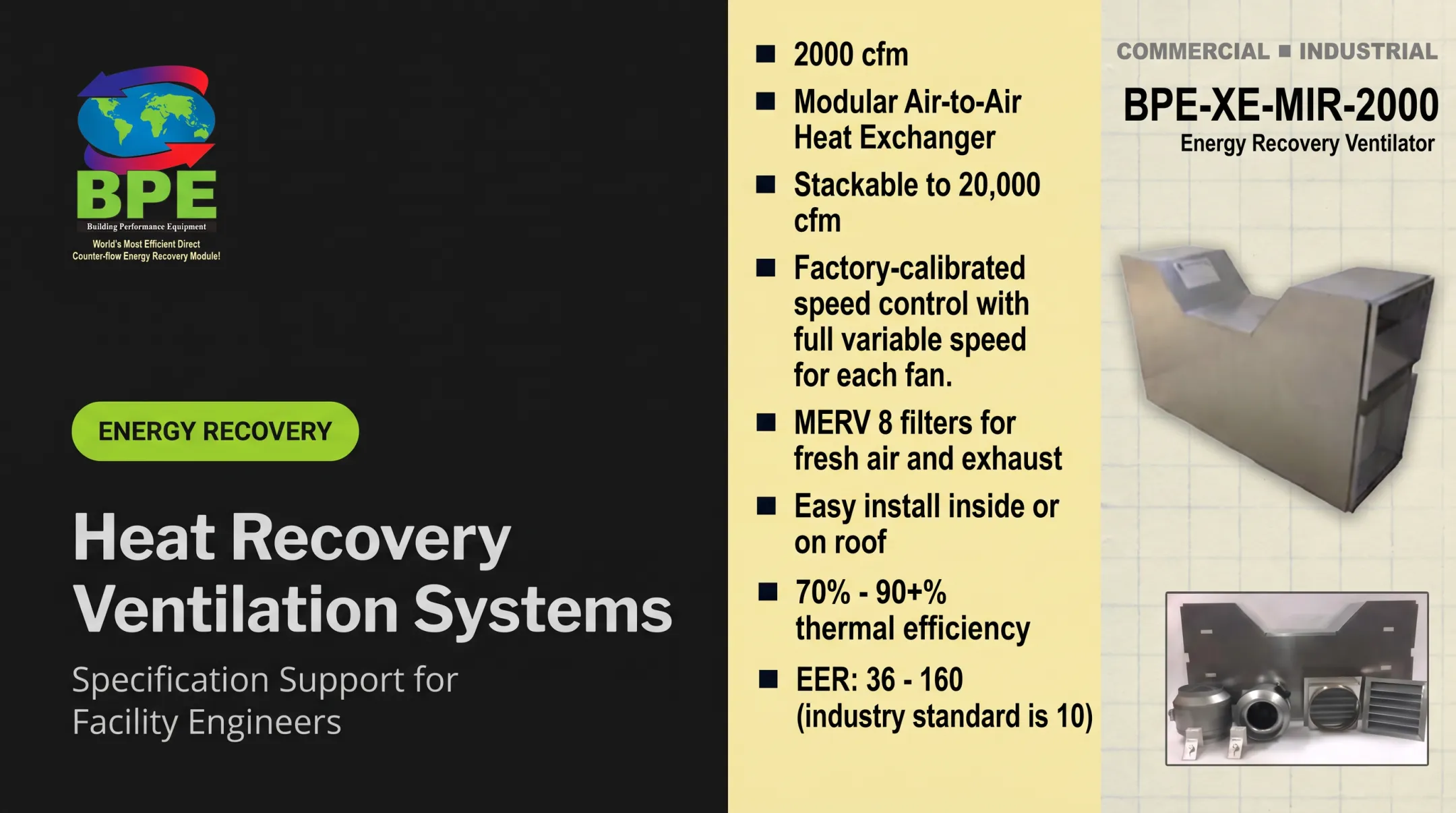
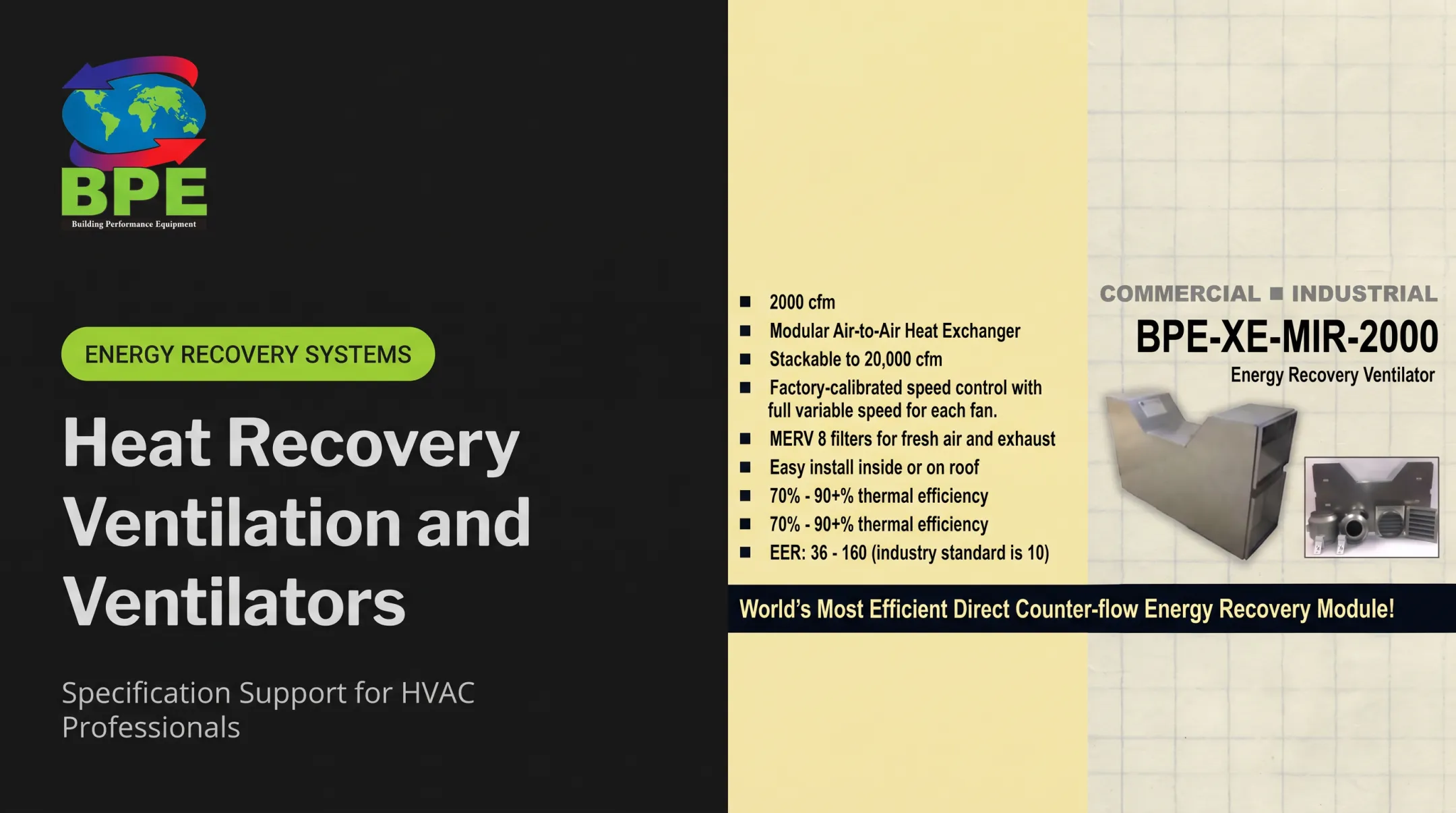
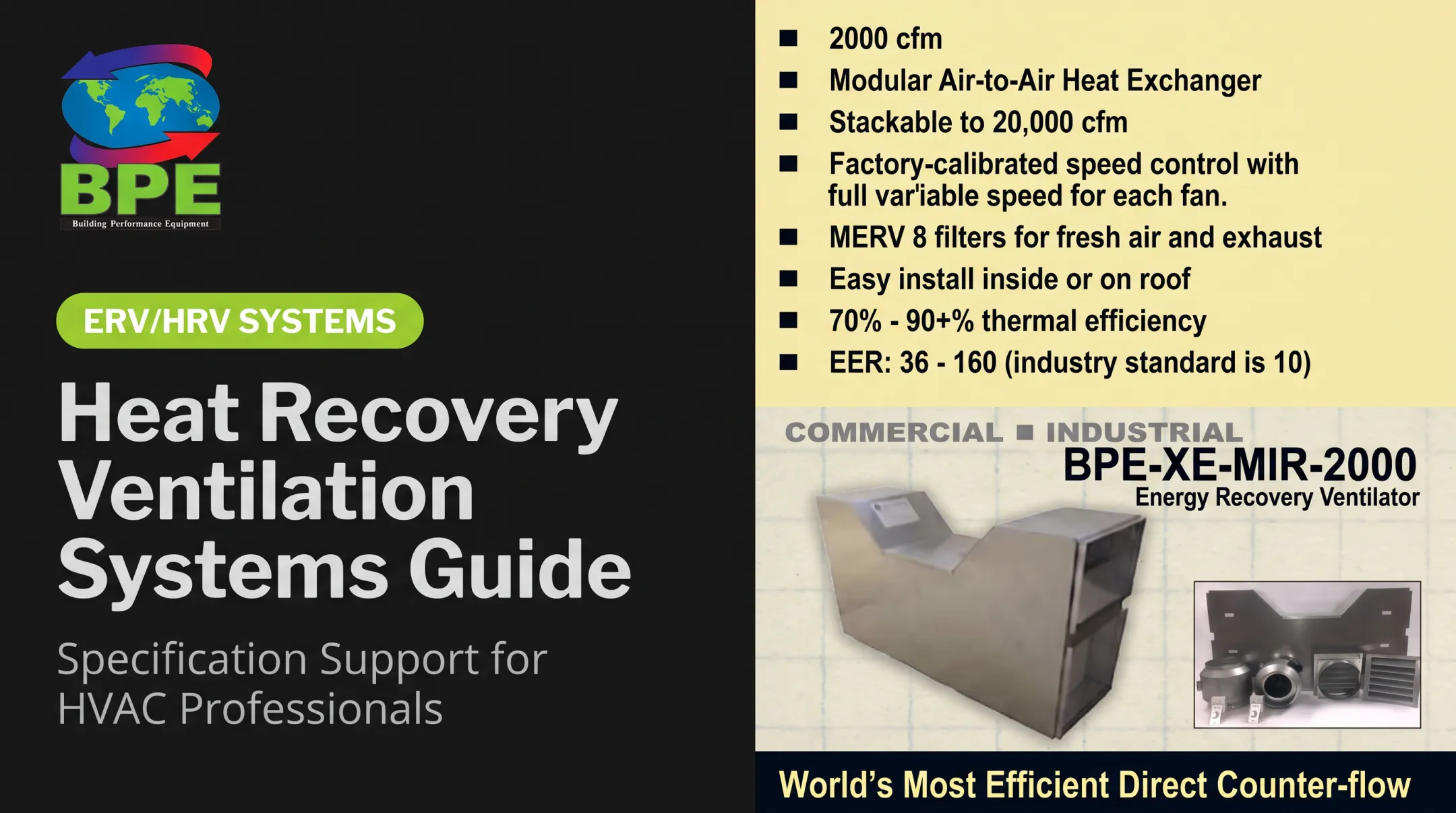
Building Performance Equipment (BPE) ERV platforms can also be configured as HRVs when a building runs too humid in winter.
Climate Is the Deciding Factor
Per the Department of Energy’s ventilation guidance, HRVs tend to work well in colder, drier climates, while ERVs suit a broader range, including humid regions.
Still, climate alone does not pick the unit. Factor in:
- Climate zone and seasonal humidity swings
- Building envelope tightness
- Occupancy density and indoor moisture loads
- Target ventilation rate
A DOE-modeled example in Orlando found that an ERV nearly eliminated cooling-season hours above 60% relative humidity, but had little effect during "floating" periods when the system wasn't actively conditioning. Humidity control isn't automatic just because moisture transfer is part of the design.

What Neither System Does
Neither HRV nor ERV is a substitute for:
- Source control of specific contaminants
- Specialized filtration for industrial fumes or chemicals
- Air conditioning
- Dedicated dehumidification
- Industrial exhaust treatment systems
Verify current code requirements, certifications, and manufacturer guidance before specifying a climate-specific system. Local jurisdictions and building types vary.
Benefits and Suitable Applications
Controlled outdoor-air exchange helps dilute and remove odors, excess moisture, carbon dioxide, and other indoor contaminants — assuming source control, filtration, and airflow are all adequate. That's a real benefit, but it depends on execution, not just the presence of a unit.
Comfort and energy gains show up too. Recovering heat reduces drafts and lowers the conditioning load tied to ventilation. Balanced airflow also gives more predictable building operation than relying on random envelope leakage or intermittent bath fans.
Where These Systems Get Used
- Airtight single-family and multifamily homes
- Schools and university buildings
- Offices and institutional facilities
- Commercial and industrial buildings with planned ventilation needs
BPE installations range from Hunterdon and Hopewell high schools to warehouses, manufacturing plants, salons, and even an indoor tennis facility. There, a 3,000 cfm unit captured roughly 80% of exhaust heat energy while circulating 6,000 cfm total. Only half the circulated air needed additional thermal conditioning as a result.
Retrofit Realities
Retrofitting an existing building introduces its own constraints:
- Limited mechanical-room space
- Existing ductwork that may need modification
- Roof or wall penetrations and structural limits
- Electrical capacity and acoustic requirements
- Whether a central or decentralized system makes more sense
These aren't dealbreakers. BPE's modular energy recovery modules, for example, are man-portable and sized to fit through standard 36-inch doors, which matters when there's no crane access or extra mechanical room.
Trade-Offs to Weigh
Plan ahead for these costs and operating factors:
- Upfront equipment and installation cost
- Ongoing fan energy use
- Filter and core maintenance
- Condensate or frost management in cold climates
- Duct losses, noise, and control complexity
Professional design becomes non-negotiable when exhaust air carries hazardous contaminants, as in certain industrial or chemical-processing settings.
How to Choose, Install, Operate, and Maintain an HRV
Getting the right unit starts with the right airflow number.
Sizing and Selection
Required airflow depends on building size, occupancy, room use, and applicable code. Building Performance Equipment's engineering guidance uses roughly 20 cfm per person as a starting point, then adjusts for the specific space and HVAC integration.
Selection checklist:
- Certified recovery efficiency at relevant conditions
- Airflow delivered at actual (not ideal) static pressure
- Fan energy, filtration level, and defrost method
- Sound levels and service access
- Condensate management and warranty terms
- Compatibility with existing building automation or HVAC controls
Installation Essentials
Ducts need correct sizing and sealing. Intake and exhaust locations must respect contaminant-source separation distances; ASHRAE Standard 62.1 lists these in its outdoor-air intake tables.
Insulate ducts in cold or unconditioned spaces, and design backdraft prevention into the system from day one.
Commissioning Isn't Optional
After installation, testing, adjusting, and balancing (TAB) verifies that the system delivers design airflow. The Department of Energy's balanced HRV/ERV checklist calls for measuring airflow with a flow hood, grid, or anemometer and checking it against design minimums.

Skip that step and you never confirm real-world performance.
Commissioning should confirm:
- Supply and exhaust airflow rates
- Pressure relationships between spaces
- Control and alarm function
- Defrost operation in cold-weather units
Operating and Maintaining the System
Run the unit on its manufacturer-recommended continuous or scheduled setting under normal conditions. Increase ventilation during high-occupancy events or heavy moisture loads (cooking, showering, gatherings) when the controls allow it.
Routine maintenance checklist:
- Inspect and replace filters on the manufacturer's schedule
- Clean the core and cabinet periodically
- Check intake and exhaust grilles for blockage
- Inspect the condensate path
- Watch for unusual noise, frost buildup, odors, or airflow drops
Building Performance Equipment builds air-to-air energy recovery equipment and supports owners, engineers, contractors, and facilities teams on ventilation projects. For project-specific sizing or application questions, request direct guidance so the unit matches the building.
Frequently Asked Questions
What is a heat recovery ventilator (HRV)?
An HRV is a mechanical ventilation unit that exchanges stale indoor air for fresh outdoor air while recovering sensible heat from the outgoing airstream. It manages air quality and reduces the energy penalty of ventilation at the same time.
How does a heat recovery ventilator work?
An HRV runs two separate air paths through a shared heat-exchange core: one exhausts stale indoor air, and one brings in outdoor air. Heat transfers between the streams without the air itself mixing.
Is a heat recovery ventilator (HRV) worth it?
It depends on your building's tightness, climate, and sizing. HRVs can improve indoor air quality and lower conditioning loads, but upfront cost, maintenance needs, and correct sizing all affect whether the investment pays off for your specific project.
Should you leave a heat recovery ventilator (HRV) running all the time?
Most systems are designed for continuous or scheduled operation rather than repeated on/off cycling. The right approach depends on your system's design, occupancy patterns, and the manufacturer's specific guidance.
How do I use and adjust the controls on a heat recovery ventilator (HRV)?
Controls typically include normal, boost, timer, humidity, and seasonal settings. Avoid disabling required ventilation or making major control changes without professional advice, since it can affect both airflow and indoor air quality.
What are the best HRV settings for winter?
Winter settings depend on outdoor temperature, indoor humidity, occupancy, and your system's airflow design. Cold-climate operation often requires frost or defrost management, so follow the manufacturer's specific winter instructions closely.