
Introduction
Many homeowners notice foggy windows, stale bedroom air, or cooking odors that linger for hours. These are signs that a house isn't breathing properly.
HRVs and ERVs are balanced ventilation systems built to fix exactly that. They exhaust stale indoor air and supply filtered outdoor air through separate streams, while a heat-exchange core recovers energy that would otherwise be wasted.
This matters more now than it did a generation ago. Newer homes are sealed far tighter than older construction, and the EPA warns that air-tightening without proper ventilation can let pollutants, moisture, and combustion gases accumulate indoors. Without a fresh-air plan, that tightness works against you.
This guide breaks down how HRVs and ERVs differ, which situations favor each, and the practical factors to review before you commit to a system.
Key Takeaways
- Balanced air exchangers exhaust stale indoor air and supply outdoor air in separate streams.
- Pick an HRV for heat-only recovery; pick an ERV when you also need moisture transfer.
- Weigh climate with indoor humidity, airtightness, occupancy, and local code—not climate alone.
- Sizing, ducts, filtration, and commissioning shape real performance as much as HRV vs. ERV.
What Are HRV and ERV Air Exchangers—and Why Do Homes Need Them?
An air exchanger is a mechanical ventilation system. It exhausts indoor air that's grown stale and replaces it with outdoor air, routing both streams through a core that transfers energy between them without letting them physically mix.
Here's the basic sequence most systems follow:
- Exhaust stale air from bathrooms, kitchens, and other moisture- or odor-heavy rooms.
- Filter incoming outdoor air before it enters the ductwork.
- Exchange energy as the two streams pass through the recovery core.
- Distribute conditioned fresh air to living spaces and bedrooms.
People often confuse air exchangers with other equipment:
- Air purifier — filters and recirculates indoor air rather than bringing in outdoor air
- Exhaust fan — removes air but recovers no energy from it
- Humidifier or dehumidifier — moisture control is a side effect, not the primary function
Homes need this equipment when condensation forms on winter windows, basements turn musty, cooking smells linger, or a builder plans combustion-safety ventilation.
The U.S. Department of Energy identifies both HRVs and ERVs as balanced systems that introduce and exhaust roughly equal volumes of air. That balance is what sets them apart from a simple exhaust-only setup.

Any health or air-quality claims about these systems should trace back to sources like EPA, ENERGY STAR, ASHRAE, or local building code, not marketing copy.
HRV and ERV Air Exchanger Types
HRVs and ERVs are close cousins. Both rely on fans, filters, ductwork, controls, and a heat-exchange core. The difference comes down to one thing: how each handles moisture.
HRV: Heat Recovery Ventilator
An HRV transfers sensible heat between the outgoing and incoming air streams while keeping them physically separate. In winter, for example, warm exhaust air passes close to cold incoming air inside the core, pre-heating it before it enters the home — though exact performance varies by model and installation.
HRVs tend to suit:
- Cold-climate homes where excess indoor humidity, window condensation, or moisture buildup is a recurring complaint
- Households that run humid already, from cooking, showering, or laundry, and don't need extra moisture retained indoors
Main strengths:
- Controlled, continuous outdoor-air ventilation
- Heat recovery that reduces the energy penalty of bringing in cold outdoor air
- Pollutant and odor removal through dedicated exhaust
**Trade-offs: An HRV won't moderate humidity in a dry heating season, and it can make a dry house drier. Results also depend on balanced airflow, clean filters, and proper ductwork—not the unit alone.
Before you pick a model, compare:
- Certified sensible recovery efficiency
- Airflow and fan energy use
- Low-temperature performance
Some ERV hardware can be field-configured to run as an HRV. BPE ERV units, for example, can be sealed to operate as straight heat-recovery devices when a building runs too humid in winter, which helps if humidity swings by season.
ERV: Energy Recovery Ventilator
An ERV transfers sensible heat and a portion of latent energy (moisture) through its core, without letting the two air streams mix directly.
ERVs tend to fit:
- Homes with seasonal humidity swings — humid summers paired with dry winters
- Tightly sealed or high-occupancy houses where moisture builds up fast
- Builders targeting net-zero or high-performance envelope standards
Main strengths:
- Continuous ventilation with energy recovery
- Moisture moderation that reduces both summer stuffiness and winter over-drying
- Compatibility with high-performance building goals
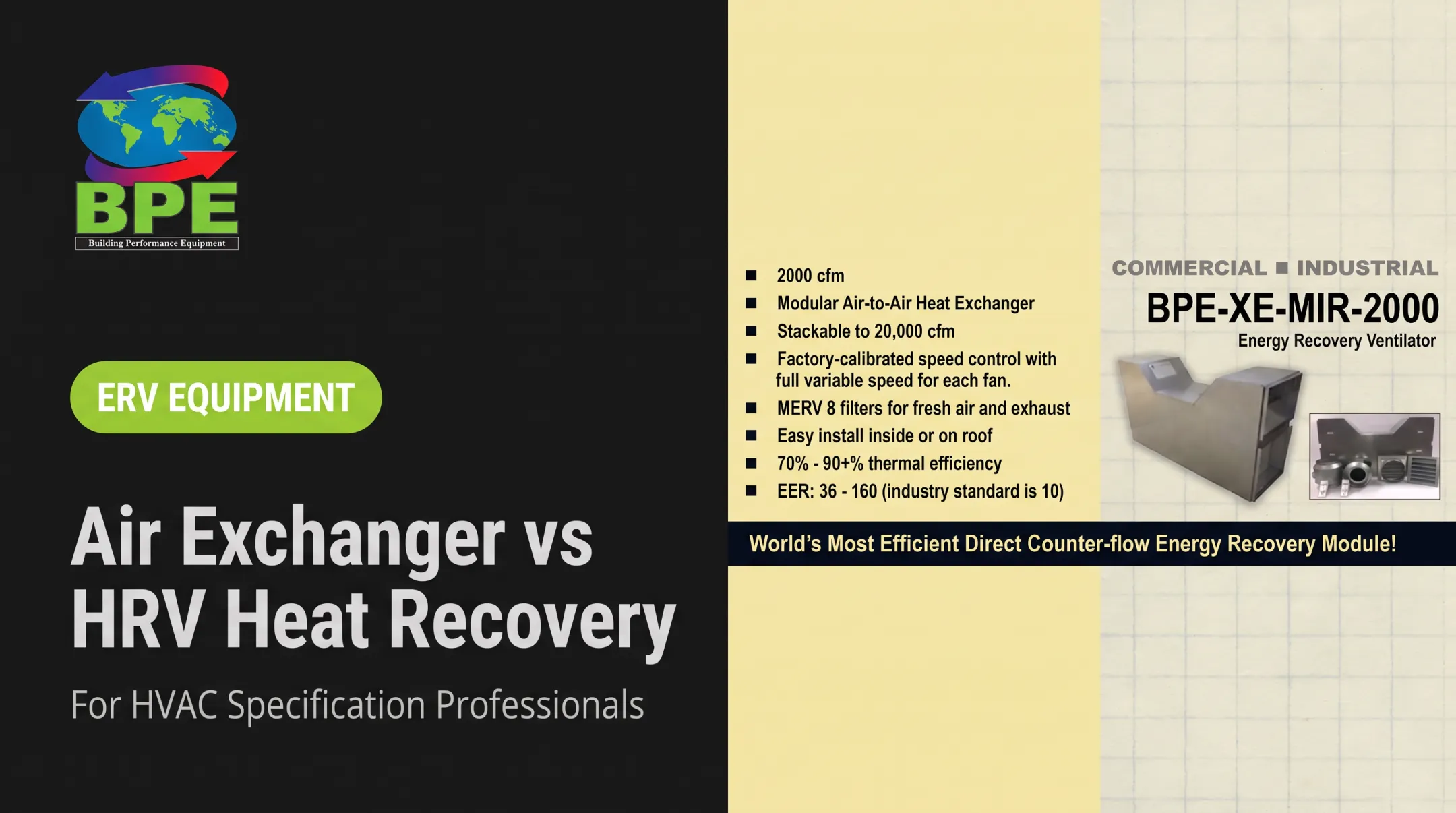
BPE's counter-flow ERV cores are rated for over 90% thermal efficiency. The company's Regenerative Condensate Return Technology is documented at 34% latent efficiency in hot, humid conditions. It moves excess condensation into the exhaust stream instead of draining it into the building.

Trade-offs: An ERV is not a full substitute for a dedicated dehumidifier or humidifier in every home. Moisture-transfer performance changes with climate, indoor conditions, and core design. Choose the system that matches the home's ventilation, humidity, and filtration needs—not the label alone.
How to Choose Between an HRV and ERV
The right system depends on your home's actual moisture and ventilation profile, not just your zip code or a headline efficiency number.
Climate and Seasonal Humidity
Cold-and-dry winters often favor an HRV, since there's little excess moisture worth retaining. Humid summers paired with dry winters (common across much of the mixed-humid U.S.) often favor an ERV. DOE notes that ERVs can shift moisture both ways: pulling humidity out of incoming summer air and returning some exhaust moisture to dry winter air. That helps many homes, but it is not a universal fix—your indoor moisture load still decides the better match.
Indoor Moisture and Occupancy
Tally the moisture you actually generate:
- Showers, cooking, and laundry
- Pets, basements, and houseplants
- Number of people living in the home
A household that stays humid needs a different strategy than one that runs dry most of the year. BPE's sizing guideline of 20 CFM of fresh air per occupant is a useful starting benchmark before you finalize equipment.
Home Airtightness and Sizing
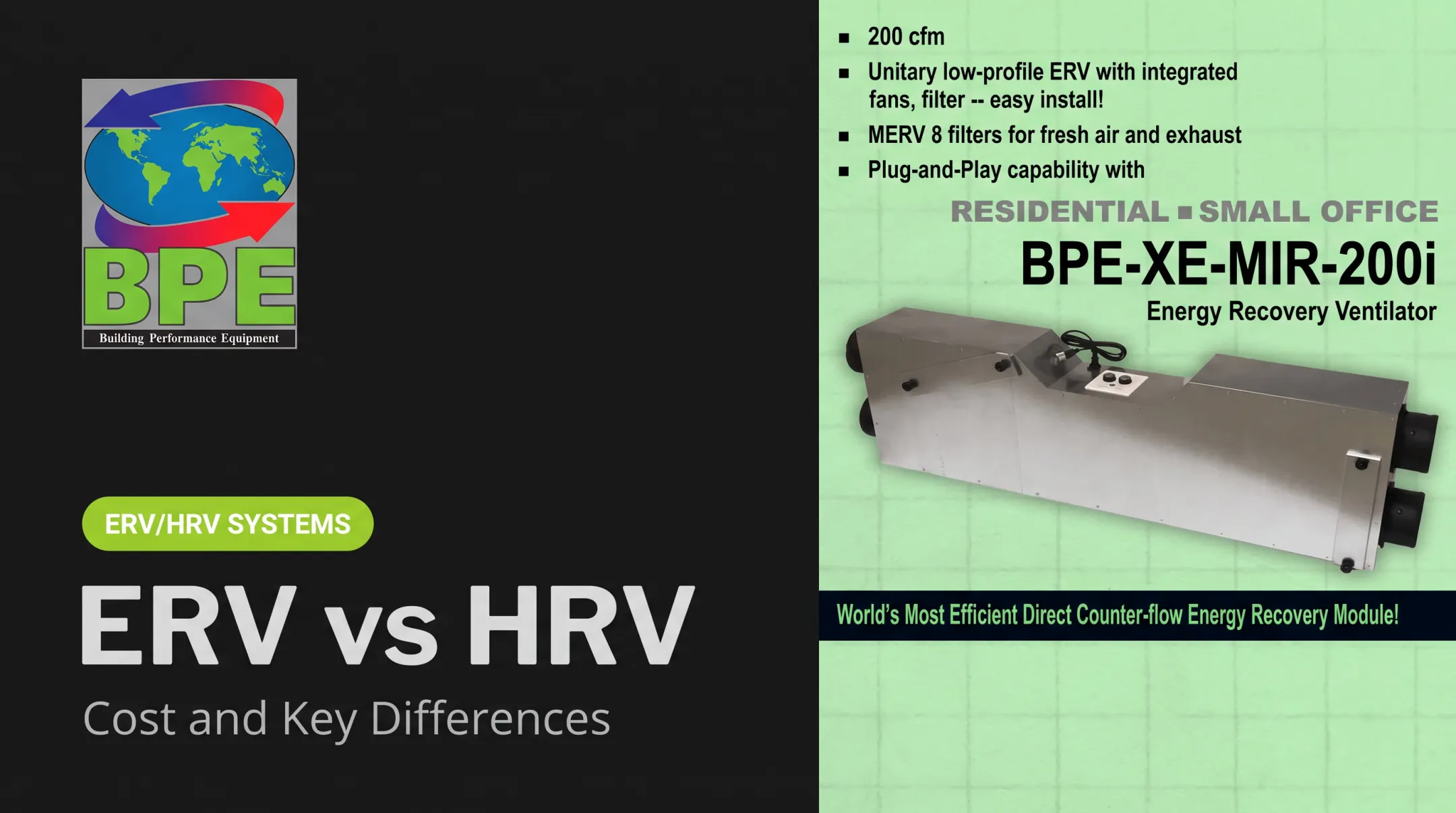
Blower-door results, square footage, bedroom count, and local code all factor into correct airflow sizing. Don't size by floor area alone — get a professional ventilation calculation. BPE's residential lineup illustrates the range: the BPE-XE-MIR-200i covers 60–200 CFM for a household of up to six, while larger 300-i and 400-i models scale up for bigger homes.
Filtration and Ductwork
Compare filter type, replacement cost, and pressure drop. Standard MERV 8 filtration handles typical household dust; MERV 13 is worth considering if pollen or outdoor pollution is a concern. On the installation side, review duct routing, intake and exhaust grille placement, and whether outdoor intake and exhaust points are separated enough to avoid short-circuiting.
Controls and Operating Cost
Look for boost settings, humidity or occupancy-based controls, and variable-speed fans. Commissioning documentation matters too: a system that is never balanced after install rarely performs to spec, and unbalanced airflow shows up as higher fan energy and uneven room comfort.

Quick selection cues:
- Cold, dry climate with low indoor humidity: lean HRV
- Mixed-humid climate or high indoor moisture: lean ERV
- Tight home or code-driven CFM target: size from occupants, bedrooms, and blower-door data—not floor area alone
- Pollen or outdoor pollution: prioritize higher-MERV filtration and clean duct routing
Before you buy, confirm current CFM ratings, filter sizes, and efficiency data with the manufacturer. Building Performance Equipment publishes residential ERV/HRV specs and can answer technical questions for homeowners, builders, and HVAC pros comparing options.
What to Check Before Finalizing a System
Don't choose based on climate labels alone. Confirm these details first:
- Indoor conditions — humidity patterns, building airtightness, occupancy, and existing HVAC setup
- Performance data beyond efficiency — certified airflow, fan energy, static-pressure handling, filtration, sound levels, and low-temperature behavior
- Professional commissioning — correct sizing, ductwork, and airflow balancing performed by a qualified installer, in line with applicable mechanical and energy codes
Ownership doesn't stop at installation. Plan ahead for:
- Filter changes and core cleaning on a regular schedule
- Protecting exterior hoods from leaves, snow, or debris blockage
- Monitoring humidity and comfort over the first few seasons
- Scheduling inspection if you notice reduced airflow, frost buildup, unusual noise, or lingering odors
Equipment built for longevity matters here. Building Performance Equipment states its ERV and HRV units can run 20-plus years with reasonable maintenance, a useful benchmark when you compare warranty terms across brands.
Conclusion
HRVs and ERVs both deliver controlled fresh air while recovering energy that would otherwise be lost through a simple exhaust fan. The real difference is moisture: HRVs move heat only, ERVs move heat and moisture together.
Match the unit to your conditions:
- HRV — excess indoor humidity paired with cold winters
- ERV — seasonal humidity swings or tight, high-performance construction
Choose based on climate, indoor conditions, home design, and verified product performance, not a single spec-sheet number.
Before you buy, get a proper ventilation assessment and compare correctly sized, balanced systems. Price and a single efficiency rating will not confirm real-world airflow or moisture control.
Frequently Asked Questions
How much does it cost to install a home air exchanger?
Cost varies widely based on equipment type, airflow capacity, ductwork, electrical work, controls, access, and whether it's new construction or a retrofit. Get quotes from local installers, since regional labor rates can shift the total by a wide margin.
What does a home air exchanger do?
It exhausts stale indoor air, supplies filtered outdoor air, and transfers heat (plus some moisture, in an ERV) between the two streams without mixing them directly. The result: fresher indoor air without losing the energy you've already paid for.
Do houses need an air exchanger?
It depends on airtightness, required ventilation rates, indoor air quality, climate, occupancy, and local code. Many modern, tightly sealed homes benefit from balanced mechanical ventilation that older, leakier homes got for free through natural air leakage.
What is the best air ventilation system for a home?
There's no single best system — it comes down to comparing HRVs and ERVs against your climate, humidity patterns, home construction, required airflow, filtration needs, and ductwork layout. A professional sizing assessment is the only reliable way to decide.