
Introduction
The cost to install an air exchanger in the United States depends on far more than the equipment price tag. Ventilation system type, building size, existing ductwork, labor rates, controls, and site conditions all factor into the final number.
According to a January 2025 Georgia state cost study, a full HRV/ERV installation in a 2,400-square-foot, four-bedroom home was modeled at $2,193. That total includes the unit, controls, labor, ductwork, and electrical connections. The figure applies to one specific house and code scenario, not every home in the country.
"Air exchanger" also means different things to different people. It can refer to a heat recovery ventilator, an energy recovery ventilator, a ductless plug-and-play unit, or a large commercial energy-recovery system. Quoted prices for these systems are rarely comparable.
This guide breaks down realistic installed-cost categories, the variables that drive final pricing, what a professional quote should include, and how to budget for both upfront and lifecycle costs.
Key Takeaways
- Residential installed costs typically run $2,000–$8,000+, depending on unit size, ductwork, and controls.
- System capacity, HRV vs. ERV selection, existing ductwork, and site access drive the biggest price swings.
- A simple replacement costs far less than a retrofit with no usable ducts or a custom commercial system.
- Lowest upfront price rarely equals lowest total cost once efficiency, static pressure, and maintenance are included.
How Much Does It Cost to Install an Air Exchanger?
There's no single national price for an air exchanger. Pricing varies by project type, and the gap between a small residential unit and a commercial system can be enormous.
For commercial equipment, RenewAire's January 2024 price list shows the spread clearly. A small indoor ERV unit (HE07IN) lists at $5,195, while a larger rooftop unit (HE6XRT) lists at $67,825. Those figures are equipment only; ductwork is specifically excluded.
Internal project data shows how costs compound once labor and oversight are added. One modeled commercial ERV project broke down as:
- Equipment and installation: $232,846.93
- Soft costs: $23,284.69
- Management and commissioning: $23,284.69
- Combined total: $279,416.31
That scope is large commercial, not a typical residential job. Soft costs and commissioning alone can add roughly 20% on top of the base installation price.

What commonly goes wrong:
- Underbudgeting ductwork and electrical scope
- Selecting a unit that can't actually meet required airflow (CFM)
- Overlooking commissioning, balancing, and future filter or service costs
Those same gaps show up at every budget tier.
Typical Cost Categories
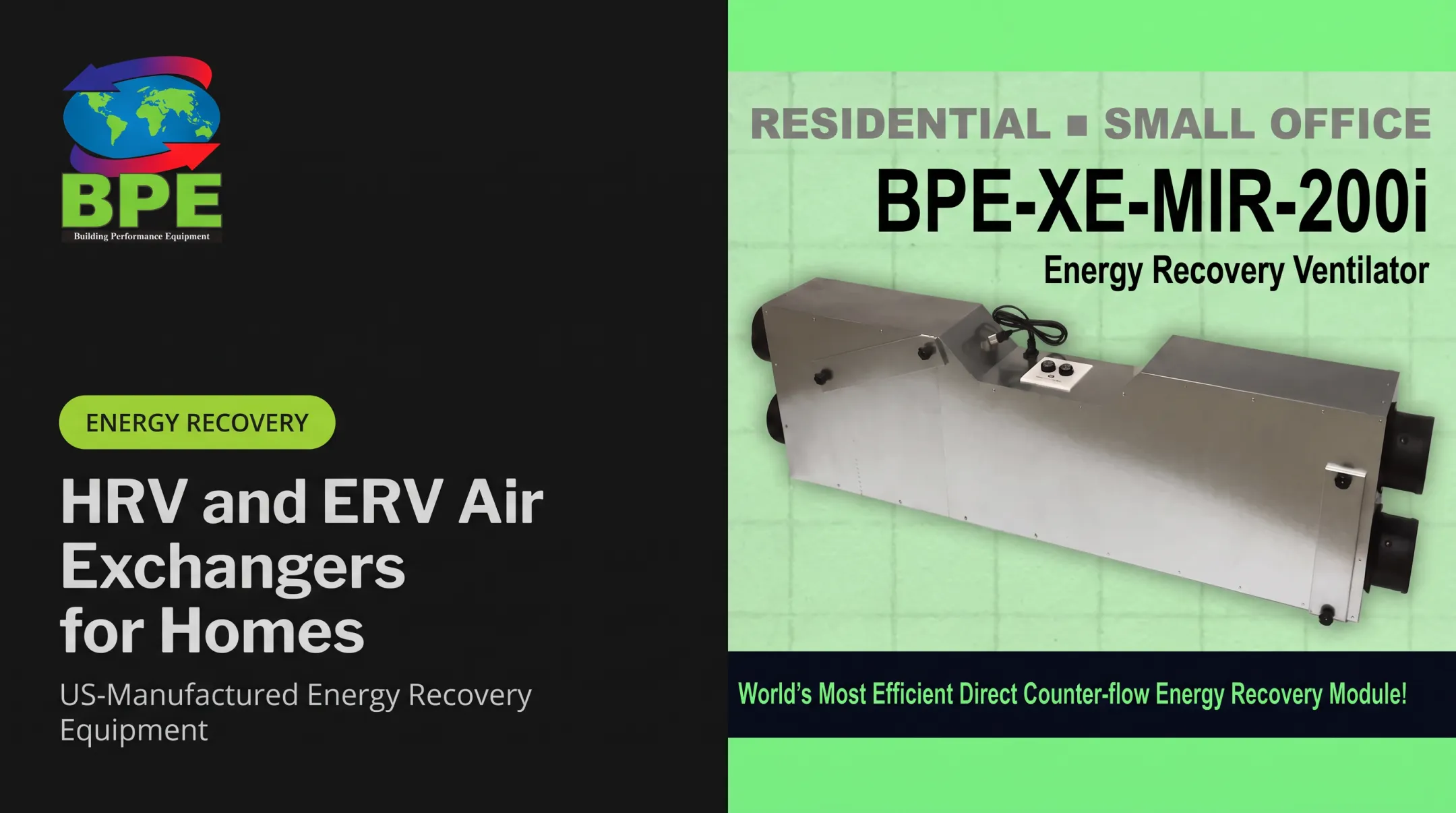
Entry-level or straightforward setup: A smaller plug-and-play unit, such as the BPE-XE-MIR-200i (60–200 CFM), can be installed where suitable infrastructure already exists. These units run on a standard 120V plug and connect to ductwork directly, with no dedicated electrical circuit required in many cases.
Mid-range or standard setup: A properly sized residential HRV or ERV with professional installation, standard controls, duct connections, and commissioning fits the Georgia Department of Community Affairs (DCA) cost model at roughly $2,000 to $2,500 for the unit and labor alone.
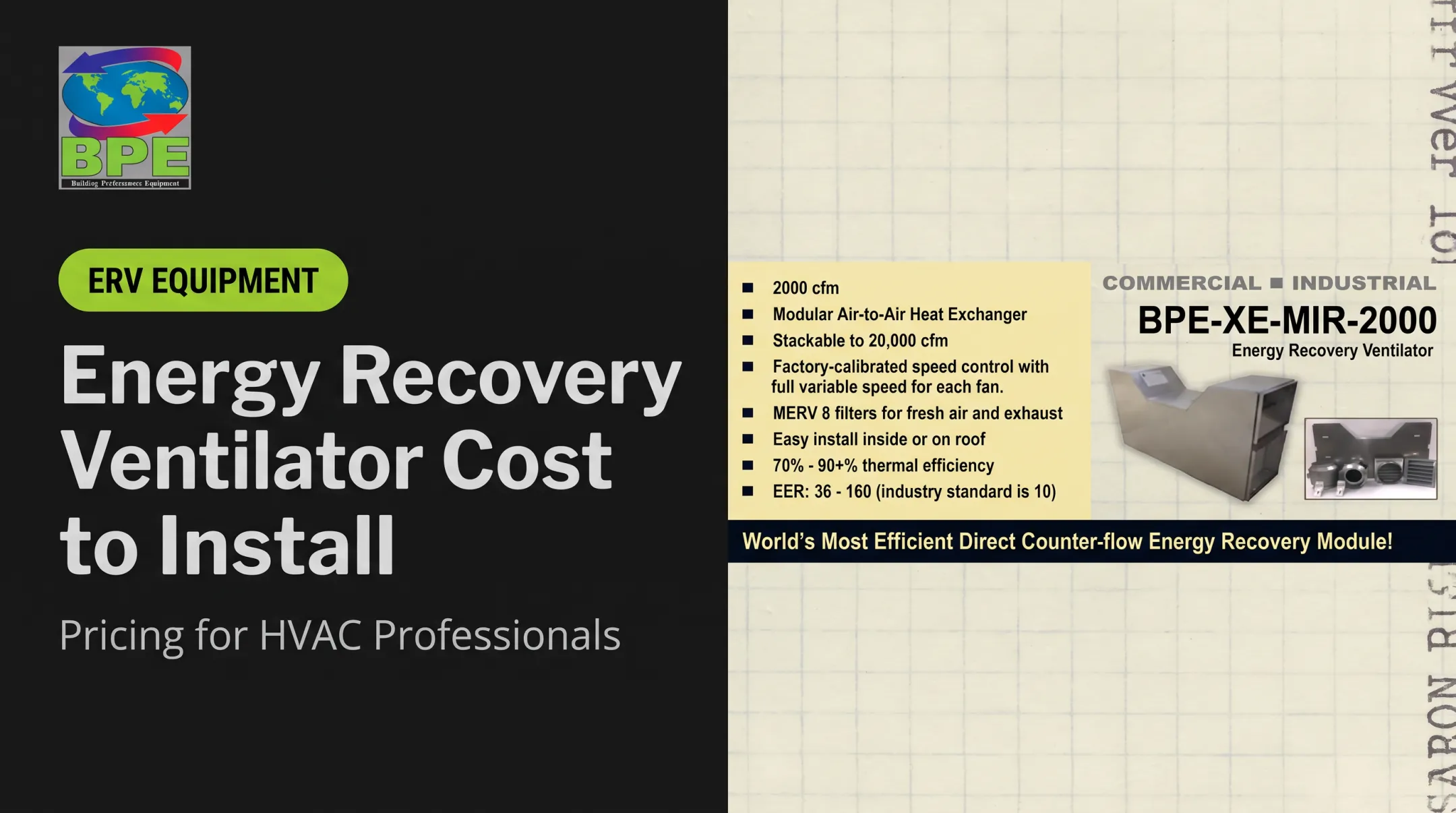
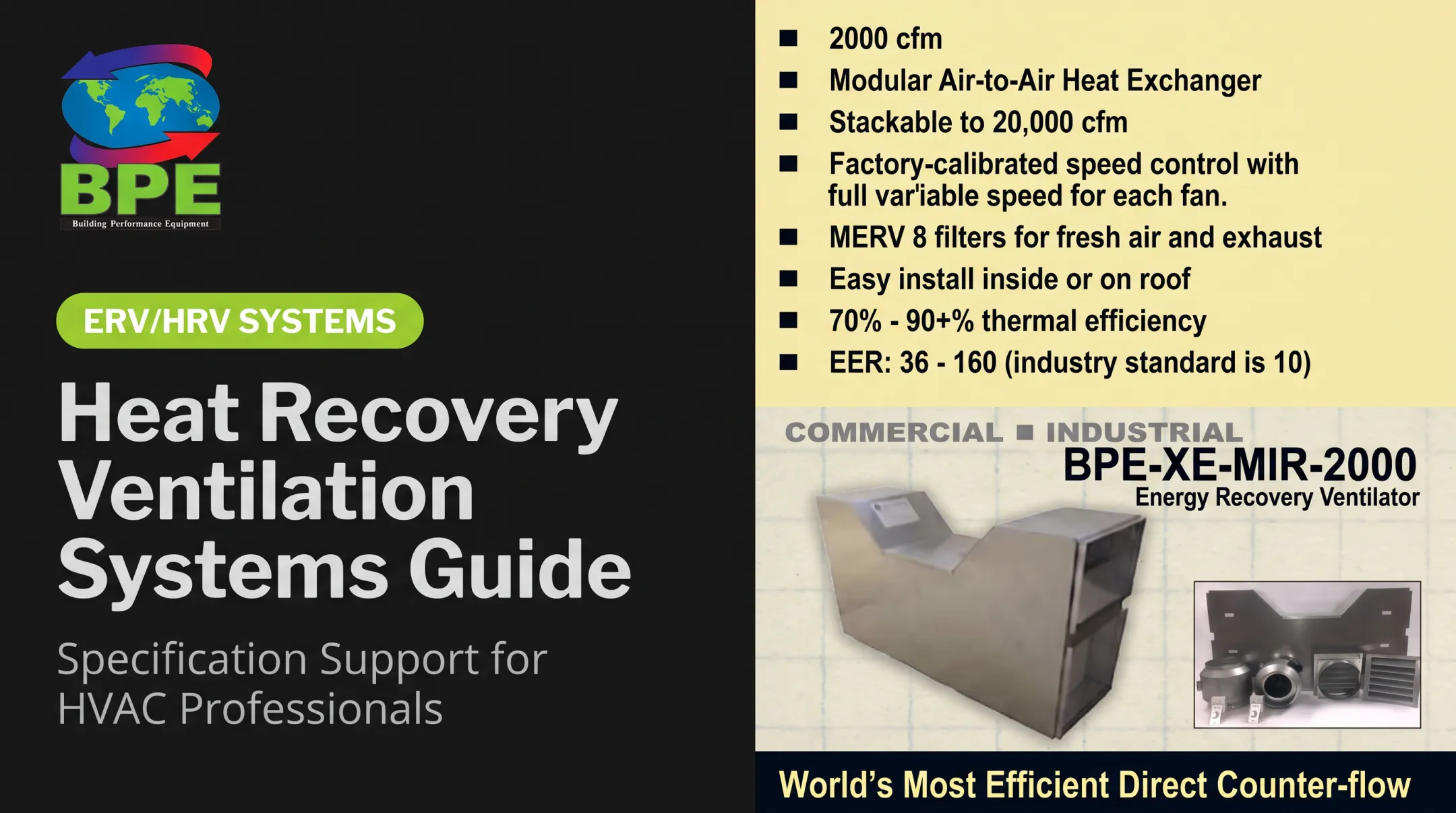
High-end or complex setup: Retrofits requiring dedicated ductwork, difficult access, advanced BACnet controls, multiple zones, or commercial-scale capacity (2,000–20,000 CFM) push costs well beyond residential ranges.
Typically excluded from any range: permits, electrical panel upgrades, extensive drywall repair, asbestos remediation, structural work, crane access for rooftop units, long duct runs, and tax or utility incentives.
Commercial, institutional, industrial, and multifamily projects should always be estimated from a design and equipment schedule, not a residential average.
Key Factors That Affect Air Exchanger Installation Cost
Cost is determined by technical design, building conditions, labor scope, and operating requirements. Two similar-looking properties can require very different installations.
System Type and Configuration
HRVs, ERVs, ducted units, and ductless units each carry different equipment and installation costs:
- HRVs transfer heat only, with no moisture recovery
- ERVs transfer heat and some moisture, which matters in humid or dry climates
- Ducted units integrate with existing forced-air systems
- Ductless units (like BPE's plug-and-play models) skip extensive ductwork
The right choice depends on climate, indoor humidity goals, occupancy, and applicable code requirements, not the lowest equipment price. BPE's residential ERVs, for instance, can be configured as HRVs by sealing the moisture-transfer path when heat-only recovery is needed.
Capacity, Airflow, and Building Scale
Required airflow (measured in CFM), occupant count, floor area, and ventilation zones all influence unit size, fan energy, and duct dimensions. ASHRAE 62.2 governs residential ventilation rates, while ASHRAE 62.1 sets commercial outdoor-air requirements by occupancy and floor area.
BPE's product line illustrates how capacity scales with building size:
| Model | CFM Range | Typical Application |
|---|---|---|
| BPE-XE-MIR-200i | 60–200 | Single rooms, apartments |
| BPE-XE-MIR-500 | 400–500 | Homes, small offices |
| BPE-XE-MIR-1000 | 400–1,100 | Larger homes, light commercial |
| BPE-XE-MIR-2000 | 500–2,250 | Commercial, stackable to 20,000 CFM |

Existing Ductwork and Site Accessibility
A usable forced-air duct system simplifies integration. Homes with boilers, baseboard heat, slab construction, or no suitable ducts require dedicated supply and exhaust runs instead.
Retrofit complications that raise cost include:
- Multiple floors with long duct paths
- Roof or wall penetrations (coordinate with roofers to preserve warranties)
- Electrical access limitations
- Structural obstacles requiring finished-wall repairs
- Equipment-room space constraints
Efficiency, Controls, and Customization
Higher recovery performance, low-static-pressure design, humidity sensors, and demand-controlled ventilation (using CO2 sensors) raise initial cost but can improve comfort and lower operating energy.
Direct-counterflow energy-recovery technology can exceed 90% efficiency. Internal engineering data shows static pressure as low as 0.25 in. wg and power use at roughly one-fifth that of less efficient designs.
BACnet-compatible controls with touchscreen interfaces add cost but simplify commissioning and remote monitoring for facilities teams managing multiple units.
Labor, Compliance, and Commissioning Requirements
Installation labor covers mounting, duct connections, insulation, electrical work, controls wiring, sealing, testing, and cleanup.
Regional labor rates vary. The Bureau of Labor Statistics reports HVAC mechanic wages averaging $28.66/hour nationally, ranging from $26.27 in Texas to $33.68 in California (May 2023 data).
Permits, code compliance, airflow testing, and balancing are frequently treated as separate line items, not automatic inclusions. Confirm these before approving any quote.
Air Exchanger Cost Breakdown and Low-Cost vs. High-Cost Options
The purchase price is only one part of the investment. A proper quote separates one-time installation expenses from recurring ownership costs.
Initial Equipment Purchase
One-time. Unit price depends on capacity, HRV or ERV design, recovery performance, filtration grade, and whether the system is residential, multifamily, or commercial. In the Georgia DCA model, the HRV/ERV unit itself was priced at $946, separate from controls, labor, and ductwork.
Installation, Ductwork, and Electrical
One-time. Installation covers more than mounting the unit:
- Labor, wiring, controls, permits, and finish repairs
- Supply and exhaust ductwork, grilles, dampers, and insulation
- Exterior hoods and wall penetrations
The same cost model itemized 50 feet of insulated flexible duct at $467 and two exterior wall caps at $251. Ductwork and terminations can rival the unit's own price.
Commissioning and Balancing
Usually one-time, with follow-up testing after major service or modifications. Airflow measurement, balancing, control setup, and leak checks verify the system performs against its design specs. BPE's SC-UNI controls include a built-in system-test screen specifically to speed this process.

Operating and Maintenance Costs
Recurring. This covers fan electricity, replacement filters, core and cabinet cleaning, and service visits. Fan power scales with airflow, static pressure, and operating hours. According to the U.S. Department of Energy, in mild climates fan electricity can sometimes exceed the energy an HRV/ERV recovers, so correct sizing matters.
Replacement MERV 6 filters run around $12.50 each plus shipping. Annual inspection is recommended to catch filter-change needs early.
Upgrades, Replacements, and Quote Comparison
Periodic. Budget and premium systems usually diverge on a few cost drivers:
- Durability, warranty length, and core replacement intervals
- Noise, controls, and service access
- Recovery efficiency under continuous or extreme-climate loads
A 20-year lifecycle-cost comparison is the industry standard for commercial specs. If a unit has only a 4-year projected life, five additional core replacements get added to the base price for a fair comparison.
Premium features make sense for high-occupancy buildings, cold or humid climates, and continuous ventilation loads. A simpler system may be enough for a single-family home with modest airflow needs.
Manufacturers such as Building Performance Equipment can help MEP engineers, contractors, and building owners evaluate energy-recovery equipment, airflow requirements, and controls before final selection. That specification support is not a substitute for a local installation quote.
How to Estimate the Right Budget and Avoid Missed Costs
A practical workflow keeps surprises off your final invoice:
- Define the building type and ventilation goal: residential comfort, code compliance, or industrial process exhaust
- Determine required airflow using ASHRAE 62.1 or 62.2 as applicable
- Inspect existing ducts and access points before assuming reuse is possible
- Choose HRV or ERV based on climate and indoor moisture goals
- Request itemized proposals from qualified professionals, not single-line estimates
Quote-comparison checklist:
- Unit model and rated capacity
- Recovery performance and static pressure
- Duct length, material, and routing
- Controls (BACnet, CO2 sensors, touchscreen)
- Electrical scope and permits
- Balancing, warranty terms, and startup documentation
- Maintenance access and stated exclusions
Commonly missed costs:
- Design or engineering fees
- Demolition, patching, and difficult penetrations
- Electrical panel upgrades
- Insulation and crane access for rooftop units
- Replacement filters
- Future controls or software licensing
Higher spend usually pays off for:
- High-occupancy buildings, schools, and multifamily properties
- Cold or humid climates
- Net-zero or high-performance projects with continuous ventilation loads
Caution: An air exchanger does not replace source control. Kitchen and bathroom exhaust, combustion safety measures, and specialized contaminant filtration still need dedicated systems where required.
Conclusion
Air exchanger installation cost varies by several project factors:
- Equipment type and airflow capacity
- Building layout and ductwork
- Labor, controls, and compliance requirements
A smart budget balances upfront price against efficiency, static pressure, service access, and expected service life. The lowest quote is rarely the full cost picture.
Frequently Asked Questions
How much does it cost to install an air exchanger?
A documented residential HRV/ERV install totaled $2,193 for unit, labor, and ductwork. Commercial equipment alone often runs $5,000–$68,000 before labor, with final price set by capacity, ductwork, controls, and site conditions.
Is an air exchange system worth it?
For most homes and buildings, yes. Improved ventilation, indoor air quality, and moisture control are measurable benefits, and energy recovery can offset some conditioning costs when the unit is sized for the climate and building.
Does an air exchanger use a lot of electricity?
Fan electricity depends on airflow, fan efficiency, static pressure, and run time. The Department of Energy notes that in mild climates, fan energy can sometimes exceed the energy recovered if the unit is a poor fit for the job.
What is the average lifespan of an air exchanger?
Well-maintained HRV/ERV systems often exceed 20 years of service life. Filter care, operating conditions, and installation quality have the biggest effect on how long a unit lasts.
What is the difference between an HRV and an ERV?
An HRV recovers sensible heat only; an ERV also transfers some moisture between incoming and outgoing airstreams. Climate, humidity goals, and building use decide the right choice, and some ERVs can run in an HRV-like mode.
What is included in an air exchanger installation quote?
A complete quote should list the unit, mounting, ductwork, grilles or hoods, controls, electrical work, labor, permits, testing, balancing, startup documentation, warranty terms, and any stated exclusions. Confirm each line item before approving the proposal.