
Basement air exchangers and ventilation systems solve one specific problem: replacing stale indoor air with fresh outdoor air, sometimes recovering heat or moisture in the process. They don't fix leaks. They don't lower radon. They don't dry out a damp slab.
This guide covers how to diagnose what's actually wrong, which system types apply to basements, how to choose between an HRV and an ERV, sizing basics, safety considerations around combustion appliances, and when the job calls for a professional.
Key Takeaways
- Ventilation swaps indoor air for outdoor air — it doesn't cure water intrusion, humidity, mold, or radon on its own
- Exhaust-only fans cost less upfront; balanced HRV/ERV systems give you controlled airflow plus energy recovery
- System choice hinges on basement use, moisture levels, combustion appliances, radon results, and duct access
- Combustion appliances, elevated radon, or complex ductwork mean it's time to call a professional
Why Basement Ventilation Matters — and What Problem Are You Solving?
Below-grade spaces fight physics every day. Cold foundation walls meet warm indoor air, and moisture migrates through concrete. Odors have nowhere to escape, and soil gases can enter through cracks and gaps.
Add limited natural airflow, and the space traps whatever is floating around in it: VOCs, CO2, humidity, and more.
Four Problems, Four Solutions
One device rarely solves every basement air issue. The jobs break down like this:
- Ventilation: exchanges indoor air with outdoor air
- Dehumidification: removes moisture from air that's already inside
- Filtration: cleans particulates from circulating air
- Waterproofing/radon mitigation: addresses the source of water or soil-gas entry
Mixing these up leads to buying the wrong equipment and still having a damp or stuffy basement.
A Quick Diagnostic
Use symptoms to point you in the right direction:
- Stale, stuffy, or odor-heavy air → you likely need air exchange
- Clammy air, visible condensation, or persistently high humidity → focus on moisture control
- Visible water or mold growth → correct the source first, with remediation if needed
Opening a basement window helps on a dry spring day. In summer, it can backfire: warm, humid outdoor air meets a cold basement surface and condenses, making things worse, not better.
The EPA recommends keeping indoor relative humidity below 60%, ideally between 30% and 50%, to limit mold growth. That's a moisture target, not a ventilation rate, but it's a useful number to measure against before buying anything.
The EPA advises testing the lowest level of the home that people regularly use, which often means the basement. Follow-up testing and action are recommended when results hit 4 pCi/L or higher. No air exchanger changes that number. Test first.
Types of Basement Air Exchangers and Ventilation Systems
Not all ventilation is created equal. The table below breaks down the main categories.
| System Type | How It Works | Basement Consideration |
|---|---|---|
| Exhaust-only fan | Mechanically expels air; replacement air enters through leaks or openings | Can depressurize the space and pull soil gas or backdraft combustion fumes |
| Supply-only | Mechanically pushes outdoor air in; stale air leaves through openings | Tends to pressurize the house; cold-climate moisture needs assessment |
| Balanced ventilation | Matched supply and exhaust airflows | Predictable, but only if actually balanced and verified |
| Balanced HRV/ERV | Balanced ventilation plus heat (and sometimes moisture) recovery | Reduces load on heating/cooling equipment |
| Decentralized unit | Small, single-room energy-recovery models | Covers one room, not a whole basement, unless designed for it |
Why Exhaust-Only Has a Catch
Exhaust-only fans are the cheapest and easiest to install. They pull stale air out, period. Replacement air has to come from somewhere, and in a basement, "somewhere" often means cracks in the foundation, gaps around sill plates, or soil beneath the slab.
That matters for two reasons:
- Negative pressure: Can pull soil gas (including radon) through foundation openings
- Backdrafting: Nearby furnaces, boilers, or water heaters can pull combustion exhaust back into the living space
That's not a reason to avoid exhaust fans entirely. It's a reason to check what else is sharing air with that basement before installing one.
Balanced Systems Close the Gap
Balanced ventilation, the category that includes HRVs and ERVs, supplies and exhausts roughly equal airflow. No net pressure swing, no guessing where makeup air comes from.
An energy-recovery core between the two airstreams is what separates a basic balanced system from an HRV or ERV. As stale air leaves, it transfers heat (and in an ERV, some moisture) to the incoming outdoor air.
The U.S. Department of Energy notes that most energy-recovery ventilation systems recover roughly 70% to 80% of the energy in exhaust air. That is a general figure, not a guarantee for any specific unit.

Ducted vs. Decentralized
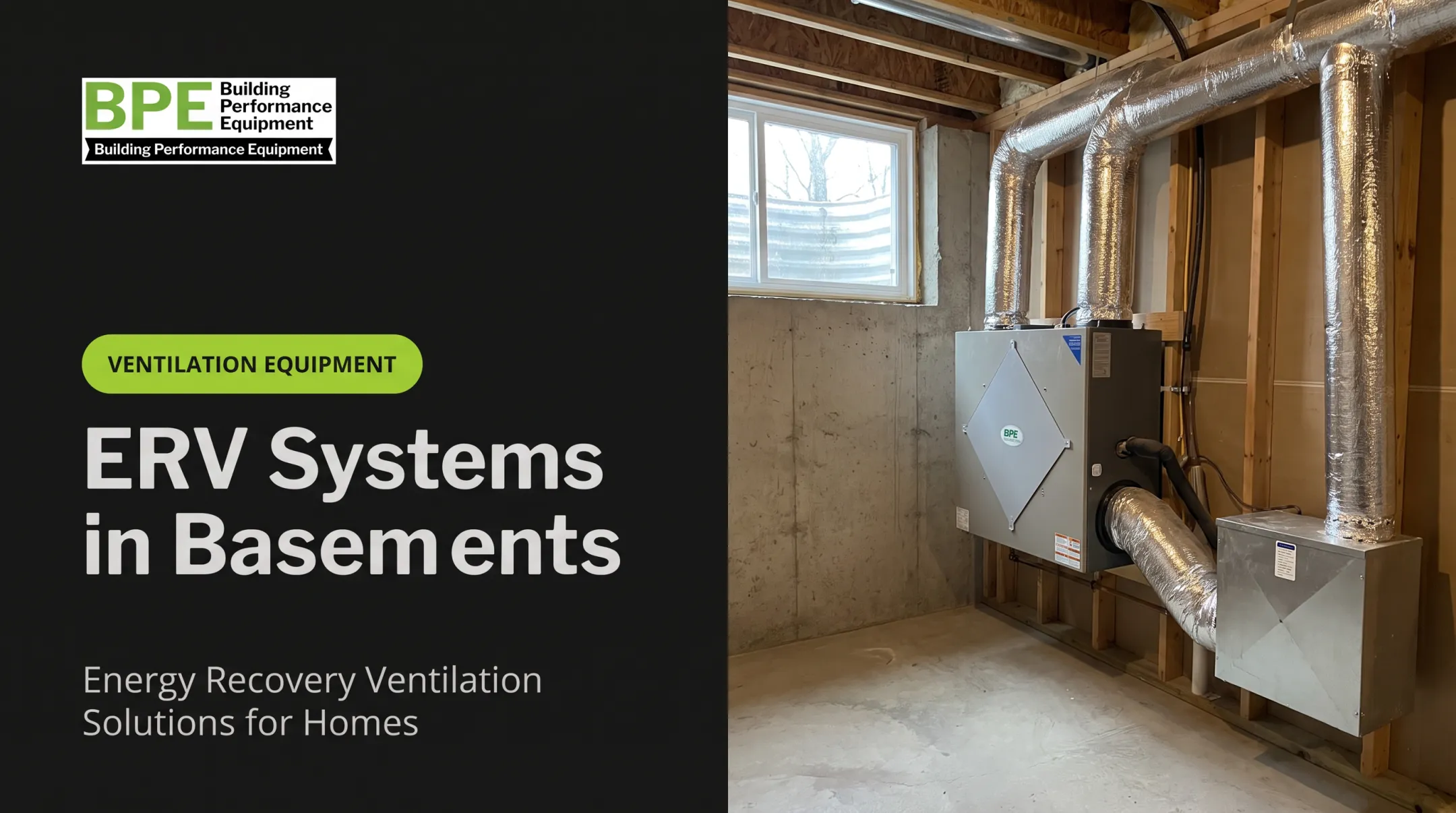
A ducted system distributes air to multiple rooms through ductwork. More installation work, but better coverage for a finished basement with several rooms.
A decentralized, wall-mounted unit handles one room through an exterior wall penetration. It is simpler to retrofit where running ducts is not practical, but it will not ventilate rooms it is not installed in.
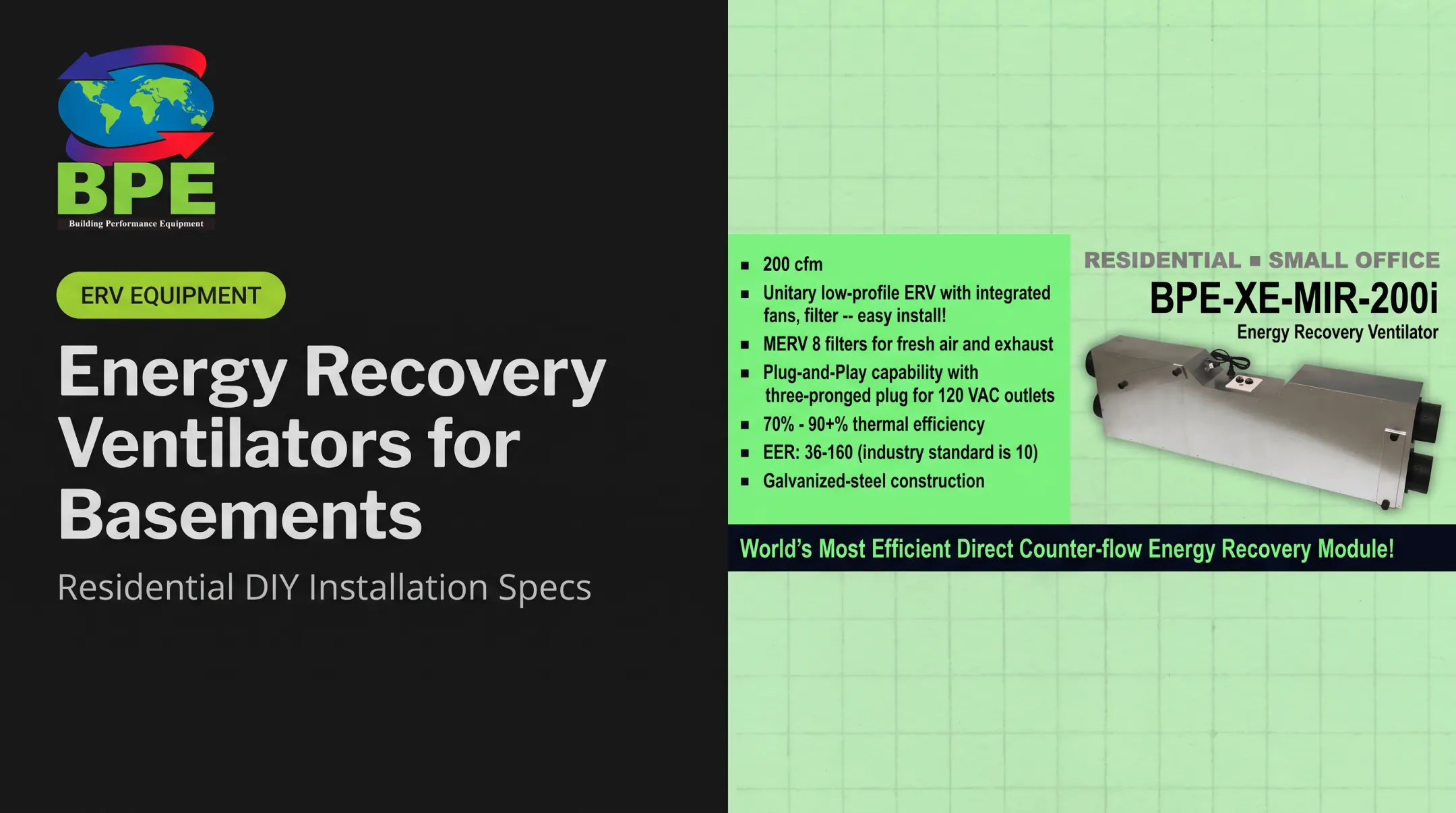
For context, Building Performance Equipment's compact residential units, like the BPE-XE-MIR-650LA, are built just 8 inches tall specifically for low-clearance basement installs where joist bays and ceiling height are tight.
HRV vs. ERV: Which Air Exchanger Fits a Basement?
This is the question most homeowners get stuck on.
An HRV (heat recovery ventilator) transfers sensible heat between outgoing and incoming air. It moves heat, not moisture.
An ERV (energy recovery ventilator) transfers heat and some water vapor. It moves both.
Picking Based on Moisture, Not Just Temperature
The distinction matters most in how it affects basement humidity:
- Cold, dry winters: An ERV can retain some indoor humidity instead of exhausting it all outside, which helps if your basement already runs dry in winter
- Humid summers: An ERV's moisture transfer can cut the humidity load on incoming air, though it won't hit a set RH target on its own
- Already-humid basement in winter: An HRV may be the better call, since you don't want to retain more moisture
Building Performance Equipment's ERVs can be sealed to function as HRVs when a building runs too humid in winter. That flexibility helps if you're unsure which category fits and don't want the choice locked in at purchase.

What Neither One Does
An HRV or ERV will not:
- Dehumidify a wet basement
- Stop a foundation leak
- Lower radon
Both support better indoor air quality, but neither replaces a dehumidifier, waterproofing, or a dedicated radon system. Treat air exchange as one layer of a larger plan.
Evaluating Equipment
Beyond the HRV/ERV decision, look at:
- Recovery efficiency : ask for rated numbers under relevant test conditions, not marketing averages
- Filtration class : BPE's plug-and-play residential units ship with integral MERV 8 filters on both airstreams
- Controls : variable-speed fans and programmable controllers let you match airflow to actual conditions instead of running one speed year-round
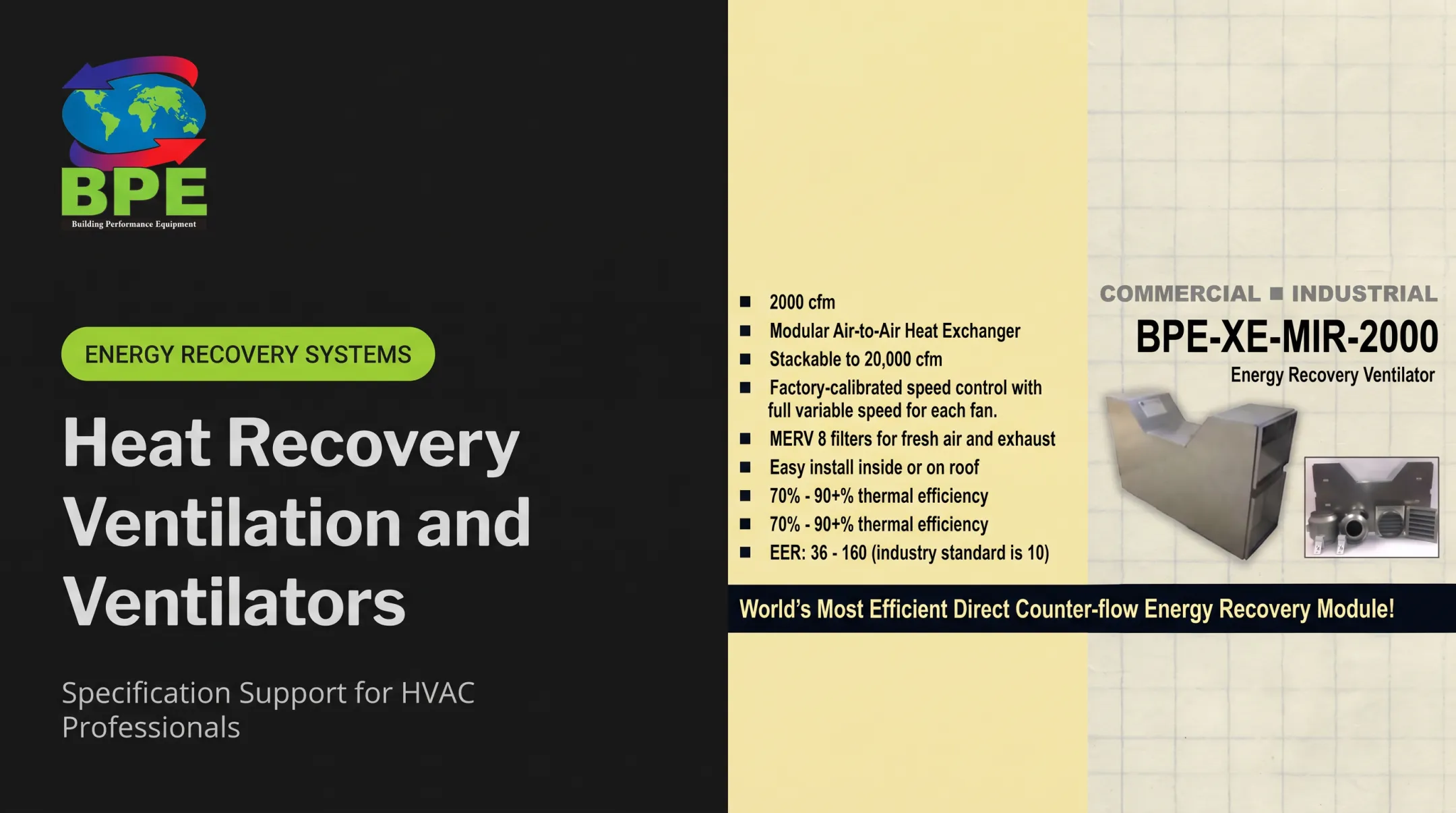
Match the unit to airflow needs, climate, and basement layout. Building Performance Equipment's air-to-air energy recovery line covers residential through light-commercial sizes, so selection stays project-specific rather than one-size-fits-all.
How to Choose and Size a Basement Ventilation System
Sizing a basement ventilator starts with how the space is actually used.
Build Your Decision Path
Walk through these factors before looking at specific units:
- Occupancy and use — storage space, finished rec room, or basement bedroom all have different airflow needs
- Floor area and ceiling height — affects total air volume and duct routing
- Climate — cold, humid, or mixed climate shapes HRV vs. ERV selection
- Envelope tightness — a tighter basement needs more deliberate mechanical ventilation
- Moisture load — existing dampness changes equipment and control choices
- Finished vs. habitable status — a basement bedroom may trigger additional code requirements
Airflow Standards, Not Guesswork
Avoid a generic "one fan size fits every basement" rule. ANSI/ASHRAE 62.2 governs residential ventilation and indoor air quality; verify the current edition's requirements with a professional rather than relying on an outdated formula.
For reference, the 2024 International Residential Code sets whole-dwelling continuous mechanical ventilation rates based on floor area and bedroom count. Selected examples from IRC Table M1505.4.3(1):
| Dwelling Floor Area | 0–1 Bedrooms | 2–3 Bedrooms | 4–5 Bedrooms |
|---|---|---|---|
| Under 1,500 sq ft | 30 CFM | 45 CFM | 60 CFM |
| 1,501–3,000 sq ft | 45 CFM | 60 CFM | 75 CFM |

These are whole-dwelling numbers, not basement-only rates. A basement bathroom's local exhaust requirement (50 CFM intermittent or 20 CFM continuous under the same code) is separate and doesn't substitute for whole-space ventilation.
As a rough starting point, Building Performance Equipment (BPE) uses a preliminary sizing rule of 20 CFM per occupant. Six occupants, for example, point to roughly 120 CFM before you refine that figure against code requirements and space conditions.
Check Sources Before Buying Equipment
Before selecting a unit, rule out or address:
- Plumbing or foundation leaks
- Poor drainage around the foundation
- Combustion appliances sharing the space
- Radon test results
- Stored chemicals or solvents
- Existing HVAC supply/return pathways that might conflict with new ductwork
Controls Worth Specifying
- Timers for scheduled operation
- Humidity sensors — helpful, but relative humidity alone does not capture full air quality
- CO2-based demand control — adjusts airflow to actual occupancy
- Continuous low-speed operation — common for baseline ventilation with boosts during high-demand periods
Specification Checklist
When comparing units, confirm:
- Rated airflow at external static pressure (not just nameplate CFM)
- Recovery efficiency under stated test conditions
- Filter class (MERV rating)
- Condensate/drain pan management for cold or humid operation
- Service access for filters and core cleaning
- Intake/exhaust separation — BPE specifies a minimum of 10 feet between intake and exhaust grilles to prevent cross-contamination
- Local code compliance
For basement-specific installs, Building Performance Equipment's engineering team supports project-specific unit selection rather than a blanket recommendation. Airflow needs, ceiling clearance, and moisture conditions all factor into the right call.
Installation, Operation, Maintenance, and Safety
Getting the equipment right is half the job. Installation quality determines whether it actually performs.
Installation Essentials
- Properly sized, balanced supply and exhaust ductwork, sealed at every joint
- Exterior terminations with corrosion-resistant screens blocking anything larger than a 0.5-inch probe
- Backdraft dampers preventing reverse airflow when the unit isn't running
- Intake and exhaust separated by at least 10 feet
- Condensate drainage where cold or humid conditions apply: BPE specifies ductwork sloped at least 1% toward a drain below -10°F or above 40% relative humidity
- Clear access for filter changes and core cleaning
Never install a stale-air exhaust register in a room containing a combustion device (a gas water heater, furnace, or fireplace). This single rule prevents one of the most dangerous installation mistakes homeowners make.
Combustion Safety Comes First
Any basement with a furnace, boiler, water heater, or fireplace needs a closer look before installing exhaust-based ventilation.
Depressurization from an exhaust fan can cause combustion appliances to backdraft, pulling exhaust gases (including carbon monoxide) back into living space instead of outdoors.
Have a qualified professional test combustion-appliance-zone pressure and spillage after any ventilation change that could alter building pressure.

Commissioning and Ongoing Care
Once combustion safety checks are clear, commission the system and keep a simple maintenance rhythm:
- Verify actual airflow at installation; rated CFM and delivered CFM aren't always the same
- Inspect filters about once a year on both the exhaust-air and outdoor-air sides of the core
- Clean the recovery core per manufacturer instructions, and contain drainage water during the process
- Test sensors and controls to confirm correct response
- Check frost protection in cold climates before winter
With reasonable maintenance, energy-recovery units like BPE's are built for a service life exceeding 20 years.
Know the Limits
Elevated radon, visible mold, active water intrusion, or chemical/industrial exhaust all require specialized assessment, not a ventilation upgrade. Air exchange supports indoor air quality; it doesn't replace source control or code-required hazardous-air treatment.
Frequently Asked Questions
How much does a basement ventilation system cost?
Cost depends on system type, airflow needs, ductwork, electrical work, and exterior penetrations. Get a project-specific quote—basement conditions vary too widely for generic online estimates.
What is the best way to ventilate my basement?
It depends on how you use the space. Natural ventilation suits dry, lightly used basements; exhaust-only fans cover simple needs away from combustion appliances; balanced HRV/ERV systems fit occupied or finished basements that need controlled airflow.
Should you leave your air exchanger on all the time?
Continuous low-speed operation is commonly recommended, with controls boosting airflow when demand rises. Follow your unit’s guidelines—design and indoor conditions vary by installation.
What is the most energy-efficient way to dehumidify a basement?
Dehumidification and ventilation are different jobs. Fix moisture sources first, then pair a properly sized dehumidifier with ventilation. An ERV can transfer moisture in the right climate, but it is not a dehumidifier on its own.
Are air-to-air exchangers worth it?
Yes, when the basement is occupied often, moisture or air quality needs year-round control, and energy recovery can offset heating and cooling load. For rarely used storage space, a simpler system is usually enough.
Which is better for cold climates, HRV or ERV?
HRVs are often favored when heat recovery matters most and you do not want indoor humidity retained. ERVs can help in cold climates when moisture transfer eases dry winter air. Check climate-specific manufacturer guidance for your home.